
On July 6, the group led by Do Minh Ho Hai set off from Hanoi.
“The goal was not to arrive as quickly as possible, but to enjoy the scenery and explore the culture and daily life of the places between the start and the end,” Hai says.
Each vehicle carried one or two members. The group traveled in seven cars and two motorbikes, and passed through 20 countries including China, Turkey, and Germany.
While returning, they chose to fly.
|
Do Minh Ho Hai (3rd, L) poses in Paris, France, beside the car he drove from Vietnam. Photo courtesy of Do Minh Ho Hai |
This was not a typical road trip. Hai calls it a rally-style journey. The vehicles shared the same route and destination, but each traveled at its own speed and chose rest stops, and did not travel in a convoy.
After every two to three days of driving, the group took a day off to explore the city they had just reached.
The members spent a year preparing. They trained physically, secured all travel documents, and mapped out their route. They also came up with plans in case a vehicle or a member ran into trouble.
“For us, the year of preparation was just as important as the 68 days on the road,” Hai says.
All the vehicles were SUVs or pickup trucks fitted with all-terrain tires, and could handle highways, rocky roads, and areas far from cities.
China was where the group stayed the longest, 17 days. But for Hai, the longest day of the trip came when they left China to enter Kyrgyzstan.
The group spent 13 hours at the border, checking documents and processing paperwork for 16 people and their vehicles. It was 2 a.m. before everyone reached the hotel, exhausted.
Hai says the main worry was not the wait but that a problem with the papers of just one member or one vehicle could have meant the whole group would have to change plans.
Fortunately, everyone crossed over safely.
But Kyrgyzstan was also the country that overwhelmed him most with its scenery.
In 2025, after watching the Netflix film “Off Road”, he was captivated by the Altyn-Arashan Valley. Situated at a height of over 2,300 meters, the valley has meadows, pine forests, glaciers, and hot springs. He had told himself that one day he would drive a Vietnamese-plated car there.
On July 27, that wish came true.
The 14-kilometer Altyn-Arashan road took two hours to navigate due to its steep slopes and cliffside bends. A single mistake could send the car over the edge.
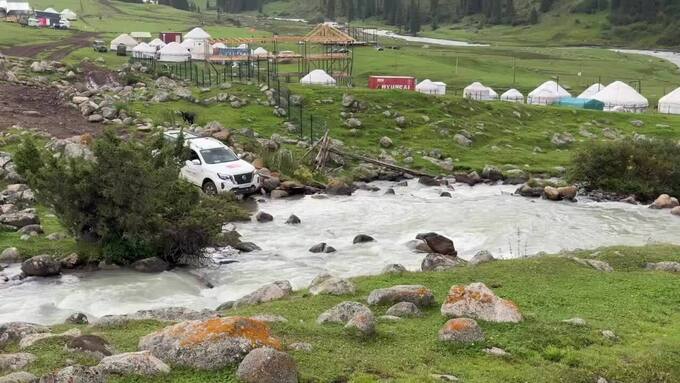
Do Minh Ho Hai’s journey through the Altyn-Arashan Valley on July 27, 2026. Video courtesy of Do Minh Ho Hai
Over 68 days, chance encounters with locals became the memories Hai kept longest.
In Chechnya, they met a melon farmer. Learning that the group had driven all the way from Vietnam, he sliced melons for everyone, refused payment and asked only for a photo.
“Some encounters lasted only a few minutes, but I remember them long after the journey,” Hai says.
Another memorable moment came when Russian police fined some of the vehicles $150. Window tint is illegal in Russia and many Central Asian countries, risking fines and removal if pulled over.
The trip cost about VND600 million (US$23,080) per person, including VND300 million for food, hotels and tours. Each car cost up to VND400 million for fuel, tolls and maintenance, plus up to VND200 million for return shipping to Vietnam. Several companies sponsored the tires.
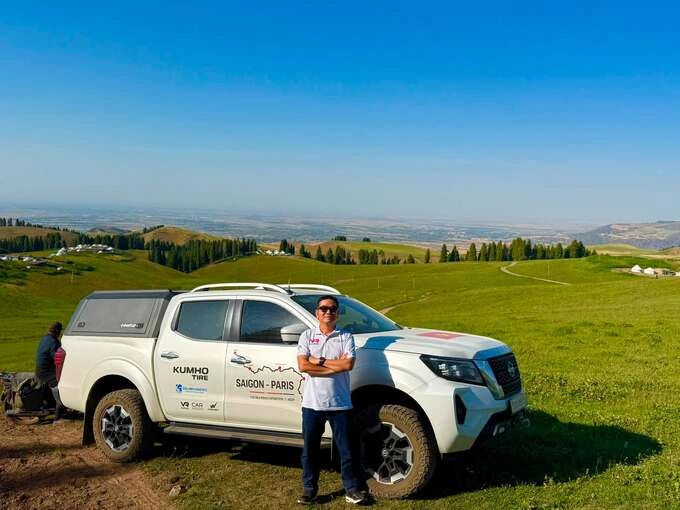 |
|
Do Minh Ho Hai poses beside the car he drove from Vietnam to Europe at a spot in Xinjiang, China. Photo courtesy of Do Minh Ho Hai |
In Europe, roads were easier to travel but prices were higher. Parking could cost up to 50 euros ($57) a day, and fuel about VND75,000 ($2.90) per liter.
“Every trip to a gas station was like getting pickpocketed,” Hai jokes.
In the Czech Republic, travel enthusiasts came to the hotel to film Hai’s group. He also had a chance to try what he called Europe’s best soupor raw blood pudding, at a Vietnamese restaurant.
After 65 days on the road, five of the nine cars reached Paris on Sept. 8, bringing Hai a sense of relief. The group spent another three days exploring the city before flying home. The other cars took different routes through Europe before joining them in Paris.
Over dinner that evening, the discussion shifted from planning the next day’s route to sharing memories of the journey.
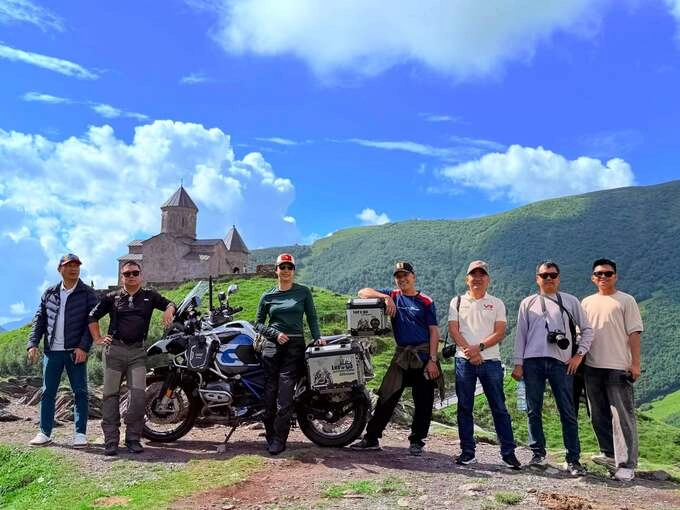 |
|
Do Minh Ho Hai (5th, L poses with the group in Georgia. Photo courtesy of Do Minh Ho Hai |
Nguyen Phuong Nga, one of two women in the group, was shocked at the thought of a 68-day trip. She still decided to join her husband. Besides gifts for her family, her luggage on the way home included about 2 kilograms of fridge magnets.
On Sept. 13, Hai landed in Ho Chi Minh City, ending a journey of 22,000 kilometers.
After each trip, he finds that he sees things more simply, and that the world holds many places worth visiting at least once in a lifetime.
In 2027, Hai plans to drive from Hanoi to Moscow. But for now, one “procedure” he considers the most important has yet to be completed: “Waiting for my wife’s approval!”