
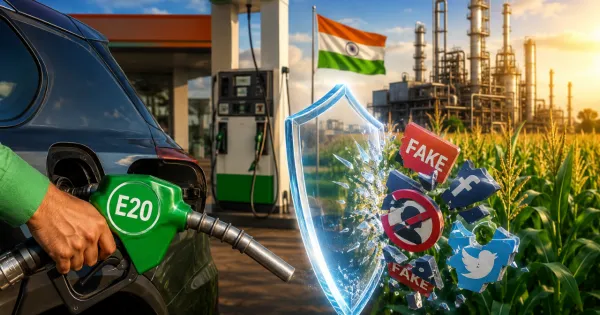
E20 Petrol Fact Check: Social media lies exposed on ethanol petrol, government exposes 10 big claims

Lucknow/New Delhi: Amidst the rapid spread of misleading information on social media regarding E20 ethanol mixed petrol in the country, the Central Government issued a detailed clarification on Friday. The Ministry of Petroleum and Natural Gas clearly said that many false and misleading claims are being made regarding the E20 program, whereas this entire scheme is based on scientific research, global experience and regulatory safety standards.
The ministry responded to the viral claims related to E20 petrol through 10 key points and said that the process of mixing up to 20 percent ethanol in petrol is being followed strictly as per the prescribed standards.
The claim that 10,000 liters of water is used to produce 1 liter of ethanol is false.
The government completely rejected the viral claim that 10,000 liters of water is used to produce 1 liter of ethanol.
According to the ministry, ethanol production uses only about 3 to 5 liters of processed water per liter. ‘Zero Liquid Discharge’ technology is being adopted in modern distilleries, through which water is recycled.
The government also clarified that only that surplus rice which is left after meeting the food security requirements of the country is used for ethanol production. Also, now the use of maize in ethanol production is being promoted, because its cultivation requires less water as compared to paddy.
No major negative impact found on engine in ARAI trials
The government also clarified the position regarding the effect of E20 petrol on vehicles.
According to the ministry, the Automobile Research Association of India (ARAI) conducted tests for about 40,000 kilometers on cars and about 20,000 kilometers on two-wheelers. These tests found no major negative effects on vehicle performance or engine. However, some limited changes were recorded in mileage.
E20 and ethanol mixed fuel is already being used in many countries.
The government said that ethanol blended fuel is being used for a long time in America, Brazil, Canada, Japan and many European countries.
The ministry also termed claims like engine failure, warranty expired or insurance being invalid. According to the government, the warranty and insurance on vehicles manufactured to meet the E20 standards remains fully valid.
Government’s response to claims of engine damage and rust
The government also described as misleading those posts viral on social media, in which it was said that E20 petrol causes engine damage or vehicle parts start rusting.
The ministry said that ARAI has conducted a detailed study in collaboration with Indian Oil Corporation, Indian Institute of Petroleum and Society of Indian Automobile Manufacturers (SIAM), which did not confirm such claims.
Claims about water getting into the fuel tank and mixing sugarcane juice also turned out to be fake.
The government also clarified that the claim of E20 petrol causing water in the vehicle’s fuel tank is completely baseless.
Apart from this, those videos viral on social media were also declared as fabricated, in which it was being claimed that sugarcane juice was being mixed directly in petrol. The ministry said that ethanol used in fuel is prepared through industrial processes.
E20 was a contract matter, not a policy, in the Supreme Court
The ministry also clarified that the recent hearing in the Supreme Court was not on the scientific utility of the E20 programme, but related to matters related to ethanol supply and contracts. Therefore it is wrong to pose this as a question on E20 policy.
The Central Government says that many claims viral on social media regarding E20 ethanol mixed petrol are not based on facts. The ministry has appealed to people to rely only on official and certified information and avoid misleading messages.
Also read: E-rickshaws were being stopped remotely through Chinese app ‘Bat-BMS’. The central government is strict; 2 apps removed from Play Store

Comments are closed.