
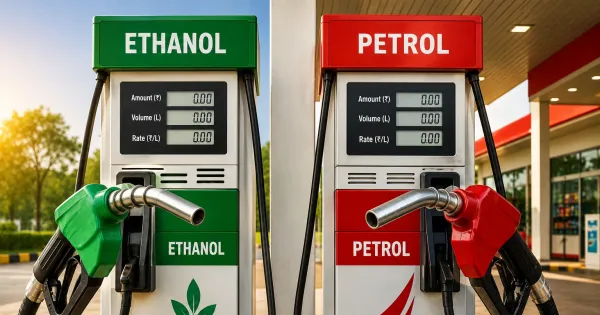
Ethanol worth ₹71 litre: Why is it still being mixed in petrol? The government told the complete mathematics

Read, New Delhi. The quantity of ethanol in petrol is being continuously increased, but the question is arising that when the purchase price of ethanol itself is around Rs 71 per liter, then why is the government putting so much emphasis on mixing it in petrol? The same question was raised in the Lok Sabha also. In response, the central government said that the objective of the Ethanol Blended Petrol (EBP) program is not to provide cheaper fuel to oil companies, but to make the country more self-reliant in the energy sector, to provide better markets to farmers and to reduce dependence on foreign crude oil.
Question 1 : For how much is ethanol being purchased?
According to the government, in the current ethanol supply year (November 2025 to October 2026), public sector oil companies are purchasing ethanol at the rate of around Rs 71 per liter. This price also includes GST and transportation charges.
Indian Oil: Rs 71.18 per liter
Hindustan Petroleum: Rs 71.10 per liter
Bharat Petroleum: Rs 71.21 per liter
The government said the average ex-distillery price of ethanol produced from various sources such as sugarcane juice, B-heavy and C-heavy molasses, damaged food grains, rice and maize in excess of FCI is Rs 66.61 per litre, excluding GST and transportation costs.
Question 2: When ethanol is not cheap, why is it being mixed with petrol?
The government says that this scheme should not be seen only from the perspective of purchase price. The purpose of ethanol blending is to serve long-term national interests. According to the government, this reduces dependence on crude oil imports. The impact of fluctuations in international oil prices is less. The energy security of the country becomes stronger. Farmers get additional market for their crops. Pollution caused by vehicles reduces. The government clarified that the system of ethanol purchase has been made not to increase the profits of oil companies, but to ensure adequate supply and to give fair prices to producers.
Question 3: What benefit did you get during the West Asia crisis?
The government said in Parliament that during the recent West Asia crisis, even when crude oil prices jumped by 70 to 80 percent in the global market, the rise in petrol prices in India remained limited to about 7 to 8 percent. The government says that when the price of Indian crude oil had reached around $ 135 per barrel, then according to the market, petrol could be sold at around Rs 125 per liter. Despite this, petrol was made available to consumers in Delhi at the rate of Rs 94.77 per litre. The government also cited domestically available ethanol as one of the reasons for this. However, during this period, public sector oil companies suffered an average under-recovery loss of about Rs 11 per liter on petrol, which totaled about Rs 21,300 crore.
Question 4: Does E20 petrol harm the vehicle engine?
The government said that before implementing more ethanol blending, extensive trials were conducted by the Automotive Research Association of India (ARAI), vehicle manufacturing companies, oil marketing companies and other expert bodies. According to the government, more than 23 crore vehicles in the country are using high ethanol blended fuel. These include more than 20 crore two-wheelers and about 3 crore petrol cars. So far, there has been no confirmed case of large-scale engine failure due to ethanol blending. Automakers are also continuing to warranty vehicles that use E20 fuel.
Question 5: What benefit will farmers get from this?
The government believes that increasing demand for ethanol creates a new market for sugarcane, corn and other agricultural products. With this, there is a possibility of farmers getting better prices and promoting agro-based industries.
Question 6: What is the big goal of the government?
The government says that ethanol blending is not just a fuel policy, but part of a long-term strategy for energy security, increasing farmers' income, environmental protection and reducing dependence on foreign oil. Therefore, this scheme should not be evaluated only on the basis of whether ethanol is cheaper or costlier than petrol.
at a glance
-Ethanol purchase price: around Rs 71 per liter
-Objective: Energy security and reducing dependence on imported oil.
-Benefit to farmers: Possibility of increase in demand for agricultural products
-Environment: Claims to help reduce emissions from vehicles
-Vehicles: More than 23 crore vehicles are using high ethanol blended fuel
-Government's message: This scheme is being implemented not for profit, but keeping in mind the long-term national interests.

Comments are closed.