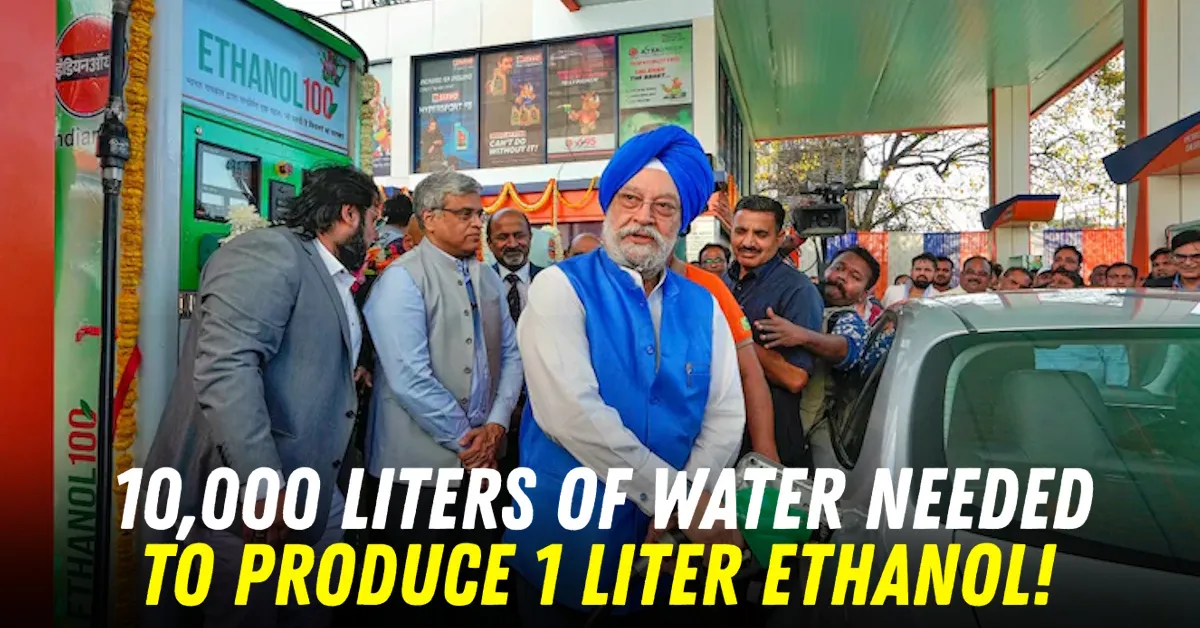
E20 petrol is now a reality across the country, but the debate around ethanol is moving beyond vehicle compatibility and mileage. The latest concerns focus on how much land and water ethanol feedstocks use, what farmers choose to grow, and whether fuel demand starts competing with food and animal-feed demand.
The concern is relevant because the programme has expanded quickly. Ethanol blending rose from below 1.5 per cent in 2013-14 to 20 per cent in 2025-26, reaching the target five years ahead of the original 2030 schedule. Ethanol production capacity has grown to around 2,000 crore litres, while procurement for 2025-26 is projected at more than 1,200 crore litres.
That scale creates benefits, but it also makes the choice of feedstock important. Sugarcane, rice and maize are now all part of the ethanol supply chain. If production grows mainly by putting more food crops into fuel, the environmental cost can shift from the tailpipe to farms, irrigation systems and land use.
The government’s own planning documents have recognised this problem for years. The 2021 ethanol roadmap noted that sugarcane and paddy together consume a very large share of irrigation water and recommended lower-water crops and second-generation ethanol made from agricultural residue.
More recent NITI Aayog work shows why the issue has not disappeared. Its 2026 modelling estimates that producing one litre of sugarcane-based ethanol can involve around 2,860 litres of water when crop cultivation is included. The corresponding estimate is above 4,600 litres for maize and more than 10,700 litres for rice.
Those figures do not mean every litre of ethanol directly consumes that quantity inside a distillery. Most of the water footprint sits in growing the crop. That makes location crucial. A feedstock grown largely with rainfall has a different impact from the same crop produced through stressed groundwater irrigation.
The earlier roadmap called maize the least water-intensive grain option for ethanol compared with rice and broken rice. Even so, scaling maize purely to meet fuel demand can change cropping patterns and divert land from food or animal-feed markets.

The government has actively widened the raw-material base to keep E20 supplied. It approved 52 lakh tonnes of surplus FCI rice for ethanol production for 2024-25 and again for 2025-26 up to June 30, 2026. It also allowed diversion of 40 lakh tonnes of sugar in 2024-25 and has promoted maize clusters around grain-based distilleries.
That approach solves one problem, which is dependable ethanol availability, but creates a second question: what happens when the so-called surplus shrinks? Climate variation can quickly change sugar, rice or maize output. A fuel programme needs predictable supply every year, while food production cannot always be predicted with the same confidence.
The more sustainable answer is likely to be a larger share of ethanol made from crop residue, waste biomass and other non-food feedstocks. The government already supports such plants through the PM JI-VAN programme, but second-generation ethanol has been slower and more expensive to scale than conventional grain or sugar-based production.

Ethanol blending has clear economic reasons behind it. The government says the programme has saved more than Rs 1.9 lakh crore in foreign exchange since 2014-15, substituted over 310 lakh tonnes of crude oil and generated more than Rs 1.6 lakh crore in additional farmer earnings. Those are substantial gains for a country that imports close to 90 per cent of its crude.
The argument, therefore, is not whether ethanol has benefits. It is whether the next stage can deliver those benefits without encouraging water-intensive cultivation or pushing productive farmland towards fuel simply because administered ethanol prices make that crop more attractive.