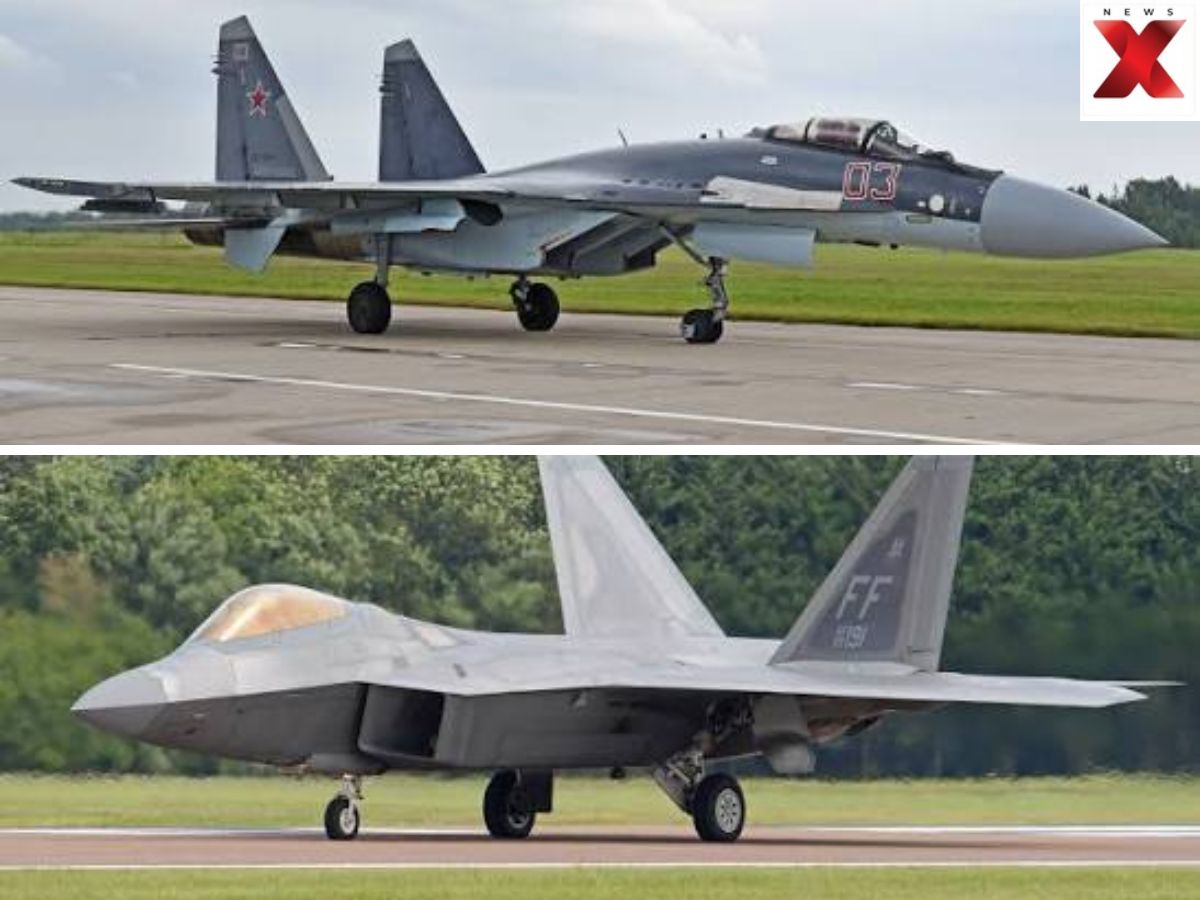
The Lockheed Martin F-22 Raptor and Russia’s Sukhoi Su-35S represent two very different ideas of air combat. The F-22 is built around fifth-generation stealth, sensor fusion and the ability to detect and attack an enemy before being seen. The Su-35S, a Russian-built 4++ generation fighter, relies on speed, powerful radar, a huge weapons load and extreme supermaneuverability. While the Su-35S has been described as a highly capable rival to fighters such as the F-15, F-16 and F/A-18, the F-22’s stealth gives it a major advantage in long-range combat. Importantly, the Su-35S is Russian-made, not an Indian-built fighter.
F-22 Raptor vs Su-35S: how their speed and range compare
The F-22 has an estimated speed of about Mach 2.25 or approximately 2,414 kilometers per hour, and the F-22’s estimated range is approximately 1,840 to 1,850 miles or 3,000 kilometers. The main strength of the aircraft is that it is capable of supercruise and can fly at Mach 1.5 without using afterburners.
The Su-35S also reaches up to Mach 2.25, with the figures provided putting its high-altitude speed at around 2,778 km/h. Its maximum range is slightly longer at roughly 1,940 miles, or about 3,500 km. The fighter has a maximum take-off weight of 34.5 tonnes, a service ceiling of 20,000 metres and an operational range listed at around 1,500-4,500 km.
F-22 Raptor vs Su-35S: stealth meets supermaneuverability and heavy weapons
The biggest difference appears in how the two aircraft are designed to fight. The F-22 carries its weapons inside internal bays to keep its radar signature extremely low. In a standard air-to-air configuration, it can carry six AIM-120D AMRAAMs and two AIM-9X Sidewinders, along with an internal 20mm cannon. The AIM-120D is estimated to have a range of roughly 160 km.
It lacks internal weapons bays. It has 12 hardpoints which enable it to carry weapons weight up to 8,000 kg. These weapons include the air-to-air R-77-1 missiles, the long-distance R-37M missiles, and R-73 and R-74M infrared missiles used during close combat. It is reported that the R-37M can reach a speed of Mach 6 and can engage high-value targets at the distance of about 300 km. In addition, Su-35S uses helmet-mounted targeting system and enables the pilots to direct short-range missiles to the targets the pilot looks at.
F-22 Raptor vs Su-35S: what will happen beyond visual range?
In a hypothetical battle scenario, the goal of the F-22 is to maintain the distance. Within 150-200 km, the low-observability of the F-22 makes it very difficult to be detected by the Su-35S, while the F-22 can utilize its advanced sensors against the large radar signature of the Russian fighter.
The F-22 could launch an AIM-120D from its internal weapons bay and turn away to preserve distance. The Su-35S might only become aware of the incoming missile when its seeker activates during the final stage. It could then use its Khibiny-M electronic warfare system and thrust-vectoring manoeuvres to try to break the missile’s lock and drain its remaining energy.
F-22 Raptor vs Su-35S: the fight changes if they get close
If the Su-35S survives the initial beyond-visual-range attacks and closes to around 30 km, the balance changes. Its IRST system could detect the F-22’s heat signature, while its thrust-vectoring engines would give it exceptional manoeuvrability. In a visual-range dogfight, the Su-35S would have advantages from its 3D thrust vectoring, helmet-mounted sights and larger weapons load.
The F-22, however, would be built to prevent that situation. Its stealth, sensor fusion and supercruise are designed to allow it to attack from a distance and disengage before an opponent can force a close-range fight. If missiles are mounted externally, the F-22 loses much of its stealth advantage, which is why its standard combat configuration keeps them inside the aircraft.
F-22 Raptor vs Su-35S: which fighter costs more?
The price difference is also significant. The F-22 is described as an extremely expensive fighter, with unit costs ranging from about $150 million to $350 million. The Su-35S is far cheaper, with an estimated cost of around $60 million per aircraft.
The Su-35S entered Russian Air Force service in 2014 and first saw combat in Syria in 2015, where it was used to provide cover for Russian aircraft conducting bombing missions. It is a heavily upgraded derivative of the Su-27 and was originally intended for export. Its combination of speed, range, weapons capacity, powerful radar and supermaneuverability makes it formidable, but it gives up the F-22’s defining advantage: low-observable stealth.
Overall, the comparison is less about which aircraft is universally “better” and more about how differently they approach air combat. The Su-35S is built to carry enormous firepower and dominate manoeuvring fights, while the F-22 is designed to find, strike and leave an opponent before a dogfight begins. In a long-range engagement, that stealth and sensor advantage could prove decisive; in a close-range fight, the Su-35S becomes a far more dangerous opponent.
Also Read: Tejas Mk2 Vs JF-17 Block 3: Can China’s Fighter Match India’s Jet On Speed, Weapons And Range, All You Need To Know
Khalid Lateef is a Sub-Editor at NewsX Digital, specializing in Indian politics and global affairs. He also covers viral trending stories and major crime developments.
The post F-22 Raptor Vs Russia’s Su-35S: Can America’s Stealth Fighter Outclass Russian Jet? Speed, Weapons, Cost Compared appeared first on NewsX.