“Piya baaj pyala piya jaye na / Piya baaj yak-til jiya jaye na”, a song written by poet-king Muhammad Quli Qutb Shah — the 16th-century ruler of the Golconda Sultanate and founder of Hyderabad — more than four centuries ago, begins with a simple proposition Which is that without the beloved, even drinking becomes impossible and life itself loses its meaning. Written in Dakhni (the dialect of the Deccan region), the lyric has now travelled from the Qutb Shahi world of Golconda to Cannes and Toronto, carried by a film about a woman whose own history survives somewhere between archive, oral memory and legend.
The song is at the heart of Chand Tara: The Legend of Taramati, which marks actor and theatre practitioner Mohammad Ali Baig’s feature-film debut as director. The film, which had its trailer launch at Cannes 2026 earlier this year and will have its world premiere in the ‘market’ section of the ongoing Toronto International Film Festival next week, turns its gaze towards Taramati, the legendary singer-performer associated with the Qutb Shahi court, opening a window on a cultural world that tends to disappear behind the more familiar silhouettes of Mughal emperors, Rajput warriors and nationalist heroes.
That the journey should begin with a love song is fitting. Piya baaj pyala is itself an act of cultural archaeology. Its language belongs to a Deccan where Persian, Hindavi, Telugu and local court cultures met and mingled. Muhammad Quli Qutb Shah wrote in Persian, Urdu, Telugu and Dakhni.
Also read: How Last Man In Tower continues Manoj Bajpayee’s journey of bringing the extraordinary to ordinary characters
For Baig, the song is not simply an antique piece of literary heritage. “Muhammad Quli Qutb Shah’s Piya baaj pyala has been part of my family life for generations,” he says. “For us, however, this nazm (verse) is more than a piece of Dakhni literary heritage. It is about longing, about missing the beloved, and about the beloved itself, an intensely poetic sentiment with a universal appeal.”
The intimacy is personal. Baig had used the nazm in his earlier play Taramati: The Legend of an Artist, staged years ago at Golconda, while his father (the late theatre legend Qadir Ali Baig) had used it in his own play before him.
Bridging time with a song
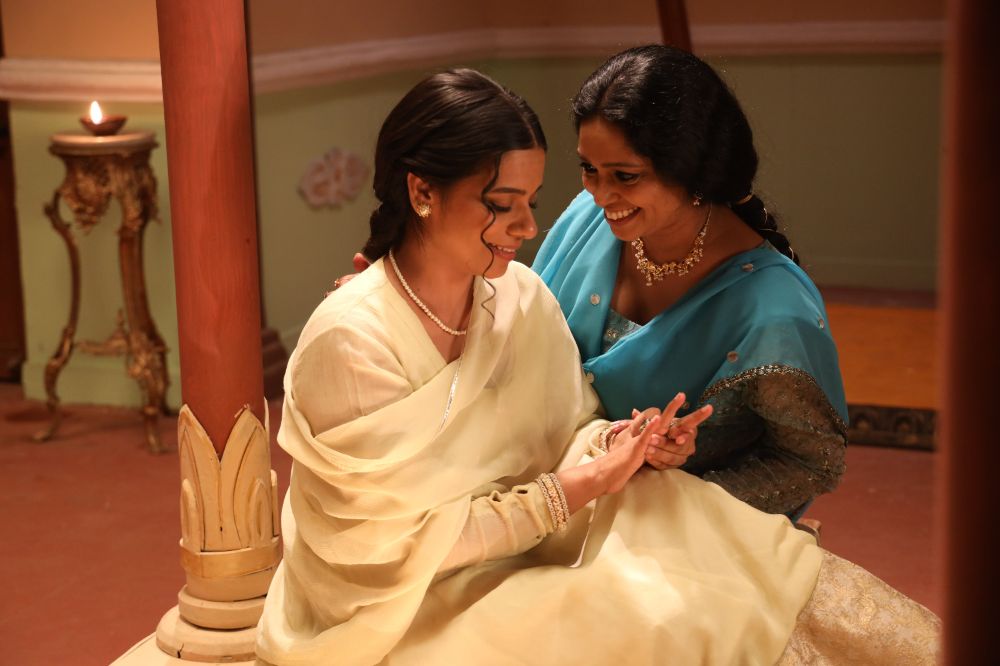
In Chand Tara, Baig makes the poem the bridge between Taramati and Sultan Abdullah Qutb Shah, the seventh ruler of the Qutb Shahi dynasty. Taramati refuses to enter the Sultan’s darbar and become his court singer. The Sultan sends her the poem instead, a work by his grandfather that he regards as part of his inheritance, and asks her to sing it.
“That becomes their first meeting point,” Baig says. “For the film, I had the nazm composed as a song, creating through it the emotional and artistic meeting ground between Taramati and the Sultan.”
It is an elegant device because it allows the past to arrive through sound rather than dates, battles and dynastic succession. The civilisation is not presented as a museum exhibit but as something capable of speaking, singing and feeling.
Vasundhara Das, the actor and singer whose career has moved between cinema and music, and who has sung Piyaa baaj pyala in Chand Tara, says her first response was not to the age of the composition or the unfamiliarity of Dakhni, but to the music itself.
“When I hear a piece of music, my brain usually processes the melody first and then the lyric,” she says. “My first reaction to the tune and the instrumentation was that I was instantly very attracted to it.”
The sarod particularly caught her ear, as did the classical approach to the melody, arriving when she was herself “in a deep dive to rediscover my roots in Hindustani Classical music”.
The language did not “intimidate” her. “If anything, it drew me closer.”
In Chand Tara, the poem Piya baaj… becomes the bridge between legendary performer Taramati and Sultan Abdullah Qutb Shah, the seventh ruler of the Qutb Shahi dynasty. Photo: By special arrangement
Das immersed herself in Dakhni for days before entering the studio, learning the words, familiarising herself with the melody and trying to inhabit its emotional landscape.
“Four hundred years is a formidable distance until someone sings about longing. Then the centuries collapse rather quickly,” she says.
Setting it to tune
The composer Karthik Raja was given an unusually precise brief. Baig had a particular raga and beat in mind. Raja set the song in Raga Des, building the composition around the director’s conception rather than imposing a contemporary gloss upon the old lyric.
The song’s emotional lightness also makes Des apt for a lyric about longing. Its ache need not be dark or oppressive. It can be romantic and wistful, nostalgic without becoming despairing.
But the woman at the centre of the film requires more than a beautiful song.
Taramati is one of those historical figures whose existence has survived more robustly in cultural memory than in documentation. Much of the texture of her life, however, remains elusive.
Baig is emphatic that he regards her as a historical figure, not simply a mythological or legendary creation. “Taramati and Premamati (also a performer at the Qutb Shahi court) are buried in the Qutb Shahi family necropolis,” he says, “a physical presence anchoring them in history even as the stories surrounding them have accumulated layers of legend.”
He does not pretend cinema can recover every lost fact. “We have slightly fictionalised her character in the interest of the needs of the medium,” he says. “I’ve dramatised situations under cinema and theatre, and made those liberties to present history on stage.”
But there is a line he does not want to cross. “As I am a professional theatre maker, now a professional filmmaker, it’s important for me to stick to professional ethics and not either demonise historical figures or glorify them.”
His intention is to present Taramati and Abdullah Qutb Shah, the Sultan, as a connoisseur of the arts and himself a poet, without reducing them to easy moral binaries.
That concern with authenticity extends beyond the characters. Baig’s family has spent generations recreating historical periods on stage, from the Qutb Shahis and the Asaf Jahs, popularly known as the Nizams, to Mughals and Rajputs.
For Chand Tara, “the architecture, the decor, the music, the fabrics, the prints, the colours on the fabric, the jewellery, the gems on the jewellery” were painstakingly researched, Baig says. “Everything is presented as authentically as we could.”
Bringing Taramati to life
Yet historical authenticity is only half the challenge. The other is making a woman who has survived largely as fragments come alive as a person.
That task fell partly to actor Ranjana Srivastav.
“Because I have never seen Taramati myself, I think an actor’s first responsibility is to surrender to the director’s and writers’ understanding of the character and the world they are creating,” she says.
For Srivastav, the gaps in the historical record are where acting begins. “Where my craft comes into play is in filling those gaps with something deeply human,” she says. “The history may tell us very little about her everyday life, her emotions or her behaviour, but as an actor, I can explore those emotional and behavioural truths.”
She is also wary of turning Taramati into a flawless historical heroine. “I am in absolute awe of the kind of devotion Taramati had towards her craft,” she says. “I think, above all, she was married to her singing.”
Das makes the point more explicitly. “Taramati seems to be someone who was consumed by her art. So entrenched in art was she that her artistry moved the power to be, the Sultan, to long for, love and revere her for it. Can you begin to then imagine how powerful her existence was?”
That makes the story potentially more interesting than another royal romance. The Sultan is important, but the film is interested in what happens when a performer becomes the gravitational centre of a courtly world.
There is also something contemporary in reversing the familiar gaze. Women artists have often been remembered through the men who watched them, loved them, patronised them or wrote about them. Taramati offers another possibility, Das says. “She was well and truly the hero of her own story.”
Indian historical cinema has long been drawn towards its grandest subjects. Empires, battles, kings, queens and dynasties provide ready-made spectacle. The archive itself tends to favour rulers and institutions because they leave inscriptions, buildings, genealogies and official records.
Performers leave other kinds of evidence: a song, a gesture, a stage, a memory, a story repeated from one generation to another. “A civilisation is not only built by the people who ruled it,” says Srivastav. “It is also built by the people who sang, danced, created, performed, loved, questioned and shaped its cultural memory.”
Also read: How team of web-series The Revolutionaries are widening the frame on India’s freedom narrative
That, she argues, is where Chand Tara becomes more than a film about Taramati. “Artists often become the keepers of a time in ways that official history doesn’t always necessarily record. A song can survive a dynasty. A performance can survive a political regime. A story can travel much further than the person who originally told it.”
The song at the centre of the film has done precisely that. Muhammad Quli Qutb Shah wrote of longing more than 400 years ago. The lyrics survived dynasties, political upheavals and changes in language. A civilisation can sometimes be rediscovered through the people who made music while the rulers were busy making history.