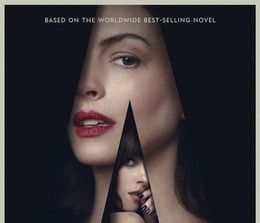
In the heyday of the erotic thriller in the 1980s and ‘90s, desire was dangerous. It was something so potent it could lead characters to their doom, particularly women. One of the genre’s enduring criticisms was its misogyny: the sexually transgressive woman was often reduced to the “crazy psycho”, the villain who had to be contained. Think Fatal Attraction (1987), or Basic Instinct (1992).
More recent fiction has complicated that template, allowing women darker desires and messier inner lives without necessarily turning them into villains. Gillian Flynn’s Gone Girl — though not an erotic thriller per se — is the obvious example. More recently, Die My Love (2025) has explored postpartum depression and maternal rage without reducing its protagonist to a monster.
Michael Showalter’s Verity, adapted from Colleen Hoover’s novel, seems to want to belong to this lineage, but it never quite knows what to do with it.
Reminders of Rebecca
Anne Hathaway’s Verity is a bestselling writer of twisty thrillers whose characters are, in her words, “f*****-up”. After giving birth to twins, she becomes consumed by thoughts of filicide. She also feels abandoned by her husband, Jeremy (Josh Hartnett), whose attention has shifted towards their children. The audience discovers this through Lowen (Dakota Johnson), a struggling novelist hired to complete Verity’s bestselling series after an accident leaves Verity paralysed and unable to speak.
Also read: Why for these Indian drag performers the loss of Dolly Parton feels so personal
Lowen moves into the family home and begins going through Verity’s notes, trying to get inside the head of the woman whose books she must finish. It is a deliciously Gothic setup: a wife who dominates the house despite being unable to move (much like Hitchcock’s Rebecca, also a film headlined by her character), an unwelcoming caretaker, a husband who seems almost too good to be true and a young woman whose professional relationship with him inevitably begins to blur.
Then there are glimpses of Verity moving around the house, turning her neck from the wheelchair, visible only to Lowen. Has she stumbled into a messed-up domestic drama, or is she losing her mind?
The notes are the film’s most intriguing device. Their contents are dramatised in flashback: Verity meeting Jeremy, their marriage, pregnancy and eventual disintegration. But just when the audience thinks they have discovered the truth about Verity, the film pulls the rug away. Perhaps the journal is not a confession at all, but an exercise in “antagonistic journalling”, in which a writer adopts the persona of a villain to understand her characters.
Never entirely plausible
It is a potentially fascinating idea. Unfortunately, the twist only makes the film’s already shaky construction more apparent. Why does Jeremy need Lowen to finish the books? Why does he bring her into the house? Why keep Verity alive? And what exactly was Verity’s plan? The screenplay by Nick Antosca never supplies convincing answers, leaving the mystery increasingly dependent on contrivance.
Lowen herself is more interesting in theory than in execution. She is grieving her mother, broke and emotionally vulnerable, but she is also drawn to the life Verity has: her success, her house, her husband, her family. The possibility that she might replace Verity gives the film an intriguing undercurrent, particularly because she is supposed to be writing another woman’s books while slowly stepping into her life.
Early on, Lowen mistakes the snow-covered landscape outside the house for a field. Jeremy tells her it is a lake. Through the glass wall, Verity’s reflection falls across its frozen surface. Things are not as they appear. It is a lovely image for a film obsessed with deception. What Verity needed was more of that — less reliance on twists and more faith in ambiguity.
Also read: Why current times resonate with the paradox of Dickens’s A Tale of Two Cities, Auden’s anxious years
The problem isn’t that Verity has too many twists; twists are part of the appeal of this kind of thriller. It’s that the film never makes them feel entirely plausible or earned. Too often, the audience finds themselves questioning the mechanics of what is unfolding rather than surrendering to the mystery.
The ideas — the unreliable journal, the possibility that Verity is not the monster she appears to be, the shifting loyalties — are intriguing in theory, but the plot is so contrived that they rarely acquire the force they should. What might have been a deliciously murky thriller instead feels like a film straining to keep up with the twists its genre demands.