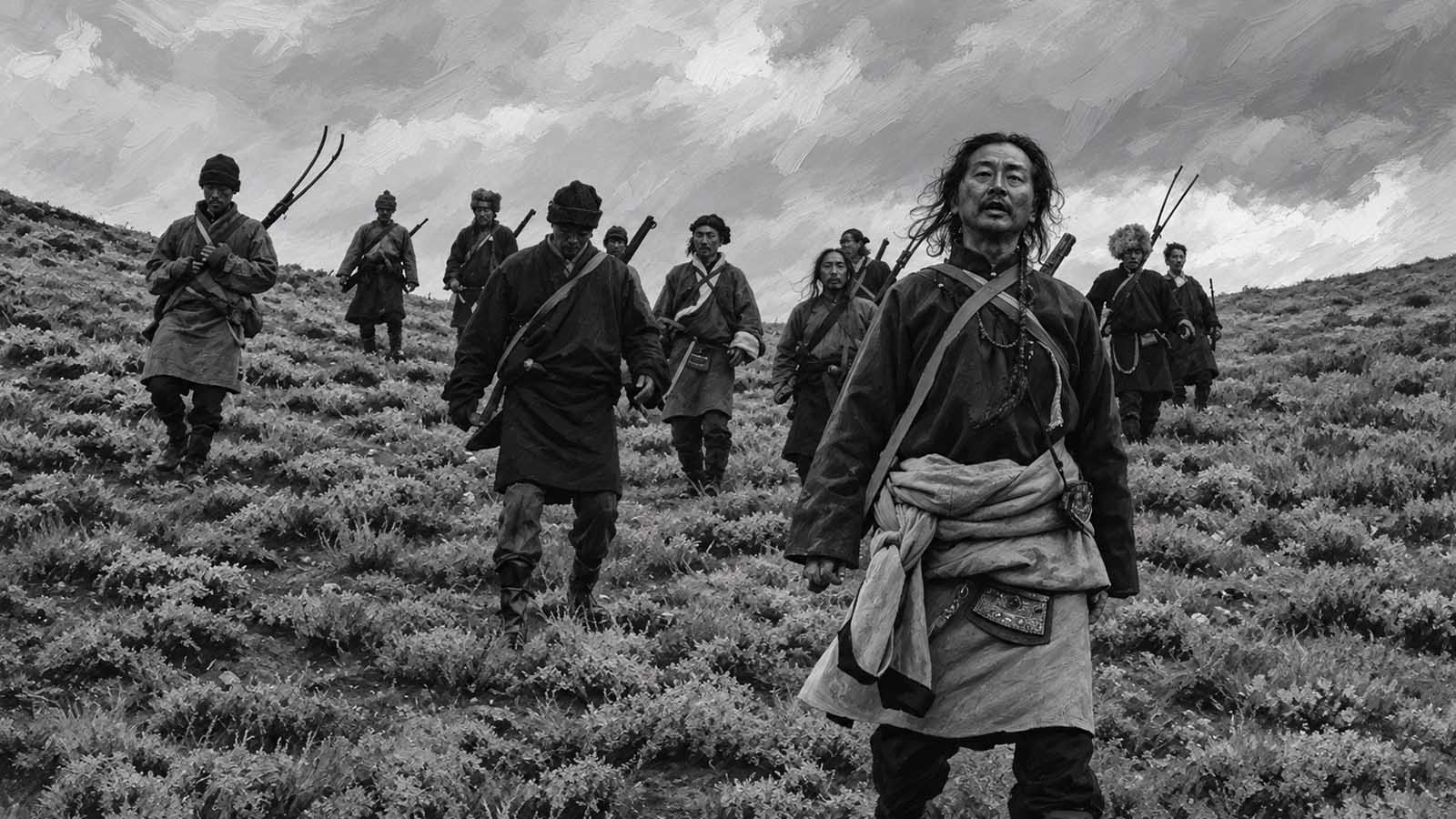
From its opening moments, Tibetan filmmaker Shenpenn Khymsar’s 4 Rivers 6 Ranges announces itself as a film deeply concerned with history, identity and the price of resistance. Set against the upheaval surrounding China’s annexation of Tibet in the early ‘50s, it explores the lives of those who chose armed resistance while confronting the enormous personal and moral cost of that decision. Rather than presenting resistance as a simple tale of heroism and villainy, Khymsar focuses on something more complicated: the burden of preserving a threatened identity. The result is an effective historical drama that deserves to be seen widely.
Written, directed and produced by Khymsar, the English-language film is set in 1958, as the People’s Liberation Army (PLA) tightens its control over Tibet and resistance movements swell. At the centre of the story is Gonpo Tashi (Tenzin Dhondup), who brings together a group of men to join the Chushi Gangdruk (which translates to “4 Rivers 6 Ranges”), an armed Tibetan resistance movement.
Alongside this story of fighters preparing for battle is that of the young 14th Dalai Lama, who is faced with the enormous responsibility of deciding Tibet’s future. The film places these two paths alongside one another, asking what happens when political circumstances force a population to make choices they might never have imagined making.
Treatment of conflict
The film’s opening immediately establishes its willingness to confront the violence of its subject. As PLA soldiers enter a Tibetan settlement, civilians scatter and the atmosphere shifts from panic to confrontation. Kunga Samten (Thupten Chukhatsang), a resistance fighter, turns the tables on one of the soldiers inside a deserted home, setting off a tightly choreographed sequence in which the resistance fighters move through the settlement.
The scene is brutal but carefully composed, introducing the film’s distinctive visual language from the outset: violence unfolding against the vastness of the Tibetan landscape, where moments of stillness can give way to sudden eruptions of conflict.
Also read: Lust Stories 3 review: New Netflix anthology season offers pleasures, but not quite the satisfaction
One of the film’s most compelling aspects is its treatment of the conflict between Buddhist principles and armed resistance. The characters are not portrayed as fearless warriors untouched by doubt. Rather, their actions are shaped by faith, loyalty, grief and a sense of responsibility toward their homeland. A Buddhist monk joining the resistance and reciting a prayer before taking his first shot captures this contradiction particularly well. Violence is not something to celebrate. In fact, the film repeatedly returns to the moral questions surrounding it, giving its fighters an emotional and spiritual dimension beyond the battlefield.
The performances deepen the film’s emotional weight. Dhondup brings both determination and vulnerability to Gonpo Tashi, while Chukhatsang gives Kunga Samten the qualities of an ordinary man caught in extraordinary circumstances. The largely Tibetan cast adds to the film’s sense of intimacy and immediacy, while the young 14th Dalai Lama provides a parallel perspective on the unfolding crisis. His youth is particularly striking: even as a teenager, he is confronted with decisions carrying consequences far beyond his own life.
The memory project
In terms of its imagery, 4 Rivers 6 Ranges is at its most impressive when it uses the Himalayan landscape to convey both grandeur and confinement. Vast mountains dominate the frame, yet the characters often appear trapped within them, surrounded by a landscape that is simultaneously beautiful and unforgiving. The action sequences have a muscular, widescreen quality, while the film’s quieter passages build an atmosphere of unease. This contrast gives the film much of its momentum, shifting between expansive landscapes and intensely personal moments of fear, loss and resolve.
Yet beneath its battles and sweeping imagery, the film, which premiered at the International Film Festival Rotterdam (IFFR) in 2025, remains deeply concerned with memory — particularly what remains of a culture when its people are displaced and how those stories survive across generations. That question gives the film a purpose beyond simply revisiting the past: it becomes a record of a chapter of Tibetan history.
Indeed, it is this perspective that has also made the film politically contentious. Chinese official media has criticised the film’s portrayal of Tibetan history, accusing it of promoting separatism and rewriting history. These criticisms reflect the wider political sensitivity surrounding representations of Tibet and underscore the contested nature of whose version of history gets remembered and preserved.
Still, for all its political weight, 4 Rivers 6 Ranges ultimately works because it remains grounded in the people at the centre of its history.
Also read: Daayra review: Why Mehgna Gulzar film starring Kareena, Prithviraj Sukumaran fails morality test
In Khymsar’s hands, the Tibetan fighters are not symbols but men confronted with fear, uncertainty and choices that carry consequences they cannot fully foresee. That human dimension gives the film its lasting force, even though it is not without shortcomings. The pacing occasionally slows the momentum, while some of the dialogue can feel heavy-handed, spelling out ideas that might have carried greater weight if left unsaid. Yet these weaknesses do little to diminish the force of what the film is attempting: a dogged determination to keep these lives, sacrifices and memories from slipping into historical obscurity.