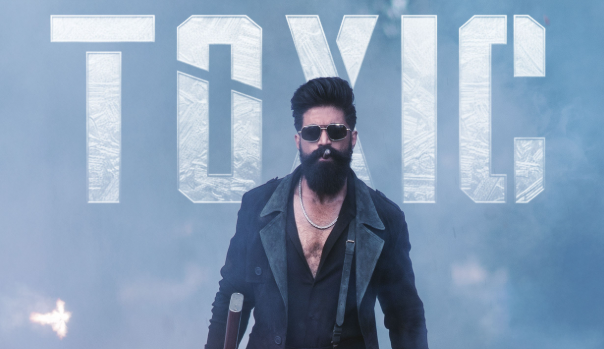
Of course, Toxic has a narrator. How can it not? How can it not have the lazy storytelling device that’s quintessential of this brand of film that’s basically ‘stuti’ (hymn of adoration) of the protagonist. How can we just have an introduction scene of Yash without a narration in the background that is all talk and no sense How can he make a direct entry, without teasing the fans with glimpses of his hands, neck tattoo and cigar, before finally revealing his face. So, yes, Toxic has a narrator, the bazooka gun, small guns, big guns, big cigars, small joints, women, more women, beheadings, blood splattering, mutilated hands, mutilated legs and for good measure, also another Yash! What it doesn’t have is the depth and style it so badly attempts at.
Toxic is a confusing film right from the get-go. It begins with the death of Nadia (Kiara Advani), who runs a circus troupe. She dreads the arrival of her lover Raya (Yash) to an extent that she kills herself in style. Before that she asks her child, Ticket, to go welcome his father and tells him that she has done something his father doesn’t like. As the son leaves and powers up the entire circus, Nadia gets on the stage and holds onto the hoop as it slowly lifts her up. Her gown has a bunch of grenades attached to it, and as she is lifted, off they go. When Raya arrives at the gate, he finds his son wearing clown make-up sitting at the gate. Instead of crying, he laughs.
It’s easy to imagine the kind of excitement that would have gripped the makers while this scene was being conceptualised; the sense of accomplishment and smugness, for that only can explain the disaster that ensues in the next three hours in Toxic.
Also Read: Kriti Sanon’s Rakhi ad withdrawn by brand after controversy
A gangster film that wants to be more
And what a disaster it is, dressed up as a plot. It starts off like any usual gangster film — a small boy’s rags to riches story. The only difference here, he has a sister too, Ganga (Nayanthara), who is as much of a badass. Having lost their revered father to a scheming mother and rivals, the two end up homeless. The sister resorts to extreme measures to sustain them and in the end the grown-up Ganga wants her brother Raya to rule all of 1940s Goa, currently in the hands of a Portuguese druglord. So, siblings kill people and start serving a warlord. Then there’s a marriage of convenience to sustain their power, but an unplanned romance threatens to jeopardise the calculation.
Post-interval, we enter what feels like a different film altogether — one that’s forgotten what the first one was chasing. The problem is nothing seems interesting, because there is no goal. Toxic follows the template of a gangster film to make a drama in character study of it and ends up unclear about what it’s actually about.
It is true that without Ganga, there is little difference between Toxic and the rest of the barrage of gangster films made in recent times. Ganga is director Geethu Mohandas’s touch of nuance, meant to bring a sense of self-awareness about the toxicity of everything in the film. But that’s exactly what she remains — a touch, not a departure. She isn’t a strong female character with any motive beyond serving the hero. Be it Ganga, Nadia, or Mellisa (Rukmini Vasanth), women in Toxic aren’t any different from the ones you find in films like KGF or Pushpa. The film just wants credit for pretending otherwise.
Also Read: Dolly Parton, American music and film icon, dies at 80
When self-awareness doesn’t bring depth
Then there’s the self-awareness of Yash’s character. At one point, he goes, “Don’t go looking for a hero in the film. It is about a villain and another villain.” At another point, Raya tells Nadia, “There’s nothing worthy/good about me that you have to be curious about.”
These lines are supposed to tell us the film isn’t glorifying everything it’s actually glorifying.
Looking back, Toxic is a sequence of Yash kissing women and killing women and dropping obsolete lines that try hard to sound deep. He goes, “Karpanaila irukkira viswatha vida nejathula irukka dhrogathuku thooymai jaasthi (The imagined loyalty is purer than the real treachery).” Sounds pretty, even deep, but scratch under the surface and you are left with the meaninglessness of it.
That is exactly the problem of Toxic. It is a film that tries to be deep and profound about how toxic it is. It has a protagonist who admits he’s not a hero, but admitting to a problem doesn’t absolve one of being complicit in it. And a film that makes a superstar out of a monster by using violence and sleaze as props, doesn’t become a profound watch just by reminding the audience that it is not the tale of a ‘hero’.