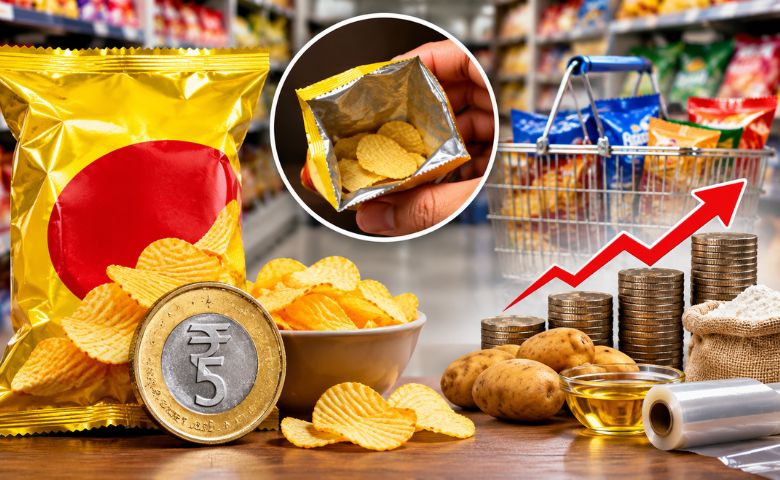
5 Rupees Chips Packet: You buy a five-rupee packet of chips from a shop, but do you know how much profit the company makes by selling this packet? Due to rising inflation, raw material prices and packaging costs, a shocking estimate has come out that the manufacturer gets a profit of only around 15 paisa from a ₹5 packet of chips. Some packets of chips, which once weighed 25 to 30 grams, are now only 11 to 14 grams. Thus the customer still pays five rupees, but the amount of snacks in the packet has reduced. According to an English business newspaper report, it is becoming increasingly difficult for Indian snack companies to produce and sell the ₹5 packet profitably. Due to this, companies are now turning to larger packets, premium products and changes in packaging.
How much cost and how much profit from a five rupee packet?
According to estimates for a typical potato wafers packet in the report, most of the ₹5 received from the consumer is spent on manufacturing, raw materials, packaging, transportation and traders’ margins.
| Details of expenditure | Estimated amount |
|---|---|
| Raw materials including potatoes, edible oil, spices | ₹1.70 |
| Packaging and other processing | ₹0.85 |
| Distributor’s and Retailer’s Margin | ₹0.85 |
| Transportation and Freight | ₹0.55 |
| tax | ₹0.55 |
| Factory processing and electricity | ₹0.35 |
| Profit of the company | ₹0.15 |
| Total | ₹5.00 |
According to this estimate, the profit of the company is only 3 percent of the selling price of the packet. However, this figure is based on an example of a typical wafers packet of 11 to 14 grams. The actual costs and profits of each brand may differ.
Packet weight reduced from 30 grams to 11 grams
Rising manufacturing costs are having a direct impact on packet weight. According to the report, the weight of some ₹5 packets of brands like Laz and Yellow Diamond has come down from 25 to 30 grams to 11 to 14 grams in the last three to four years. Such a situation is called shrinkflation in economics. That is to reduce the quantity inside the product while keeping the price unchanged. Consumers see no change in the price of the packet, but get less snacks than before. However, the possibility of increasing customer dissatisfaction with continued weight reduction is also a concern for companies.
Increase in potato and edible oil prices put pressure on companies
One of the biggest challenges for the snack industry is the rising cost of raw materials. According to the report, the price of potatoes kept in cold storage has increased by 30 to 40 percent. Lower crop yields in key potato producing states like Uttar Pradesh and Gujarat have impacted prices. On the other hand, the price of edible oil in the international market and the import duty have also increased the cost of oil. According to the industry, the cost of edible oil has increased by 25 to 35 percent. Costs of packaging, labour, electricity and transport are also affecting the profits of manufacturers.
₹5 packets worth for Gujarat’s Balaji Wafers and Gopal Snacks
The sale of Rs 5 packets is also very important for the well-known snack companies of Gujarat. According to the report, about 65 percent of Balaji Wafers’ annual revenue comes from ₹5 packets, while such packets account for about 60 percent of Gopal Snacks’ revenue. On the other hand, the ₹5 packet accounts for around 75 percent of Parle Products’ wafers sales. As demand for ₹5 and ₹10 packets is high, especially in rural areas and small towns, it is important for companies to maintain sales of these products.
Now companies are shifting to ₹10 and larger packets
As the profits in the Rs 5 packets are very low, some companies are now trying to attract customers to the ₹10, ₹20 and above packets. Production and packaging costs can be handled more efficiently in larger packets. In addition, companies are focusing on increasing sales in premium flavors, healthy snacks and modern retail stores. The increasing influence of quick-delivery quick-commerce companies is also encouraging the sale of larger and more expensive packets over smaller ones.
Fear of upsetting consumers by reducing packet size
According to experts in the snack industry, steadily reducing the weight of packets can be dangerous in the long run. When a consumer opens a packet and finds counting chips in it, trust in the brand may decrease. Companies are now trying to reduce costs by changing packet sizes, thicknesses, packaging materials and manufacturing processes.
What is the future of the ₹5 packet?
The demand for five-rupee breakfast packets is still huge in India. The importance of this price packet remains, especially among children, students, small towns and rural areas, but it is becoming a challenge for companies to maintain this price amidst the ever-increasing costs. Now the big question for the snack manufacturers is how they will maintain the price of the packet while providing enough quantity to the consumers. In this situation, further changes in the weight, size and product price of the packet may be seen in the future.