They have bought VND583 trillion worth of shares while selling VND710 trillion on the Ho Chi Minh Stock Exchange (HOSE) in the year to date after net selling a record VND125.5 trillion last year.
Property giant Vinhomes and conglomerate Vingroup were among the most heavily net-sold stocks, with net outflows of VND22.9 trillion and VND10.9 trillion, respectively.
Other stocks that saw large net outflows included tech giant FPT and lenders ACB, Vietcombank, Sacombank and HDBank.
Sustained selling pressure since the start of the year has pushed foreign investors’ ownership of stocks on the exchange to below 11%, down roughly two percentage points from a year ago.
“Foreign investors’ net-selling trend is consistent with global trends, as capital flows have withdrawn from many equity markets and shifted into bond markets,” analysts at brokerage SSI Securities Corporation wrote in a report.
|
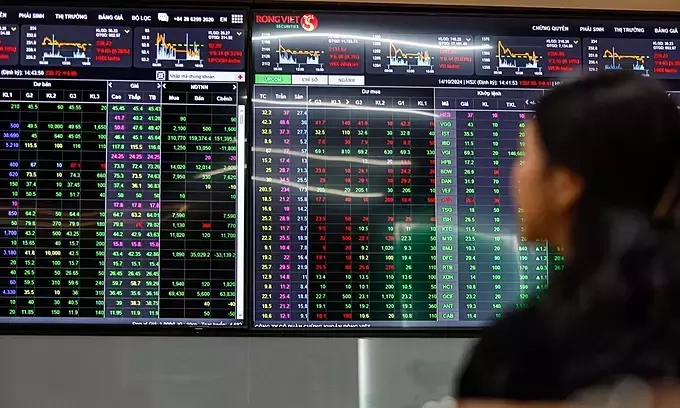
An investor looks at stock prices on the screens at a brokerage in Ho Chi Minh City. Photo by Read/An Khuong |
Vietnam’s stock market is among the Asian markets experiencing the largest foreign investor withdrawals. South Korea leads with more than $152 billion in outflows, followed by Taiwan with $93 billion, India with $20 billion and Indonesia with $5.6 billion.
Tran Hoang Son, market strategy director at VPBank Securities, another brokerage, said the sustained net selling on HOSE has kept the benchmark VN-Index under pressure for an extended period.
The index last closed at 1,688 points on Friday, down more than 12% from a record high of over 1,900 reached in mid-May.
The net-selling pressure is expected to persist as U.S. government bond yields remain elevated, the U.S. Federal Reserve continues to tighten monetary policy and the U.S. dollar remains strong.
Nonetheless, there are signs that the worst of the foreigner net-selling wave may have passed.
Foreign investors on the HOSE have net sold around VND5 trillion so far this month, down sharply from VND24 trillion in October.
SSI said profit-taking in developed markets with advantages in AI and semiconductors is likely to prompt capital to flow into traditional sectors, potentially easing selling pressure in Vietnam and helping the market find a better balance.