Over the last two decades, the company has grown into Russia’s largest e-commerce platform, with nearly 95,000 pickup points across the country and more than half of the nation’s population making purchases at least once a month.
It raked in US$9 billion in revenues in 2024, as estimated by Forbeswith unconfirmed 2025 sales reportedly reaching US$15 billion.
Kim, meanwhile, has an estimated net worth of $8.1 billion. The former English teacher, born to a Russian family of Korean ethnicity, launched Wildberries in 2004 with her now ex-husband, IT entrepreneur Vladislav Bakalchuk.
|
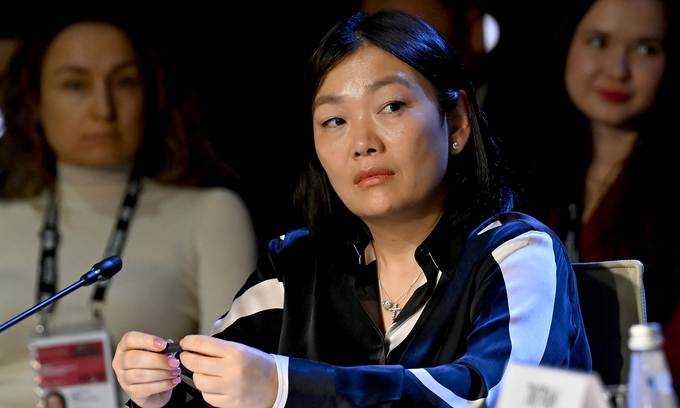
Tatyana Kim, founder of Wildberries, head of Wildberries & Russ (RWB), attends a session in Moscow, Russia on Nov. 11, 2025. Photo by AFP |
What began as a family business was run out of Kim’s Moscow apartment, where she sold clothing sourced from European catalogs through an online storefront. Kim would buy clothing in bulk, scan the catalog images and upload them to her website.
“We had a one-month-old baby and I wanted to start working again so as not to feel like just a mother,” she later told AFP in a 2018 interview.
Kim envisioned the business catering to women like herself: mothers who have little budget and time to shop. What set Wildberries apart from its rivals at the time was a model that let customers have their orders sent to a pickup point, where they could then try on items before deciding whether to buy them, according to The Wall Street Journal.
“At first, I did everything myself, collecting the goods and taking them to customers on the other side of Moscow by subway or bus,” Kim told Bloomberg in 2018.
Kim’s then-husband reportedly handled the technology side of the business, as well as overseeing the construction of large warehouses and coordinating its pickup point and franchise networks.
The business quickly grew and, within a year, Kim started hiring couriers to handle deliveries and renting storage space as her apartment could no longer accommodate the growing volume of parcels.
 |
|
A pedestrian walks past a pick-up point of Russian e-commerce firm Wildberries in Moscow on Aug. 5, 2026. Photo by AFP |
Kim became the second-ever female billionaire in Russia in 2019, when Forbes listed her among the 10 most notable new billionaires.
While she is often likened to Amazon founder Jeff Bezos, Kim is a far more private figure. The soft-spoken mother of seven rarely grants interviews and photographs of her were difficult to find until recent years.
She is said to lead a relatively modest lifestyle and rent instead of owning homes. She is rarely seen in expensive jewelry or designer clothes and has said she buys everything on Wildberries. She described herself as “introverted” in the AFP interview.
She flew economy class, albeit with priority boarding, before her employees convinced her to upgrade to business class last year, according to Air Mail.
Kim’s rise has not been without major setbacks. As Wildberries grew, its success attracted the attention of Russian businessmen, deepening tensions between Kim and Bakalchuk over the company’s future direction. Their dispute eventually led to a 2024 shootout at a Wildberries office, followed by a highly publicized divorce that was finalized the next year.
Wildberries has lost a third of its warehouse capacity and as much as 480 billion rubles (US$5.9 billion) worth of goods in Ukrainian attacks, The New York Times reported, citing Moscow-based e-commerce consultancy Data Insight.
It also has to contend with sharply lower consumer spending on nonfood products through marketplaces like itself and signs that some sellers are shifting to its rival Ozon, the second-largest e-commerce marketplace in the country.
Still, analysts believe that, as a company considered strategic to the Russian economy, Wildberries is unlikely to go bankrupt.