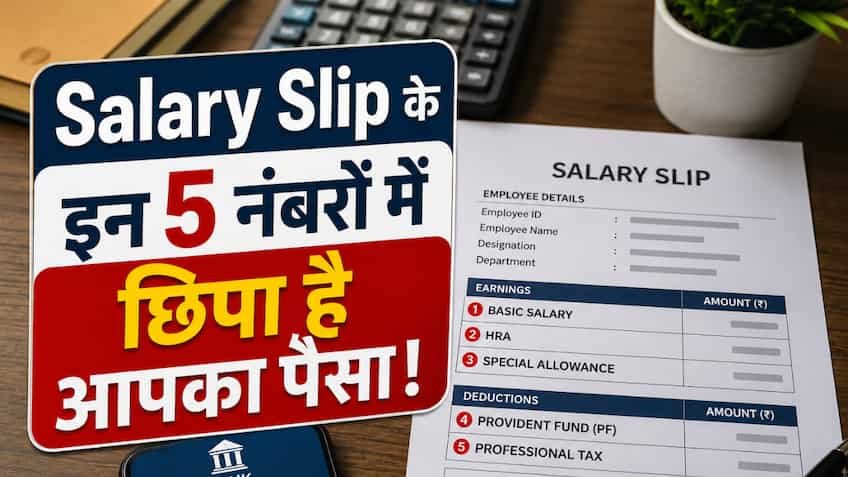
On the last or first day of every month, as soon as the bank message ‘Salary Credited’ flashes on the mobile phone screen, a smile of relief appears on the faces of most of the employed employees. As soon as the in-hand salary comes into the account, people start planning for their expenses, EMIs and bill payments. However, personal finance experts believe that it is not financially wise to be satisfied just by looking at the amount credited in the bank. Your salary slip is not just a piece of paper or a PDF file, but a complete account of your total CTC, tax liability, retirement savings and future financial entitlements. If you do not carefully understand the 5 most important columns of your salary slip, you may unknowingly incur huge tax losses and future financial losses.
1. Basic Pay: The foundation of your salary and the basis of your future.
The first and most basic part of the salary slip is ‘Basic Pay’. This is the core component of your total salary on which any other incentive or flexible benefit does not depend.
-
Direct connection to future funds: Your Employees’ Provident Fund (EPF), Gratuity and leave encashment are calculated directly based on a percentage of your basic salary.
-
Right balance in salary: Generally in companies, basic pay is kept between 40% to 50% of the total CTC. If your basic salary is too low, very little money will be deposited in your PF and gratuity fund, which can lead to a weak retirement corpus. At the same time, if the basic pay is very high, then it is fully taxable, which can increase the tax liability.
2. House Rent Allowance (HRA): Tax shield for those living in rented houses.
The second big column visible in the Earnings section of the salary slip is HRA i.e. House Rent Allowance. The company gives this amount to the employee to meet his living expenses.
-
Huge discount in old tax regime: If you file taxes under the Old Tax Regime, you can claim huge tax exemption on the actual rent paid under Section 10(13A) of the Income Tax Act.
-
Status in the new tax regime: If you have chosen the New Tax Regime, then there is no tax exemption on HRA and the entire amount is added to your taxable income. Therefore, you should choose the right tax regime only after seeing the HRA amount in your pay slip.
3. Special Allowance: Fully taxable portion of in-hand salary increase
A large column of ‘Special Allowance’ or ‘Personal Allowance’ appears in the salary slip of most private companies.
-
CTC Balancing Tool: Companies put the remaining amount after basic pay, HRA and PF under special allowance, so that the take-home salary of the employee can be increased.
-
No relief in tax: It is very important to understand that no tax exemption is available on Special Allowance under any section. It is 100% taxable. Tax is deducted directly on this entire amount as per your slab rate.
4. Provident Fund (EPF Contribution): Mandatory savings for retirement
The most prominent entry in the deductions section of the salary slip is that of Employees’ Provident Fund (EPF).
-
Contribution rule of 12%: As per rules, 12% of your basic pay and DA is deducted from the employee’s salary and deposited in the PF account. The same amount (12%) is also deposited by your company (Employer).
-
Matching with EPFO passbook is necessary: After checking the PF deduction from your salary slip every month, visit the official passbook portal of EPFO and check whether the company has actually deposited the amount in your UAN account or not.
5. Tax Deducted at Source (TDS): Income tax deducted every month.
Another important column in the deduction section is TDS i.e. ‘Income Tax Deduction’.
-
Monthly distribution of annual tax: The company deducts TDS from the salary every month by dividing the potential tax of the year into 12 months based on your estimated annual taxable income.
-
Matching with Form 26AS and AIS: If TDS is being deducted in your slip, then go to the Income Tax portal and check in your Form 26AS and AIS (Annual Information Statement) that the tax deducted is being deposited with the government. If the tax declaration is not submitted on time, the in-hand salary may suddenly become very low due to heavy TDS deduction in the last months of the year (January to March).
Why is it necessary to check salary slip every month?
Salary slip is not only for saving tax but is also considered the most important income proof while applying for home loan, personal loan or credit card from the bank. By correctly matching the leave balance, attendance and all deductions recorded in it, any kind of payroll discrepancy can be avoided in time.