
From local stall to one of Southeast Asia’s largest coffee chains: The story behind Indonesia’s Kopi Kenangan

Known as Kenangan Coffee in overseas markets, the brand had 1,324 outlets across six countries, including Singapore, Malaysia, the Philippines, Australia, and India, as of the end of 2025.
Of those, over 1,100 outlets were located at its home base of Indonesia. Its biggest overseas market, Malaysia, accounted for about 158 while Singapore had 10.
The brand also posted its first net profit at the group level last year, at $17 million on revenues of $184 million, according to The Business Times.
“We’d like to be the single company or brand that is the most dominant in Southeast Asia, not just by store count but by revenue and profitability,” co-founder and group CEO Edward Tirtanata told Forbes in an interview.
The idea for the chain grew out of a local tea chain Tirtanata had founded prior to Kopi Kenangan.
When that business fell short of expectations, he and his long-time friend James Prananto began brainstorming and identified the issue: many of the large coffee and tea chains in Indonesia were too expensive for local consumers while the widely available instant coffee sold at street stalls, though budget-friendly, lacked the quality and experience of freshly brewed drinks.
The pair, along with another co-founder, launched Kopi Kenangan, which is Indonesian for “coffee memories,” as a grab-and-go location in 2017, setting out to fill that gap.
Its best-selling drink, a palm sugar latte called Kopi Kenangan Mantan, meaning “coffee memories of my ex,” is priced at Rp22,000, positioning it between premium café offerings at around Rp40,000 and the roughly Rp5,000 charged by street vendors for a lower-quality cup.
“When I started, companies were selling coffee at Rp40,000 to Rp50,000 (US$2.33-2.92) per cup, which was unaffordable for most Indonesians,” Tirtanata recounted, as quoted by Nikkei Asia.
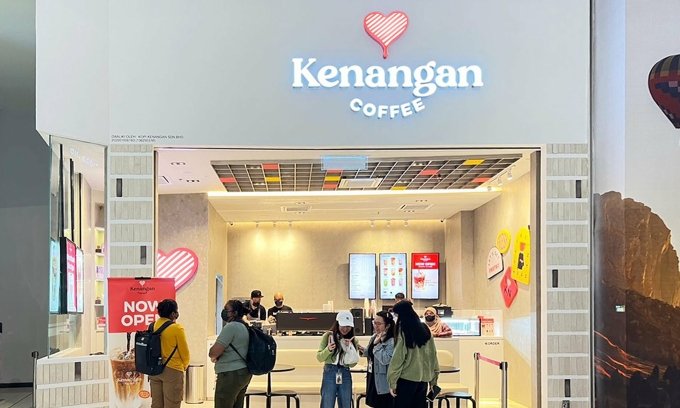
An outlet of Kopi Kenangan, known overseas as Kanangan Coffee. Photo from the company’s website |
From the outset, the grab-and-go format helped the brand avoid the costs of renting and maintaining sit-down café spaces and channel more resources into improving the quality of its ingredients.
The brand also uses technology to streamline store operations and enhance customer convenience. The Kenangan Coffee app enables customers to place orders for pickup or delivery, engages users through membership deals and loyalty points, and gathers insights into their preferences, according to Vulcan Post.
With around 1.5 million active users as of December 2025, the app has become the company’s main growth driver, contributing nearly half of sales.
And while Starbucks and other global coffee chains prioritize consistency, Kopi Kenangan adopts a data-driven, hyperlocal approach to craft beverages better suited to the Indonesian palate.
This strategy also shapes its international expansion, meaning a Kopi Kenangan latte in Singapore can taste different from the same item in Indonesia.
“We want to make sure that the sweetness and robustness of the coffee really suits the market that we are operating in,” Tirtanata told CNBC in a 2024 interview.
With these edges over its rivals, the brand expanded to more than 200 outlets across 10 cities within its first two years. During Covid-19, it ramped up efforts to integrate technology into its operations, helping it more than triple its store count over the course of the pandemic.
In 2021, the company became Southeast Asia’s first food and beverage unicorn after raising $96 million in a Series C funding round. It began its international expansion with Malaysia in 2022, followed by Singapore, the Philippines, Australia, and India in the years after.
The CEO driving Kopi Kenangan
For Tirtanata, business came almost naturally. Growing up in Jakarta as the eldest of three children of a serial-entrepreneur father and a mother who distributed imported skincare products, he had little interest in studying.
“But whenever there is an opportunity to make money or do businesses, I always (got) excited,” Tirtanata recounted. “It’s not about the money — it’s about the pleasure of doing it. It is something that really excites me until today.”
He began early, selling Pokémon cards and gaming bots at school for a profit. He later studied finance and accounting at Northeastern University in Boston, but had to rush his four-year degree in just two and a half years after his family ran into financial setbacks.
After returning home, he started a coal marketing and sales business with his father before going on to launch the tea chain that eventually led to Kopi Kenangan.
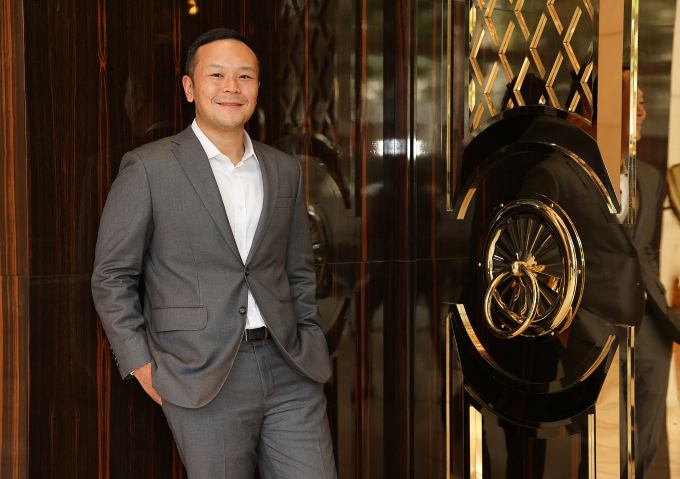 |
Edward Tirtanata, co-founder and CEO of Kopi Kenangan, Jan. 26, 2026. Photo by SPH Media via AFP |
Tirtanata is a “responsible leader who takes care of his people, takes care of his customers, and is a very good custodian of capital,” according to Rohit Agarwal, managing director of Peak XV Partners, an India-based venture capital firm that has invested a total of $25 million in the chain.
Agarwal recalls his first meeting with Tirtanata at a Jakarta hotel as being somewhat unconventional.
“Ed showed up with four cups of coffee and it was a very atypical meeting, where, instead of starting with a slide deck, a founder comes with a cup of coffee. And he’s like, leave everything else aside, let’s just start with this coffee,” he once shared with Forbes Asia.
Over the last five years, Tirtanata has explored several ideas to expand Kopi Kenangan’s customer base. One initiative that has gained traction is its ready-to-drink line, Kopi Kenangan Hanya Untukmu, which has been sold in convenience stores across smaller towns and rural areas since 2022.
However, three other experiments have been less successful, including the more premium concepts Kenangan Heritage and Kenangan Signature, as well as the low-priced mass-market chain Satu Kenangan. As a result, he had to pause their expansion.
“As a founder, you have to be willing to make tough calls based on where your resources are best utilized,” he says.
While Kopi Kenangan has become the sixth largest coffee chain in Southeast Asia by store count, per a recent report by Momentum Works, Tirtanata has set his sights higher, aiming to triple its global footprint to 4,000 outlets by 2030.
“It is the time for us to run again, to become the number one coffee chain in Southeast Asia,” he declares.

Comments are closed.