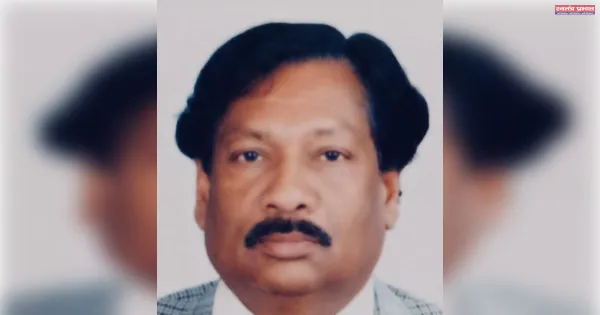
Pro. (Dr.) Manmohan Prakash
It is important for every Indian to understand that the Tricolor is not just a national flag made of three colours, but a living symbol of India's independence, sovereignty, integrity, democratic consciousness and national identity. Behind each of its colors and each symbol lies a deep national philosophy. It reflects the sacrifices of innumerable known and unknown fighters of the freedom struggle, the democratic aspirations of the constitution makers and the dream of a just, equitable and prosperous India.
That is why respect for the tricolor should not be limited to just holding it in the hand, hoisting it at home, bowing the head before it or giving salute on national festivals. There will be real respect for the flag when reverence for it is visible in our conduct and the ideals contained in it become a part of our thoughts, behavior and daily life. 'Every home tricolor' will be meaningful only when 'every heart tricolor' is also established along with it.
The three colors of the Indian national flag carry within themselves a broad message. The saffron color at the top inspires courage, sacrifice and selfless service. It reminds that nation building is not done only by the demand of rights, but by the discharge of duties, discipline and sacrifice of personal interest when necessary. In the history of the freedom movement, countless people had given top priority to the nation by sacrificing personal comforts. Even today the same spirit is needed for nation building.
The white color of the flag gives the message of truth, peace and transparency. In a democratic society, integrity, tolerance, dialogue and peaceful co-existence are not mere ideals but essential conditions of social stability. When truth and transparency in public life weaken and disagreement is considered hostility, then democratic values are harmed. Therefore, white color inspires us to adopt the path of restraint and truth in both thought and behavior.
Green color is considered a symbol of life, growth, prosperity and balance with nature. Its message is especially important for an agricultural and biodiversity-rich country like India. Economic development is necessary, but development that indiscriminately exploits natural resources and ignores the interests of future generations cannot be real progress. Therefore, the message of green color makes us aware of the responsibility of environmental protection and sustainable development along with development.
The blue colored Ashoka Chakra situated in the middle of the tricolor further deepens its philosophical soul. Ashoka Chakra commemorates the Dharmachakra associated with religion, justice and moral order in the Indian tradition. Its 24 saws inspire continuous movement and action. Its broad message is that continuous progress, not stagnation, is necessary in life, society and nation. Freedom does not mean inaction, but responsible action; Duties are associated with rights and responsibilities are associated with freedom.
Today India is registering its strong presence among the rapidly emerging economies of the world. India has made remarkable achievements in many areas such as space science, digital technology, biotechnology, manufacturing, startups, defense production and innovation. From Chandrayaan missions to digital public infrastructure and from indigenous technological capability to growing entrepreneurship globally, India's potential has expanded. But the real power of a nation is not determined only by its gross domestic product, military strength or technological achievements. Its enduring strength lies in the character of its citizens, social harmony, respect for institutions, adherence to law and morality of public life.
This is the origin of the concept of 'Har Hriday Tiranga'. This means that the tricolor should be visible in our hands as well as in our thoughts and actions. Patriotism is not just about displaying patriotism on big occasions. It is a continuous process of performing one's daily responsibilities with honesty, integrity and efficiency. A teacher's honest teaching, a student's discipline and hard work, a doctor's adherence to professional ethics, a businessman's honest behavior, an employee's dedication towards his responsibilities, a farmer's hard work and a scientist's dedication towards creating new knowledge etc. are all forms of nation building.
Patriotism cannot be limited to posting pictures of the tricolor on social media, raising patriotic slogans or singing patriotic songs and distributing sweets on national festivals. Real patriotism is manifested in our small civic actions. Following traffic rules, protecting public property, maintaining cleanliness, judicious use of water and energy, paying taxes honestly, respecting women and deprived sections and practicing the values of justice, liberty, equality and fraternity enshrined in the Constitution are all part of our responsibilities towards the nation.
India's identity lies not in its uniformity, but in its unique ability to unite in diversity. Various languages, cultures, traditions, ways of life and ideologies enrich the social structure of India. Therefore, establishing the Tricolor in the heart does not mean creating hatred towards any religion, caste, language, region or political ideology. On the contrary, it means that despite our differences, we should accept our shared identity of being 'Indian' as the supreme civic bond and respect the dignity of every citizen.
It is not only the soldiers deployed at the border who protect the nation. While the soldier protects the external borders, the citizen, by his conduct, strengthens the internal strength, social stability and global prestige of the nation. As important as the courage of the soldier on the border is the hard work of the farmer in the field, the research of the scientist in the laboratory, the labor of the worker in the factory, the knowledge of the teacher in the classroom, the innovation of the entrepreneur and the honesty of the citizen in public life. Nation building is actually the result of the collective action of crores of citizens.
Therefore, when we hoist the tricolor at our home this year, stop for a moment and ask ourselves – is our respect for the tricolor limited only to the flag, or are its ideals visible in our lives too? Are the courage and sacrifice of saffron color alive within us, the integrity and peace of white color, the growth of green color and sensitivity towards nature and the constant action of Ashoka Chakra? Do we take our duties as seriously as our rights? If the answer to these questions is positive, then only the campaign of 'Har Ghar Tiranga' will be able to achieve its broader national objective and give rise to the feeling of 'Har Hriday Triranga'.
The tricolor should be visible not only on the roofs of our houses but also in our character. It should not only be in our hands, but in our thoughts; It should be present in our daily conduct, not just on national festivals. When the colors of the national flag become the colors of our behavior and the movement of the Ashoka Chakra becomes the inspiration for our actions, then only our reverence for the tricolor will be transformed into real patriotism.
'Har Ghar Tiranga' is a celebration of national pride, but 'Har Hriday Tiranga' is a pledge to bring that pride into life. This is true patriotism, this is true national service and this is our biggest civic responsibility towards independent India.