
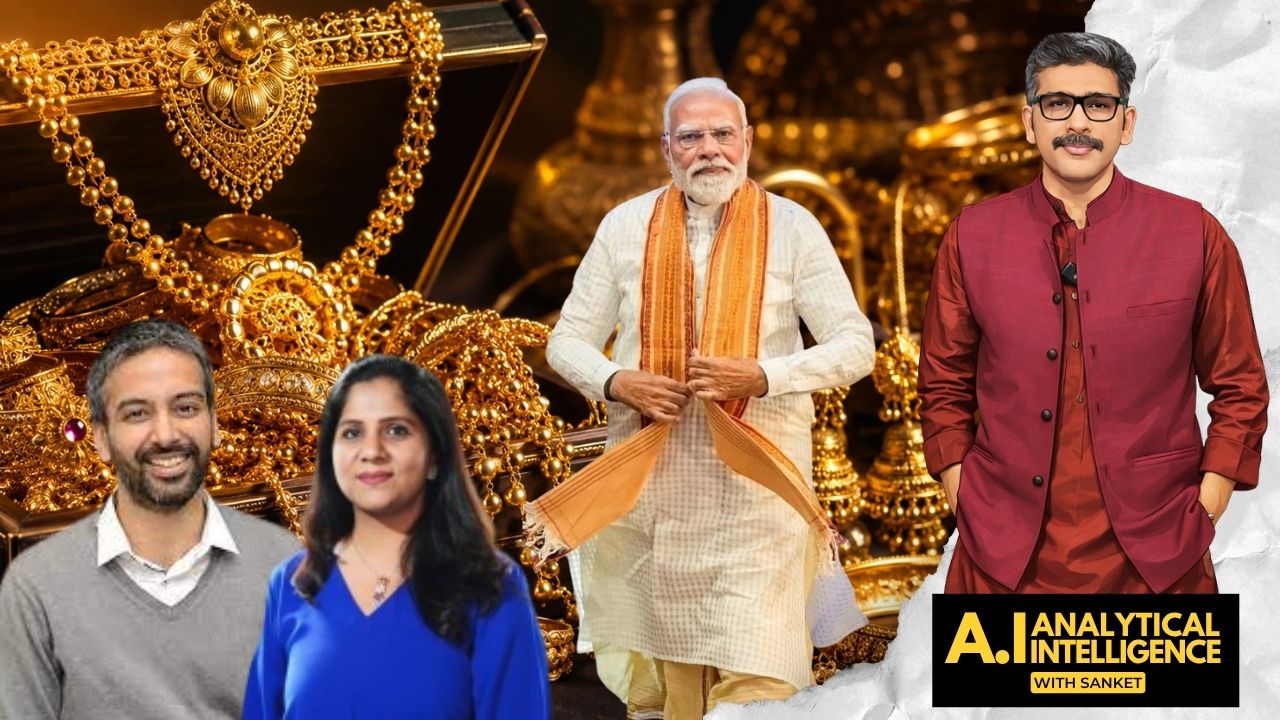

“Most economists would say that role is better played by prices rather than political appeals,” said Rahul Ahluwalia, Founder-Director of the Foundation for Economic Development, as the debate intensified over Prime Minister Narendra Modi’s appeal asking Indians to cut down on buying gold.
The remarks come amid concerns that the prime minister’s call to reduce discretionary imports could affect India’s jewellery sector, which is already facing slowing consumption and growing uncertainty. On AI with Sanket, The Federal spoke to Ahluwalia and Divya Kotawala, Director at the House of Kotawala, about the economic, cultural and emotional implications of the appeal.
Ahluwalia argued that governments should allow market prices to shape consumer behaviour instead of relying on political messaging. According to him, prices naturally determine whether consumers continue buying a commodity or move away from it.
Also read | Why PM Modi urged Indians to avoid buying gold; experts decode
He said the prime minister was attempting to influence behaviour in a way traditionally handled by market forces. “When something is priced higher than what it is worth to people, they don’t buy it. When prices are lower than what it is worth to them, they buy it,” he said.
Gold dilemma
Ahluwalia noted that if people genuinely reduced gold purchases, it could improve India’s current account deficit. However, he warned that such a move could also damage sectors dependent on gold imports.
He pointed out that nearly 30 per cent of India’s gold imports feed the jewellery export market. Any reduction in gold purchases, he said, could therefore affect jewellery exports as well.
The economist also stressed that gold has historically been one of the world’s best-performing asset classes. “The overall wealth held in India has increased substantially because of gold prices going up the way they have,” he said.
He added that many Indian households do not view gold jewellery merely as consumption but also as a long-term store of wealth. According to him, this dual role explains why gold continues to retain cultural and financial significance.
Investment shift
The discussion also focused on changing patterns in gold consumption. It was pointed out that jewellery consumption in India has already declined over the past year, while investments in gold instruments such as coins, bars and exchange-traded products have increased.
Responding to this, Ahluwalia said rising geopolitical uncertainty had pushed people towards gold as a safer investment option. “There is no real safe haven left for people,” he said, adding that consumers were prioritising wealth preservation over visible consumption. He explained that investment-oriented gold products were becoming more attractive because they offered greater liquidity than jewellery.
At the same time, he acknowledged that the prime minister’s appeal could worsen existing difficulties faced by jewellers, though he described the trend as part of a broader global structural shift.
Cultural bond
Kotawala said the jewellery industry had already been dealing with repeated uncertainties over the past few years, including debates around lab-grown diamonds and GST-related concerns.
Despite these challenges, she insisted that India’s emotional and cultural attachment to gold remained strong. “Weddings don’t stop, celebrations don’t stop, and most importantly that whole feeling, the Indian mentality of investing in jewellery in gold continues,” she said.
Also read | India’s gold demand rises 10 pc as investment buying surges
She argued that gold buying may slow temporarily but would not disappear because many Indian families still see jewellery as the safest form of savings and investment. She also supported the government’s broader concerns about economic uncertainty but maintained that consumer sentiment around gold was too deeply rooted to change quickly.
Tax fears
The conversation later turned to fears that the government could eventually impose heavier taxes on gold imports or jewellery purchases.
Ahluwalia warned against such a move, saying gold was already priced according to market conditions and should not be singled out for punitive treatment.
Instead, he argued that oil prices were being artificially suppressed despite global supply disruptions. According to him, fuel prices and the rupee’s value should be allowed to adjust naturally to reflect economic realities.
“We have not allowed prices to reflect the on-ground situation,” he said, referring to fuel pricing and exchange-rate management.
Ahluwalia suggested that if prices were allowed to move freely, consumers would automatically reduce unnecessary imports without the need for political appeals.
Middle-class impact
Kotawala cautioned that any aggressive taxation on gold would disproportionately hurt lower and middle-income households rather than the wealthy.
“The rich will continue to buy, they will find a way out of it,” she said. “But what about the lowest strata of society? They are the ones who will suffer.” She pointed out that many families accumulate gold over years for children’s education, weddings and future financial security.
According to Kotawala, restricting access to gold could therefore undermine a traditional savings mechanism relied upon by ordinary Indians.
The panel also discussed the regional dimension of India’s gold demand. It was highlighted that nearly 40 per cent of India’s gold consumption comes from the five southern states, with Tamil Nadu accounting for the largest share at 28 per cent.
Recycling push
Towards the end of the discussion, Kotawala welcomed proposals from jewellery companies such as Tanishq encouraging consumers to recycle and exchange old jewellery instead of buying newly imported gold.
Also read | Gold, silver soar as West Asia conflict deepens after US-Israel strikes on Iran
She said such measures could help maintain employment within the jewellery ecosystem while reducing pressure on imports. “The rotation should not stop,” she said, stressing the importance of protecting artisans, craftsmen and workers dependent on the sector.
Kotawala described gold exchange and recycling programmes as a practical compromise that could support both government objectives and industry survival during a difficult economic phase.
Ahluwalia, meanwhile, reiterated that long-term solutions should focus on transparent pricing mechanisms rather than behavioural directives.
The content above has been transcribed from video using a fine-tuned AI model. To ensure accuracy, quality, and editorial integrity, we employ a Human-In-The-Loop (HITL) process. While AI assists in creating the initial draft, our experienced editorial team carefully reviews, edits, and refines the content before publication. At The Federal, we combine the efficiency of AI with the expertise of human editors to deliver reliable and insightful journalism.

Comments are closed.