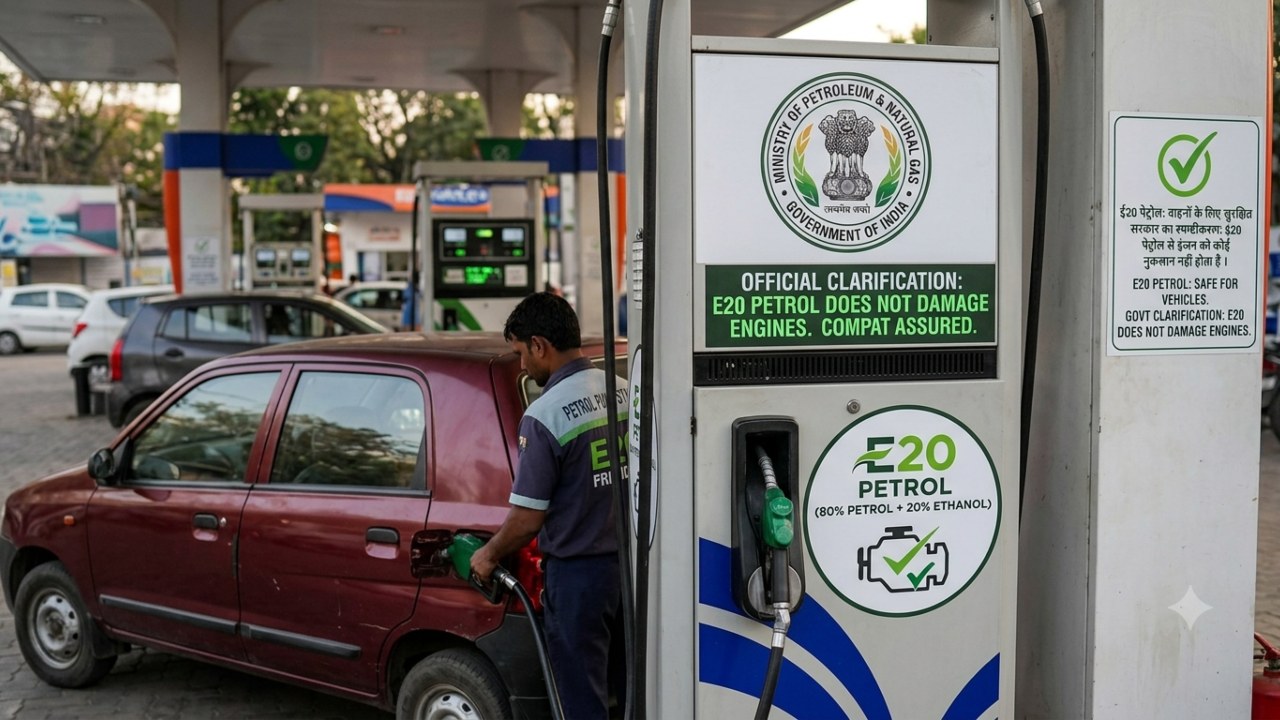
Ethanol Blending Policy Government Reply: It has been observed across the country that there has been a long-standing debate regarding E20 petrol. Many vehicle owners have this question in their mind: does petrol containing 20% ethanol harm the engine? Regarding which, the Central Government has now clarified its position on this issue in the Rajya Sabha. Regarding this matter, the government says that crores of vehicles in the country are using E20 petrol, but till now there is no evidence of engine damage or vehicle breakdown.
Minister of State for Petroleum and Natural Gas Suresh Gopi told the Rajya Sabha on Monday that more than 230 million vehicles in India use E20 petrol. This includes over 200 million two-wheelers and over 30 million petrol cars. Notably, a large number of these are older vehicles that have not been officially certified for E20.
E20 petrol implemented only after scientific testing
The government clarified that the E20 petrol implementation wasn’t a surprise. It began in 2013-14 with a mere 1.53% ethanol blending. After years of scientific testing, expert input, and a phased process, this was increased to 20% in 2025-26. Furthermore, according to the government, lab tests, road trials, and long-term driving were conducted at every stage. NITI Aayog, ARAI, SIAM, the Indian Institute of Petroleum (IIP), oil companies, and vehicle manufacturers participated in this entire process. During the testing, various aspects such as engine strength, fuel system performance, corrosion susceptibility, mileage, pollution, and vehicle performance were examined.
Does the E20 reduce mileage? The government has responded.
In response, the government cited service data from auto companies. A major car manufacturer serviced 28.4 million vehicles in the 2025-26 fiscal year, including approximately 15 million older vehicles. The company stated that no vehicle was damaged by E20 petrol. A major two-wheeler manufacturer also stated that no additional defects were observed in vehicles using E20.
However, the government has acknowledged that some older vehicles built for E10 petrol may experience a 3% to 5% reduction in fuel mileage. However, E20’s higher octane level reduces engine knocking, helps the fuel burn more cleanly, and maintains a smoother engine operation.
There are no plans to bring back the E30 at the moment.
For the foreseeable future, the government has clarified that no decision has been made to implement ethanol blending beyond E20. If E30 or higher blending is considered in the future, it will be preceded by scientific studies, technical testing, and extensive discussions with all stakeholders, including automobile companies. Furthermore, there are no plans to provide petrol without ethanol or with less ethanol at petrol pumps. The government states that its objective is to promote environmentally friendly and clean fuel.