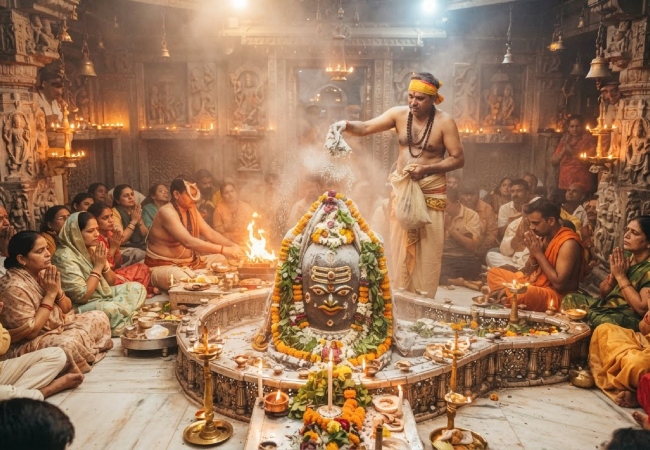
Ujjain. The “Bhasma Aarti” (Bhasma Aarti), performed during the Brahmamuhurta (the dark hour) at the shrine of Baba Mahakaleshwar, the most prominent of the twelve Jyotirlingas, is renowned worldwide. Devotees from across the country and abroad flock to Ujjain to witness this divine aarti. But do you know why ash is offered to Lord Shiva? Let’s explore the deep secrets behind it.
The ultimate truth of life is ashes
According to the Shiva Mahapuran, ashes are considered Lord Shiva’s primary form and ornament. Sanatan Dharma states that ashes symbolize the mortality of creation. Mahakaal is known as the Lord of Death, meaning “the time of all times.” By applying ashes to his body, Lord Shiva conveys to his devotees that this material world, wealth, prosperity, and the human body are all temporary, for ultimately, everything will dissolve into ashes.
The journey from pyre ashes to cow dung cakes
According to mythological beliefs, Lord Shiva is considered a resident of the cremation ground and an ascetic. In ancient times, Mahakal was adorned with the ashes of a newly burnt pyre in the cremation ground. However, this tradition has changed over time. Nowadays, pyre ashes are no longer used for Bhasma Aarti. Currently, this special sacred ash is prepared by burning cow dung cakes or cow dung cakes and sacred woods like Peepal, Shami, Palash, Banyan and Amaltas. Many medicinal herbs are also added to it.
Special importance of Dakshinmukhi Jyotirlinga
The most significant feature of the Mahakaleshwar Temple in Ujjain is that it is the only Jyotirlinga that faces south. In Hindu scriptures, it is considered the deity of Yamaraja, the god of death, who is the lord of the south. Facing south signifies Mahakal’s position as the ruler of time and the supreme center of Tantra practice. For this reason, the special practice of Bhasma Aarti, which controls time, has been prevalent here for centuries.
Aarti is performed amidst strict rules
It should be noted that the Bhasma Aarti at the Mahakal Temple begins every morning at 4:00 am during the Brahmamuhurta (divine time). The rules associated with this Aarti are very strict. During the Aarti, when ashes are offered to the deity in the sanctum sanctorum, women are ordered to cover their faces or close their eyes for a short time. It is believed that at that moment, Lord Shiva is in a formless and extremely fierce form. Furthermore, the priests performing the puja are permitted to enter the sanctum sanctorum wearing only a cotton dhoti.