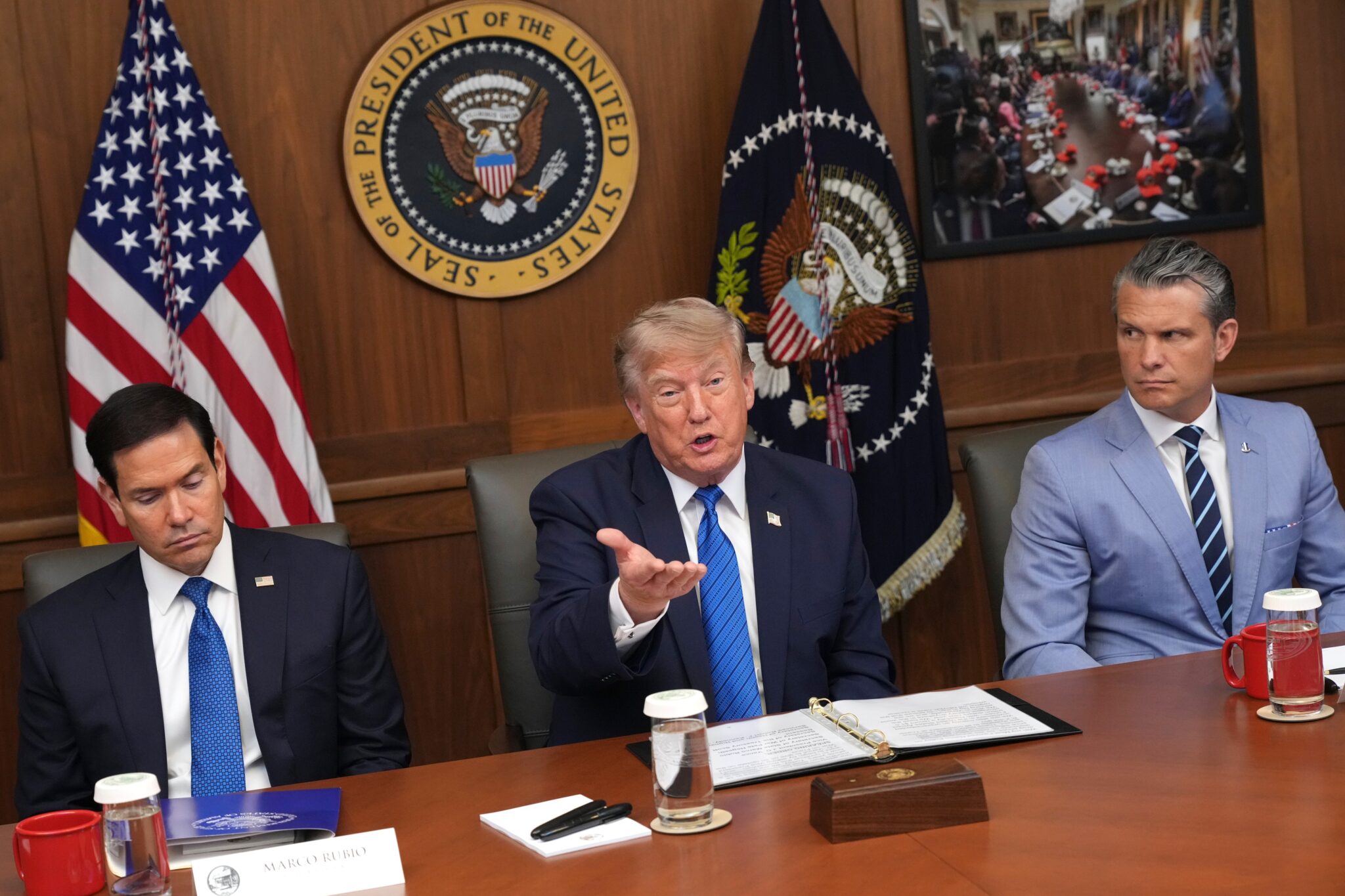
Gulf Allies and Midterm Pressures Complicate Trump’s Threats Against Iran/ TezzBuzz/ WASHINGTON/ J. Mansour/ President Donald Trump has repeatedly threatened devastating attacks against Iran before delaying military action and allowing more time for diplomacy. The strategy seeks to pressure Tehran through uncertainty, but Iran appears to be betting it can endure the war longer than Washington. Gulf allies, U.S. weapons constraints, rising energy prices and the conflict’s unpopularity are complicating Trump’s decisions ahead of the midterms.
Quick Look
- Trump threatened major strikes Friday before calling them off Saturday.
- He said he was “losing faith” in negotiations with Iran.
- The White House warned that Iran would continue to pay until it negotiated meaningfully.
- Trump credited Gulf allies with urging him to allow diplomacy more time.
- Saudi Crown Prince Mohammed bin Salman played a major role in the latest decision.
- Qatar and the United Arab Emirates also reportedly requested restraint.
- Iran said Monday that it was not currently negotiating with Washington.
- Trump accused Iran’s leadership of being “unbelievably duplicitous.”
- Trump made similar threats before backing away in April, May and June.
- A major seizure of Iranian energy assets could require U.S. ground forces.
- U.S. military stockpiles have declined during the five-month war.
- About two-thirds of American adults say the conflict has not been worthwhile.
- Approximately 37% of Republicans also say the war was not worthwhile.
- Sen. John Kennedy warned that escalation could produce additional inflation.
- Kennedy recommended maintaining the current approach for now.

Deep Look
Trump repeats familiar Iran escalation pattern
WASHINGTON — President Donald Trump’s latest reversal on Iran follows a pattern that has appeared repeatedly during the five-month war.
The president issues an ultimatum, warns of devastating U.S. military action and suggests that Iran has only a short period to accept American terms.
He then steps back shortly before the threatened attack, often saying new diplomatic progress or appeals from Gulf allies justify giving negotiations more time.
Trump has used a similar pressure strategy throughout his business and political career.
Its effectiveness against Iran remains uncertain as Tehran appears to believe it can absorb more strategic pain and wait longer than Washington.
Threats target power plants and oil industry
Trump has warned that American forces could “obliterate” Iranian power plants or seize strategic parts of the country’s oil industry.
Such actions would represent a major escalation beyond attacks against military facilities.
Strikes on energy infrastructure could damage Iran’s economy, disrupt civilian life and provoke retaliation against U.S. allies or global shipping routes.
Trump presents the threats as leverage intended to force Iran to accept American terms for ending the war.
Critics argue that repeatedly issuing and withdrawing ultimatums could reduce their credibility.
Iran bets it can outlast Trump
The U.S. military has inflicted extensive damage on Iran’s leadership, air force and navy.
Iran, however, appears to be calculating that it can withstand the pressure longer than the United States is willing to continue the war.
Tehran is aware that American stockpiles of important munitions have declined during months of fighting.
Iranian leaders also recognize the political difficulty Trump faces in sustaining an unpopular conflict before November’s midterm elections.
The result is a test of endurance in which each side believes the other may face stronger pressure to compromise first.
Trump says he is “losing faith”
The latest escalation cycle began Friday during a Cabinet meeting.
Trump said he was “losing faith” in negotiations with Tehran and warned that the U.S. military “ will be hitting them very hard.”
His remarks fueled expectations that another large American attack was imminent.
The White House did not immediately identify the potential targets, but officials had been considering strikes against Iranian energy facilities, bridges and power plants.
Those options could have expanded the war’s economic and civilian consequences.
White House intensifies warning
White House press secretary Karoline Leavitt increased expectations of military action later Friday.
She declared that “Iran will continue to pay until they come to the table in, what President Trump deems, a meaningful way.”
The statement suggested that the administration had concluded diplomacy was failing and intended to use greater military force.
U.S. officials and regional governments prepared for possible retaliation.
By Saturday night, however, Trump announced that he was postponing the attacks.
Trump cites progress and cancels strikes
Trump said Middle Eastern allies had outlined the parameters of a possible agreement.
He announced that he would suspend new strikes while negotiators attempted to complete the deal.
The potential agreement would reopen the Strait of Hormuz and address Iran’s nuclear program, according to Trump.
The president did not release detailed terms or provide evidence that Iran had accepted the framework.
Iran’s lack of immediate public confirmation raised questions about how much progress had actually occurred.
Gulf allies ask Trump for more time
Trump said requests from Gulf governments and unnamed Iranian officials influenced his decision.
Saudi Arabia, Qatar and the United Arab Emirates urged him to give diplomacy another opportunity.
“It would have been disastrous for them. And they didn’t want us to do it,” Trump said of Iran while returning to Washington from his New Jersey golf club. “And frankly, Saudi Arabia didn’t want it either. They thought that a deal is imminent.”
The Gulf countries fear that another U.S. bombardment could trigger Iranian retaliation against their cities, military installations and energy infrastructure.
Iran denies current negotiations
The diplomatic optimism lasted only briefly.
Iran’s Foreign Ministry said Monday that Tehran was not currently engaged in negotiations with the United States.
Trump responded by questioning Iran’s honesty.
“Iranian Leadership is unbelievably duplicitous!” Trump wrote on Truth Social.
The exchange renewed doubts about whether a deal was approaching or whether the weekend pause merely postponed another round of fighting.
Critics call Trump’s approach erratic
Trump could still decide that a substantial escalation is necessary.
Critics say his hesitation might also reflect an acknowledgment that military force alone cannot compel Iran to surrender or bring the war to a clear conclusion.
Democratic Sen. Mark Kelly of Arizona, a member of the Senate Armed Services Committee, described the president’s approach as inconsistent.
“I think what we’re seeing here is a president who has an approach that’s just rather erratic,” Kelly said on CBS News’ “Face the Nation.” “At this point, he’s trying to get us back to February. And I think if he could — if he had a big reset button he could hit — he would certainly take that option.”
Kelly suggested that Trump would prefer to return to conditions before the war began if that were possible.
War lasts longer than Trump predicted
Trump initially presented the conflict as a relatively short military campaign.
It has instead continued for five months, cycling through heavy fighting, temporary ceasefires and unsuccessful negotiations.
The extended war has disrupted global energy markets, increased costs and killed American service members.
It has also created strategic questions about the administration’s end goal and what conditions would qualify as victory.
Trump’s shifting objectives have ranged from eliminating Iran’s nuclear and missile capabilities to controlling energy assets and ending support for regional armed groups.
April ultimatum ended with ceasefire
The latest reversal is not the first time Trump has threatened a major attack before announcing diplomatic progress.
In early April, the United States and Iran agreed to a two-week ceasefire.
The announcement came less than two hours before a deadline Trump had set for Iran to capitulate.
He had threatened attacks on bridges and power plants, warning that “a whole civilization will die.”
The temporary ceasefire delayed the threatened strikes but did not produce a lasting end to the war.
May strike postponed for negotiations
Trump repeated the pattern in May.
After several days of severe warnings, he announced May 18 that the United States would postpone a planned military operation because “serious negotiations” were taking place.
He credited Gulf allies with persuading him to show restraint.
The announcement reduced immediate concerns about wider war, but negotiations again failed to deliver a permanent agreement.
Fighting later resumed as the two sides accused each other of violating previous understandings.
June threat targeted Kharg Island
In June, Trump warned that the United States could attack Iran “VERY HARD.”
He also threatened to seize Iran’s energy base on Kharg Island and “assume total control of their Oil and Gas Markets,” according to his social media post.
Trump later canceled the attack, claiming negotiations with senior Iranian leaders had made progress.
A military seizure of Kharg Island or other Iranian energy assets would likely require American ground forces.
The president did not publicly address that implication.
Ground operation would create political risk
Deploying U.S. troops inside Iran would represent a major expansion of the war.
It would also conflict with Trump’s previous promises to avoid prolonged foreign entanglements.
He has frequently criticized earlier administrations for committing American forces to costly wars without clear exit strategies.
A ground operation could produce significant casualties and require a long-term military presence to hold territory or protect energy infrastructure.
Those risks make threats to seize Iranian assets difficult to implement without substantial political and military consequences.
Saudi crown prince influenced latest decision
Saudi Crown Prince Mohammed bin Salman played an important role in Trump’s latest decision to pause military action.
Trump spoke with the crown prince Saturday before announcing that the planned strikes would not proceed.
The president later said the operation would have been one of the largest American military actions since World War II.
According to a person briefed on the call, Mohammed bin Salman warned that escalation could severely damage the global economy.
The person requested anonymity because the conversation was private.
Gulf energy infrastructure remains vulnerable
Saudi officials believe the kingdom can defend itself against additional Iranian attacks.
Qatar and the United Arab Emirates also possess substantial defensive capabilities.
Kuwait may be more vulnerable to attacks launched by Iran-backed militias operating in Iraq, according to the person familiar with Saudi discussions.
Iranian retaliation against Gulf energy infrastructure could reduce oil exports and drive global prices sharply higher.
That economic risk gives Saudi Arabia and neighboring countries a strong incentive to prevent another major U.S. escalation.
Midterm elections increase pressure
Trump says the November midterm elections are not influencing his decisions about Iran.
The conflict’s political consequences are nevertheless a major concern for congressional Republicans.
Higher oil and gasoline prices have added to inflation and public dissatisfaction with the economy.
A wider war could produce additional casualties, energy disruptions and voter anger.
Republicans defending control of Congress must decide whether to support greater military action or call for a more restrained approach.
Poll shows war is deeply unpopular
Approximately two-thirds of American adults say the Iran war has not been worthwhile, according to an AP-NORC Center for Public Affairs Research poll released last week.
The opposition includes large majorities of Democrats and political independents.
About 37% of Republicans also said the conflict was not worth fighting.
The findings demonstrate that dissatisfaction extends beyond Trump’s political opponents.
The war’s unpopularity could make additional escalation particularly risky before November.
Kennedy recommends maintaining status quo
Republican Sen. John Kennedy of Louisiana, one of Trump’s prominent allies in Congress, urged the administration to moderate its approach.
Appearing Sunday on NBC’s “Meet the Press,” Kennedy argued that Washington’s debate had overlooked the extent of the damage already inflicted on Iran.
He nevertheless acknowledged that further escalation could push energy prices even higher and create “a lot of inflation for the American people.”
Kennedy suggested that the United States should emphasize sanctions and continue targeting Iran’s nuclear program instead of dramatically expanding the war.
“They’re all hellish choices,” Kennedy said. “But for the moment I’d maintain the status quo.”
Trump’s pressure strategy faces credibility test
Trump’s approach depends on convincing Iran that his threats are credible even when he repeatedly delays carrying them out.
The uncertainty can encourage negotiations by making Tehran fear an unpredictable military response.
It can also have the opposite effect if Iranian leaders conclude that domestic political constraints and Gulf pressure will repeatedly prevent Trump from following through.
Iran appears to be testing that possibility by refusing to accept U.S. terms despite extensive military losses.
The next phase will show whether Trump’s combination of threats and restraint can produce an agreement or merely continue the cycle of escalation, retreat and renewed fighting.
More on US News