His office building offers more than 30 free parking spaces in its basement, but they are usually occupied early in the morning. Some colleagues arrive an hour ahead of schedule to secure a spot.
Ha, however, must take his child to school before heading to work, leaving him with little choice but to use paid parking facilities charging VND50,000 per hour or VND400,000 per day.
Ha and his wife make VND50 million a month in total, of which VND35 million goes toward living expenses, their child’s tuition, and fuel. If he bought a monthly day pass near his office building for VND4.8 million, paid VND2.5 million for overnight parking at home and occasionally casual parking fees, he might have to cough up VND8 million.
“This amount eats into our VND15-million emergency fund reserved for medical care and supporting our parents,” he says. “I am shocked that it would cost nearly VND100 million a year just to park my car.”
He has been commuting by motorbike for the past two weeks, booking taxis on ride-hailing apps only when he needs to meet partners across town. On weekends, his family visits shopping centers with free parking.
|
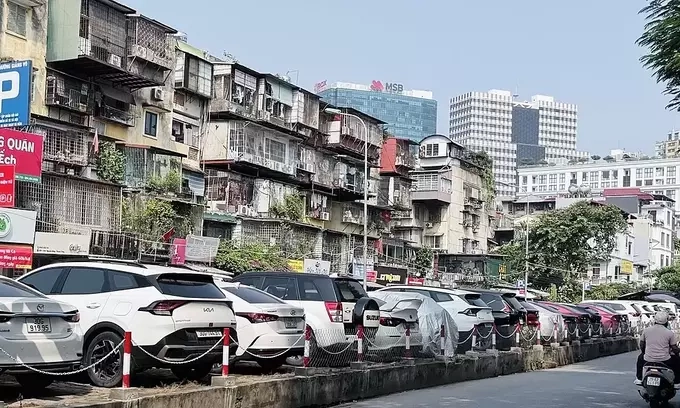
A parking lot on Nguyen Hong Street, Giang Vo Ward, starts charging higher parking fees on Oct. 15, 2026, yet has only two or three vacant spots as of Oct. 28, 2026. Photo by Quynh Nguyen |
Minh Phuc, 35, faces the same issue. Although he lives on Hang Ga Street, Hoan Kiem Ward, he chooses to park his car near his parents’ home in Hoang Liet Ward—nearly 10 kilometer away—to pay a parking rate of VND1.1 million per month.
This is because the outdoor parking lot on Phung Hung Street where he used to park has raised its monthly fee from VND3 million to 5 million.
With his wife currently on maternity leave, Phuc is the sole breadwinner, earning around VND35 million a month from his freelance work. After paying VND20 million for living expenses and VND10 million for car loan installments, he has only VND5 million left for fuel, parking and maintenance.
Since the new parking fee alone equals that leftover amount, he and his wife have gradually given up using their car and put up with nearly an hour on a motorbike whenever they need to travel long distances.
Meanwhile, Nguyen Hai, 35, of Giang Vo Ward, has decided to put the car he has had for eight years up for sale. His familiar parking spot on Nguyen Hong Street just announced that it would double its monthly rate, from VND2 million to 4 million VND from November.
“I cannot afford VND48 million a year for a fixed parking spot, not to mention extra parking fees every time I go downtown,” Hai says, adding that this expense is even higher than his basic social insurance contribution.
Believing that high prices in the core urban zone will soon push up parking rates in surrounding areas as well, he has chosen to sell his car to ease the financial burden.
New parking rates in temporarily utilized roadways and sidewalks were introduced by the People’s Committee of Hanoi from Oct. 15.
In the core urban area and Ring Road 1, hourly parking fees for cars with up to nine seats range from VND45,000 to 70,000.
Monthly passes have become 1.5 to nearly two times more expensive than before: VND3.8 million for daytime parking, VND3 million for nighttime parking, and VND5 million for all-day parking.
Monthly parking rates on 12 streets in the Level 1 conservation zone are even higher at VND4.8 million, VND3.5 million, and VND6 million.
Despite the sharp hike in the fees and people seeking ways to cut costs, the actual demand for parking in the city center still far exceeds supply.
A Hanoi residents’ community group with about 2,000 members sees up to a dozen posts a day from people seeking monthly parking spots in apartment basements or nearby residential areas for cheaper rates, but almost all of them are full.
A survey by Read at parking spots across Hoan Kiem, Cua Nam, Ba Dinh, Van Mieu – Quoc Tu Giam, and Giang Vo Wards showed that all of them were filled to capacity.
At parking spots along the To Lich River or in the Cau Giay Ward area (Ring Road 2), though monthly passes rose from VND1.8 million to 3 million, there are still dozens of people on the waiting list.
Nguyen Phong, an attendant at a parking lot on Phung Hung Street, Hang Bong Ward, says since the all-day parking fee increased to VND5 million and hourly rates went from VND25,000 to 45,000 per hour, some drivers who rarely use their vehicles have canceled their monthly passes to park in the outskirts. However, vacant spots are immediately filled, and the number of cars parked by the hour has not decreased.
According to the Hanoi Department of Construction, as of late 2025, the city had eight million motorbikes and nearly 1.5 million cars, and the number is rising by 4.5% a year.
While urban planning requires the space for static traffic (parking facilities) to be 3-4% the total area, the Hanoi figure is below 1%. The proportion of land allocated for traffic infrastructure is only over 12%, half the required regulatory standard.
 |
|
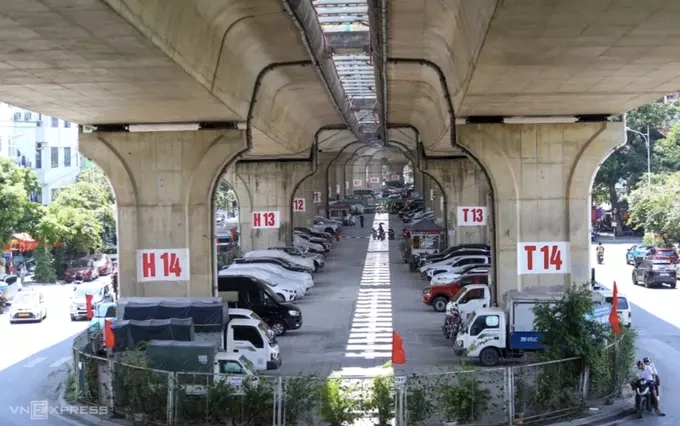
A parking lot under the access ramp to Vinh Tuy Bridge, part of Ring Road 2 in Vinh Hung Ward, in September 2025. Photo by Pham Chieu |
Nguyen Anh Dung, a financial advisor at investment consulting and asset management firm FIDT, says urban residents need to recognize expensive parking fees as a long-term trend linked to the plan to limit personal vehicles in inner urban areas rather than a temporary fluctuation.
He says the issue is not just the extra amount paid each month, but the long-term impact over many years.
“If parking fees remain high or continue to rise over the next 5 to 10 years, can you still have monthly savings? Can families save in time for their children’s education, prepare for retirement, care for elderly parents, or move to a new house?” Dung asks.
He explains that increased parking fees are only a part of the financial pressure on urban households. In reality, living costs in major cities rarely go down and will continue to rise in the future.
Meanwhile, the push to develop public transport and reduce reliance on personal vehicles will bring changes to policies for managing and pricing parking services.
Dung recommends that families comprehensively reassess their spending and savings ratios. For a household earning VND50 million per month, the minimum safe savings target is 20%, or VND10 million. All living expenses, child-rearing costs, debt repayments, and car maintenance costs should be covered by the remaining VND40 million.
“If the cost of maintaining a car eats into your monthly savings, depletes medical emergency funds, or jeopardizes long-term goals such as your children’s education and retirement, families should travel by public transportation and ride-hailing services, or consider selling the car.”