New Delhi: When the water of Bhotekoshi river moved towards the settlements below along with a glacier burst on the Nepal-Tibet border on the morning of 26 August 2026, no one had any idea that within a few hours the lives of more than 900 people would be swept away in this water. More than four and a half thousand people are still missing and the search operation is still going on. But this accident has rekindled an old, unspoken debate. The deepest wound in the mind of India is of 26 November 2008, when Taj Hotel, CSMT and Nariman House were stained with blood in the terrorist attack on Mumbai and 166 innocent lives were lost. After all, why are so many major tragedies being recorded in the world as soon as the page is turned on the 26th of the month?
That list of accidents that never forgets
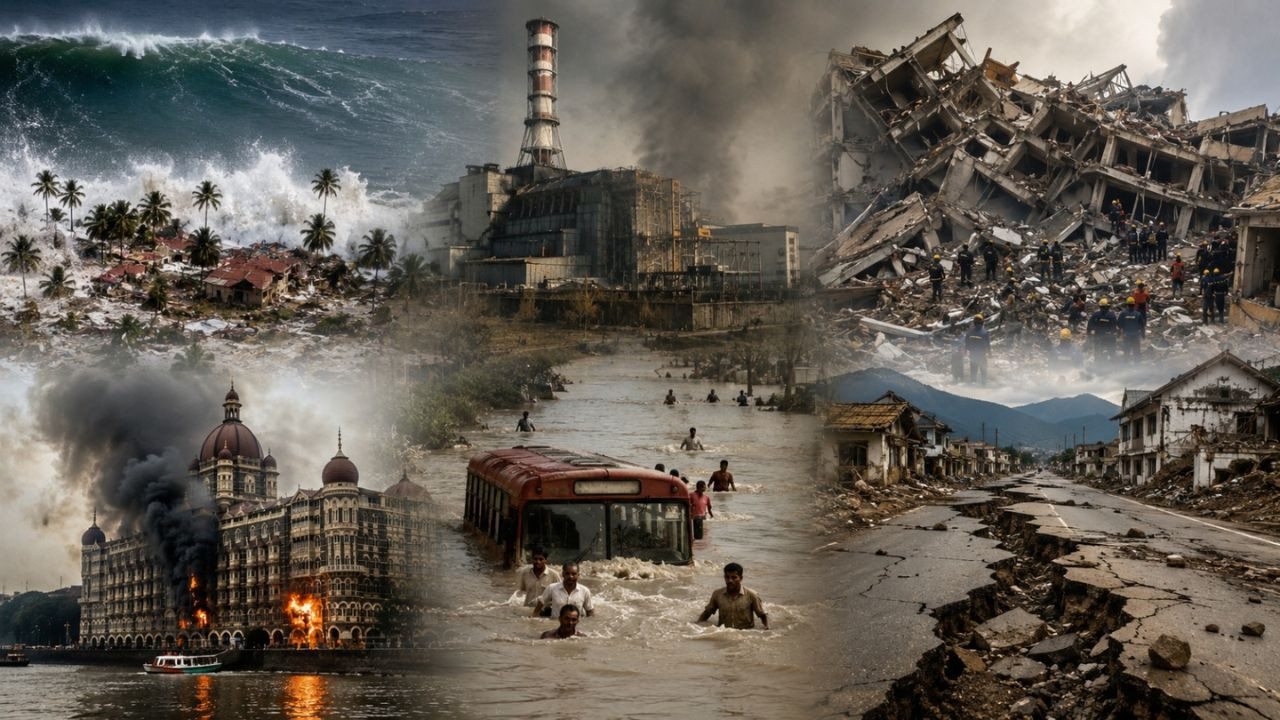
The explosion that occurred at the Chernobyl nuclear plant in Ukraine on April 26, 1986, is still considered the world's worst nuclear accident, whose radiation effects were felt for generations. On the same date, but in 1942, 1,549 workers were killed in a gas explosion at a coal mine in Benxihu, China.
This is considered to be the worst mine accident till date. Even the sky was not kind to this date. On May 26, 1991, a Lauda Air flight disintegrated in midair, killing all 223 passengers on board.
Creepy mystery of date 26
The deepest wound in the mind of India is of 26 November 2008, when Taj Hotel, CSMT and Nariman House were stained with blood in the terrorist attack on Mumbai and 166 innocent lives were lost. The 2003 earthquake in Bam city of Iran took the lives of thirty-one thousand people.
The earthquake that occurred on this date in Türkiye in 1939 took away more than thirty-two thousand lives. Earthquakes of Java and Hindukush are also recorded in this list. Science calls it a coincidence, astrology calls it a game of planets, but whenever 26 is seen written on the calendar, an unknown fear definitely raises its head in the minds of people.
hidden accounts in the movement of stars
Astrologer Pandit Narendra Upadhyay is not ready to accept it as a mere coincidence. He says that the planetary positions formed at that time and the eclipse period are more important than the date. According to him, a solar eclipse had occurred just seventeen days before the Gujarat earthquake, when the Sun, Mercury and Ketu were present together in Capricorn. There was a full moon on the night of the tsunami and the conjunction of Sun-Rahu-Ketu is considered inauspicious, whereas at the time of Mumbai floods, Sun and Saturn were present together in Cancer. Similarly, he also mentions the position of Mars-Saturn in the 2006 Java earthquake and the influence of Saturn-Ketu in the 1986 Chernobyl accident. In the language of numerology, the sum of 26 (2+6) becomes eight, and the number eight is associated with the just but harsh planet Saturn.
If we look at the history, it becomes difficult to call this a mere coincidence. On the morning of December 26, 2004, a magnitude 9.1 earthquake struck the bottom of the Indian Ocean, and the subsequent tsunami waves engulfed the coastal areas of fourteen countries from Sumatra to the Pacific Ocean. The death toll had crossed 2.25 lakh. Exactly three years before this, on January 26, 2001, when the whole of India was busy in the Republic Day parade, the earth shook with a magnitude of 7.7 in Kutch, Gujarat and about twenty thousand people were buried under the debris. Then came July 26, 2005, when the clouds over Mumbai burst so much that 944 mm of rain was recorded in just one day. The city came to a halt and 1,094 lives were lost.