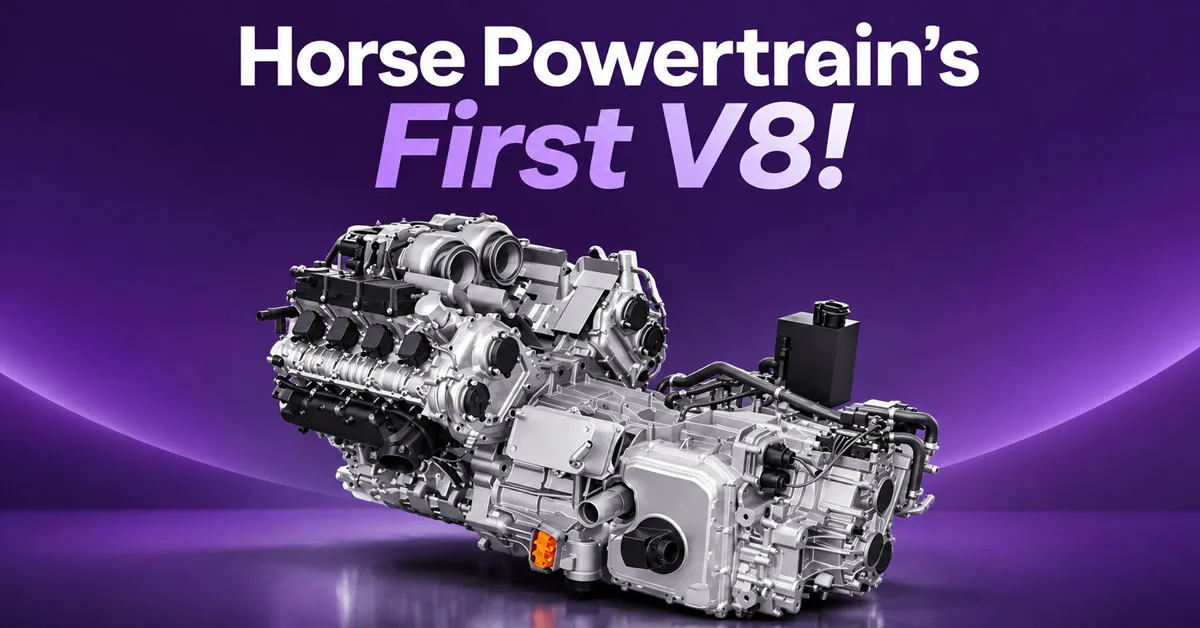
At a time when carmakers are talking almost exclusively about batteries and electric motors, Horse Powertrain has revealed a new 4.0-litre twin-turbocharged V8- the W40. And this is no ordinary old-school petrol engine. The W40 has been developed specifically to work with a hybrid transmission, and its first announced application is the upcoming Lotus Type 135 supercar.
Horse claims the engine can produce more than 500 kW, equivalent to over 680 PS, and up to 800 Nm of torque. Those are serious figures even before considering any assistance from an electric motor. The company has not, however, disclosed the combined output of the complete hybrid system. Quoting 680 PS as the Lotus’s final system output would therefore be premature.
The W40 is a 4.0-litre eight-cylinder unit with two turbochargers mounted in the space between the cylinder banks. This arrangement is often called a ‘hot-V’ layout. Placing the turbos close to the exhaust outlets shortens the path that exhaust gases must travel, helping the system respond quickly to accelerator inputs. Direct fuel injection and a compact intake arrangement form part of the package.
Horse says the engine weighs around 200 kg. That gives it an impressive power-to-weight figure for an engine of this size. More power from a compact package is useful in a sports car because engineers have to balance acceleration, cooling, handling and crash protection within a relatively small body. Horse also sees potential uses in performance pick-ups and off-road vehicles, although no such production applications have been announced.
The interesting part is that Horse is not selling the W40 as a conventional V8 that has an electric motor added later. The engine and hybrid gearbox have been designed to work together from the outset. That is increasingly important as high-performance brands try to retain the character of a combustion engine while meeting tighter efficiency and emissions expectations.
The engine will be paired with Horse’s new 8LDCT, an eight-speed wet dual-clutch transmission designed for hybrid applications. Horse says the gearbox can handle up to 1,050 Nm of input torque. That figure describes the gearbox’s design capacity; it is not the announced torque output of the Lotus or of the V8 engine itself.
The company quotes a clutch pre-fill time of under 50 milliseconds and a shift response of under 20 milliseconds. These laboratory or engineering figures suggest that fast shifts were a design priority, although real-world performance will depend on how Lotus calibrates the drivetrain. The transmission also uses silicon-carbide power electronics and a variable-displacement mechanical pump.
What Horse has not supplied is just as important as what it has announced. We do not yet know the electric motor’s output, the size of the hybrid battery, the vehicle’s electric-only capability, or certified fuel consumption and emissions. Without those details, it is impossible to judge how much efficiency the hybrid arrangement delivers in everyday use.
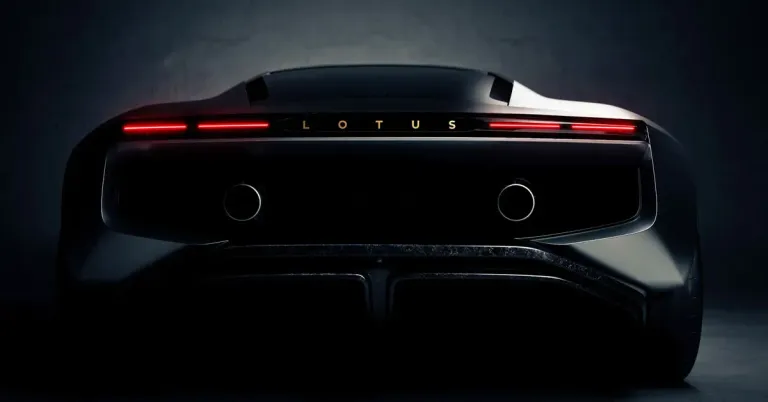
Lotus has confirmed that the W40 and 8LDCT will make their first combined production appearance in the Type 135. The company describes it as a mid-engined hybrid-V8 supercar positioned between the Emira and the fully electric Evija. That tells us where Lotus wants the car to sit in its range, but its final performance, price and launch schedule remain unconfirmed.
For Lotus, the powertrain offers a way to build a flagship focused on engine sound, throttle response and driver involvement, while bringing electrification into the equation. Whether it makes the car lighter, more usable or more economical than a purely petrol-powered rival will depend on the complete vehicle rather than the engine specification alone.