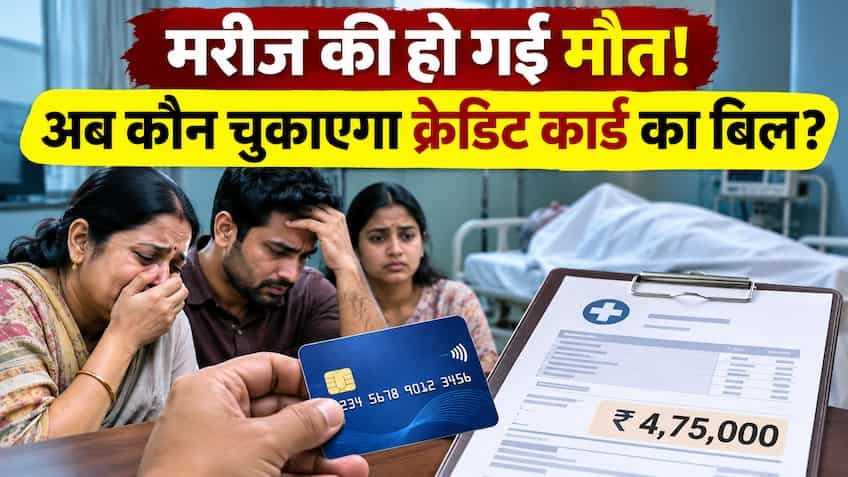
A sudden medical emergency can shake any family financially and mentally. Often people use their credit cards to arrange money immediately during treatment in hospitals. Hospital bills worth lakhs of rupees are swiped through credit cards, but unfortunately, despite all efforts, the patient's life is not saved. In such a tragic time, a big and scary question arises before the family that who will pay the huge hospital bill outstanding on the credit card of the deceased. Can the bank recover this money from the parents, wife or children of the deceased or does this loan get waived off? India's banking laws and clear guidelines from the Reserve Bank of India (RBI) paint a very clear picture on this sensitive issue. Credit card outstanding falls in the category of unsecured loan: According to experts in banking and financial laws, any expenditure or outstanding amount taken through credit card comes in the category of 'unsecured loan'. Unlike home loan or car loan, in this no property is mortgaged with the bank. When a person dies, his credit card dues are not directly transferred to his family members or legal heirs. This simply means that the bank cannot legally force the family members of the deceased to repay the outstanding bill from their own pocket or from their personal earnings. If the hospital bill was paid using the deceased's own credit card, the cardholder was personally responsible for the debt. Recovery can be done only from the estate of the deceased. However, this does not at all mean that the bank forgets its money. According to the law, the bank has the right to recover the outstanding amount only from the deceased's estate. If the deceased person has left behind any movable or immovable property like money deposited in a bank account, fixed deposit (FD), land, house, shares or gold, then the bank can claim to recover its outstanding bills from that property. In such a situation, the liability of the legal heirs is limited only to the extent of the value of the property they have inherited from the deceased. If there is no property in the name of the deceased, the bank is forced to 'write-off' the outstanding amount and the family does not have to pay even a single rupee. The rules for joint holder and add-on cards are completely different. While paying the hospital bill, it is very important to check the type of card. Even if the credit card was primarily in the name of the deceased and a family member had only an 'Add-on Card', there is no legal liability on the Add-on cardholder to repay the outstanding. All liabilities of the Add-on Card always remain with the primary cardholder. But, if the account or card was issued under 'Joint Liability' or a family member had signed as a guarantor for that card or loan, then the situation completely changes. In such a case, the surviving co-applicant or guarantor will have to pay the outstanding hospital bill. What if the family pays the bill with their credit card? It is often seen that in view of the serious condition of the patient, another family member, like a son, brother or spouse, swipes the hospital bill from his own credit card. If this happens, then even after the death of the patient, the entire responsibility of repaying the dues will remain with the person in whose name the credit card is registered. The bank is not concerned with whose treatment the card money is spent on. The card owner is alive, so he must pay the EMI or the entire bill on time, otherwise his CIBIL score may get damaged and he may have to face legal action. Insurance cover provided with credit cards: With many premium and modern credit cards, banks and card companies offer complimentary or paid 'Credit Shield Insurance' or personal accident cover. If the cardholder dies due to an accident or Credit Shield insurance was active on his card, the insurance company pays the outstanding credit card bill of the deceased to the bank. The first thing family members should do after the mourning period is over is to check the deceased's credit card statement and welcome kit to see if there was any insurance cover on the card. If the insurance is active, the outstanding amount can be waived off by submitting the death certificate and hospital documents. Correct procedure to inform the bank and submit documents: After the death of the cardholder, the first responsibility of the family is to give official notice to the concerned bank. Until the bank receives information about the death, late payment fees and heavy interest will continue to be added to the outstanding bills, which may lead to unnecessary disputes. A family member should go to the nearest branch of the bank and submit the death certificate of the deceased, the cardholder's PAN card, Aadhar card and his/her identity card. Also, a written application should be given requesting to block/close the credit card permanently and an acknowledgment receipt should be obtained from the bank. RBI has strict rules against the arbitrariness of recovery agents. Many times, due to lack of information, the recovery agents of the bank create mental pressure on the bereaved family of the deceased by calling them or coming to their home to repay the outstanding money. Under the Fair Practice Code guidelines of the Reserve Bank of India (RBI), no bank or recovery agent can intimidate or extort money from the relatives of the deceased. If the deceased has not left behind any property and there is no family member as guarantor, the family does not need to come under any pressure to give money from their savings. If an agent is rude or demands money unfairly, the family can lodge a complaint directly with the Banking Ombudsman or the police. In conclusion, the law provides complete protection to the family of the deceased from financial exploitation, all that is needed is to inform the bank at the right time and be aware of their legal rights.