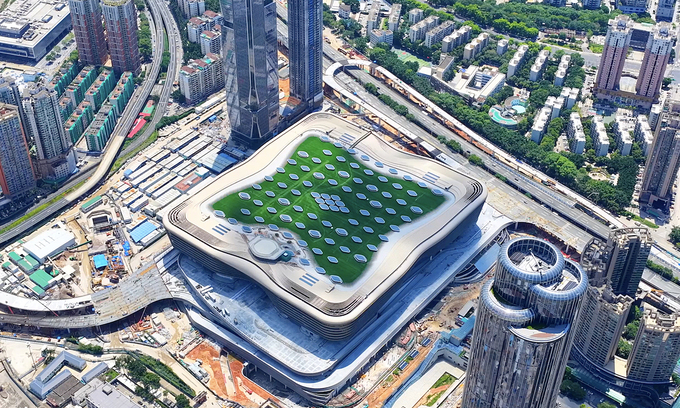
The new border facility, which is scheduled to open before the end of the year, is expected to significantly speed up and simplify travel between Hong Kong and Shenzhen, a major tech and manufacturing hub in southern China.
It is planned to operate 24 hours a day and use a “co-location arrangement” and “joint inspection” clearance model that could cut crossing times from 30 minutes to just five, official data shows.
Last month, Hong Kong and Shenzhen conducted a second large-scale cross-border drill to test the redeveloped Huanggang Port’s ability to handle heavy passenger and vehicle flows ahead of its planned reopening, according to Hong Kong Government News.
The port is expected to establish a “half-hour living circle” linking the two cities and spur cross-border commuting, according to Henry Chung, senior managing director at Midland Realty, as quoted by the South China Morning Post.
|
A bird eye’s view of buildings at Huanggang Port, Hong Kong, China. Photo courtesy of Hong Kong’s Security Bureau |
Housing demand near the border has been increasing among various groups, including students and professionals who want to live in Shenzhen while commuting to Hong Kong during the week, Chung said.
The area is also expected to draw more retirees and scientific research personnel from Hong Kong, he added.
“Year-to-date, residential transaction volume in the Huanggang area has risen by 50% compared with the same period last year, with a noticeable increase in property viewing inquiries,” Chung said.
The Shenzhen Beike Research Institute has likewise reported a sharp increase in second-hand residential property sales in Huanggang during the first half of the year.
The average transaction price for those properties increased 5.6% during the period, outpacing the 3.7% increase across Shenzhen’s overall market, according to the data.
Rental prices in the area have also risen in recent months, particularly after the Hong Kong-side port area opened in late July, Chung said.
“Taking Huangyuyuan as an example, rents in the estate rose by nearly 20% in the first half of the year,” he said, referring to a residential complex near the border crossing. “August and September mark the peak season for rentals, which drove rents up by nearly another 10%.”
The average monthly rent for a two-bedroom apartment in the complex has risen from about 5,000 yuan (US$745) last year to 6,500 yuan, he added.
According to Midland Realty, Hong Kong buyers currently account for about 28% of residential property transactions in Futian District and about 20% of the market around Huanggang Port.
Hong Kong residents also make up as much as 30% of residential tenants in the area, with much of the rental demand coming from cross-border commuters, students and families accompanying students, the data shows.