

By. Sudhir Anand
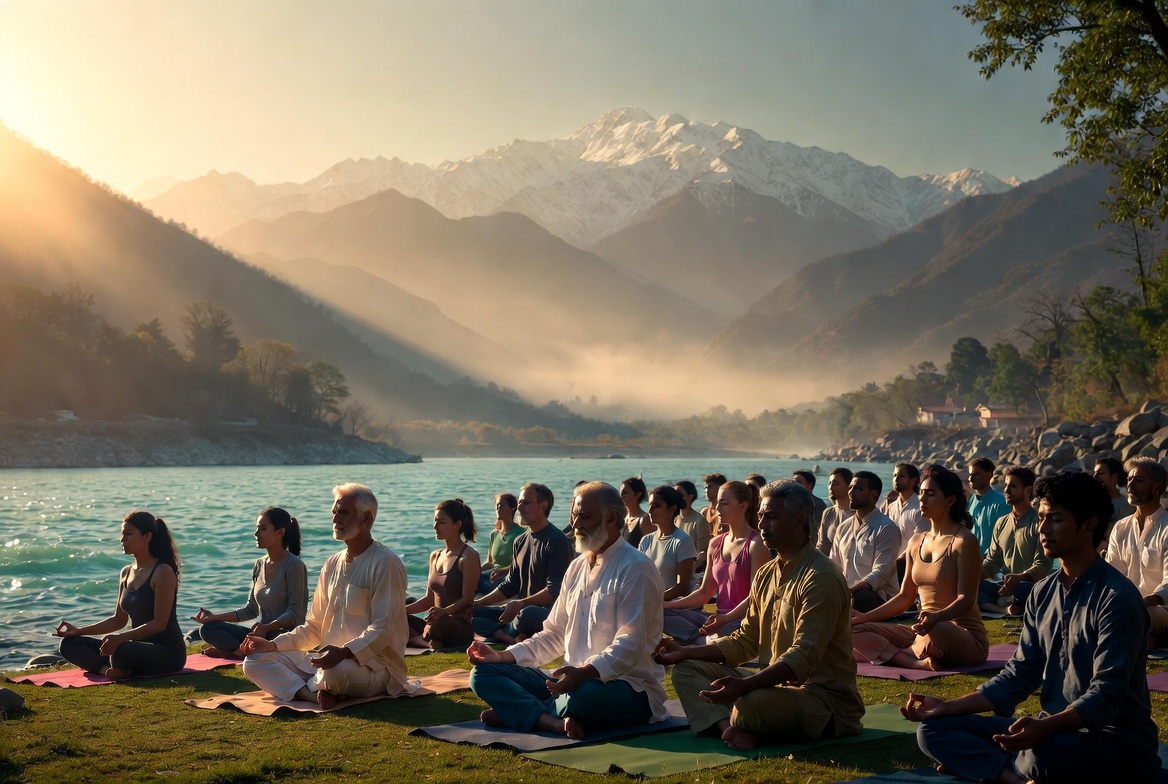
For generations, travellers have arrived in India searching for something they believe is missing from their lives. Some come to study yoga beside the Ganges, others enter silent meditation retreats, visit Buddhist monasteries, seek Ayurvedic treatments or spend time in ancient cities where religious rituals have continued for centuries.
India’s reputation as the world’s premier destination for spiritual exploration did not develop from a single movement or moment. It emerged from thousands of years of religious history, philosophical innovation and cultural continuity. That ancient foundation was later carried abroad by influential spiritual teachers, popularized by Western artists and eventually transformed into a global wellness industry.
The result is a country that occupies a unique place in the world’s imagination. For millions of people, India is not simply another travel destination. It is the place where one goes to search for meaning, confront personal questions and explore ideas about consciousness, suffering, duty and liberation.

The Birthplace of Major World Religions
India’s spiritual influence begins with the fact that the subcontinent gave birth to four major world religions: Hinduism, Buddhism, Jainism and Sikhism.
These traditions differ significantly in their beliefs, sacred texts and practices, but all emerged from the wider intellectual and cultural landscape of South Asia. Together, they introduced concepts that have influenced billions of people and shaped religious thought far beyond India’s borders.
Ideas such as karma, dharma, moksha and ahimsa developed on the Indian subcontinent. Karma describes the relationship between actions and their consequences. Dharma refers broadly to moral duty, righteous conduct or the principles that sustain life and society. Moksha represents liberation from the cycle of birth and death, while ahimsa promotes nonviolence toward living beings.
These were never merely abstract philosophical theories. They influenced daily life, politics, social customs, religious practice and ideas about humanity’s relationship with the universe.
India also became the birthplace of yoga and many of the meditative traditions now practised throughout the world. Long before yoga became associated with fitness studios, athletic clothing and wellness applications, it was understood as a disciplined spiritual path. Its purpose was not simply to improve flexibility, but to control the mind and body in pursuit of self knowledge and liberation.
A Spiritual Tradition That Never Disappeared
One of the most important reasons India retains such spiritual authority is that its ancient traditions were never completely separated from everyday life.
The religious systems of ancient Greece, Rome and Egypt largely disappeared as living public traditions. Their temples and mythology remain historically important, but they are generally studied as part of the ancient past.
India’s spiritual traditions followed a different path. They evolved, adapted and survived through changing kingdoms, foreign invasions, colonial rule, industrialization and modern globalization. Ancient prayers, festivals, pilgrimage routes and rituals continue to be practised by millions of people.

This continuity is especially visible in cities such as Varanasi, one of the oldest continuously inhabited cities in the world. Every day, pilgrims bathe in the Ganges, priests conduct ceremonies along the river and families perform funeral rites associated with Hindu beliefs about death and liberation.
For foreign visitors, this creates the feeling of entering not a museum, but a living spiritual civilization. The past is not displayed behind glass. It remains visible in the streets, temples, homes, monasteries and public rituals of the present.
Swami Vivekananda Introduces Indian Spirituality to America
For centuries, India’s spiritual traditions remained poorly understood in much of the Western world. Colonial accounts frequently portrayed Indian religions as exotic, irrational or primitive. That perception began to change during the late nineteenth century.
A major turning point came in 1893, when Swami Vivekananda addressed the Parliament of the World’s Religions in Chicago. His appearance introduced many Americans to Hindu philosophy, Vedanta and yoga in a language that emphasized universalism, reason and religious tolerance.
Vivekananda did not present Indian spirituality as superstition. He argued that it offered a sophisticated understanding of consciousness and the human soul. He spoke about the unity of religions and suggested that different faiths could represent different paths toward the same ultimate truth.
His message resonated with Western audiences who were becoming increasingly curious about religions outside Christianity. Vivekananda established organizations, delivered lectures and helped create a foundation for the study of Indian philosophy in Europe and North America.
He was among the first major figures to present India not as a colony awaiting Western enlightenment, but as an ancient civilization capable of offering spiritual knowledge to the modern world.
Paramahansa Yogananda and the Spiritual Memoir
Another influential figure was Paramahansa Yogananda, who arrived in the United States in 1920 and spent much of his life teaching meditation and Kriya Yoga.
His 1946 book, Autobiography of a Yogi, became one of the most widely read spiritual memoirs of the twentieth century. The book presented Indian saints, yogis and mystical experiences to Western readers in a personal and accessible form.
Rather than treating Indian spirituality as a distant academic subject, Yogananda described it as something that could be experienced directly through discipline, meditation and personal transformation.
The book influenced generations of artists, entrepreneurs and spiritual seekers. Apple cofounder Steve Jobs was famously associated with the work, and the book became part of a broader Western interest in meditation, consciousness and Eastern philosophy.
Through Yogananda and other teachers, India’s spiritual traditions began to establish permanent institutions outside the country. Ashrams, meditation centres and Vedanta societies appeared across North America and Europe, allowing Western students to explore Indian traditions without travelling to India.
However, many still wanted to visit the source.
The Beatles and the Transformation of Rishikesh
The most important pop culture moment in India’s spiritual globalization came in 1968, when the Beatles travelled to Rishikesh to study Transcendental Meditation with Maharishi Mahesh Yogi.
At the time, the Beatles were among the most famous people in the world. Their journey attracted enormous international media attention and transformed Rishikesh from a destination known mainly to religious pilgrims and dedicated seekers into a symbol of modern spiritual exploration.
Images of the band meditating in India captured the imagination of young people throughout Europe and North America. India suddenly appeared not only ancient and mysterious, but fashionable, rebellious and culturally relevant.
The Beatles’ visit also connected Indian spirituality with the Western counterculture of the 1960s. Many young people were questioning consumerism, organized religion, political authority and the Vietnam War. They were searching for alternative ways of living and new explanations for the nature of consciousness.
India appeared to offer both.
Rishikesh eventually became known internationally as the Yoga Capital of the World. Ashrams, schools and teacher training centres expanded to serve growing numbers of foreign visitors. The city’s identity became inseparable from the international yoga movement.
The Hippie Trail and the Search for an Alternative Life
During the 1960s and 1970s, thousands of Western travellers followed what became known as the Hippie Trail. The overland route stretched from Europe through countries such as Turkey, Iran, Afghanistan and Pakistan before reaching India and Nepal.
These travellers were not conventional tourists. Many rejected the materialism and social expectations of postwar Western life. They travelled with limited money, stayed for extended periods and sought experiences that challenged the values with which they had been raised.
India became one of the central destinations on this route. Travellers gathered in Goa, Delhi, Varanasi, Rishikesh, Dharamshala and other spiritual or cultural centres.
Some studied yoga or meditation. Others became interested in Hinduism, Buddhism or Sikhism. Many were attracted by India’s affordability, communal lifestyle and perceived distance from Western social pressures.
The era was also complicated. Western interest in India sometimes mixed genuine spiritual curiosity with romantic stereotypes, drug culture and the selective appropriation of religious traditions. Some visitors approached complex philosophies as temporary lifestyle experiments rather than lifelong disciplines.
Nevertheless, the movement permanently established India as the place where Westerners could step outside their normal lives and attempt to reinvent themselves.
The Dalai Lama and the Rise of Dharamshala
India’s spiritual importance expanded further after 1959, when the 14th Dalai Lama fled Tibet following the Tibetan uprising and was granted refuge by the Indian government.
He eventually established his residence in Dharamshala, where the Tibetan government in exile and a large refugee community also took root. Monasteries, cultural institutions and centres of Buddhist learning were created in the surrounding region.
This turned northern India into one of the world’s most important locations for studying Tibetan Buddhism. Scholars, monks, students and spiritual seekers travelled to Dharamshala to attend teachings, learn meditation and engage with Tibetan religious traditions.
The Dalai Lama’s global profile also attracted political leaders, celebrities and international media. His teachings on compassion, peace and human responsibility helped make Tibetan Buddhism accessible to people who might otherwise have known little about it.
India therefore became not only the birthplace of Buddhism, but also a vital centre for the preservation of Tibetan Buddhist culture in exile.
The Global Yoga Revolution
During the late twentieth and early twenty first centuries, yoga expanded from a specialized spiritual practice into a global cultural phenomenon.
Studios opened in nearly every major Western city. Yoga became associated with physical fitness, stress reduction, flexibility and mental well being. Teacher training programs developed into an international industry, and millions of people began practising yoga without necessarily identifying with Hinduism or Indian religious traditions.
This global popularity encouraged many practitioners to travel to India for deeper study. Rishikesh became known for traditional and modern yoga programs, while Mysuru, also known as Mysore, became internationally associated with Ashtanga yoga.
Foreign students often arrive for intensive courses lasting several weeks or months. Some seek professional certification, while others want an experience they believe will be more authentic than studying at a commercial studio at home.
The growth of yoga tourism has brought significant economic opportunities to Indian communities. It has also created debates about commercialization, cultural appropriation and whether a spiritual discipline can retain its original meaning after becoming a global consumer product.
Despite these concerns, yoga remains one of India’s most powerful forms of cultural influence.
Meditation in an Age of Digital Overload
Meditation has followed a similar path. Practices rooted in Hindu, Buddhist and Jain traditions have been adapted into modern programs for stress reduction, mental focus and emotional health.
Vipassana retreats have become particularly popular among international travellers. Participants may spend several days in silence, following strict schedules and meditating for long periods without access to phones, entertainment or ordinary conversation.
For people living in a world of constant notifications, social media and workplace pressure, this kind of retreat offers a radical break from daily life.
India’s meditation centres attract executives, students, artists, celebrities and ordinary tourists. Some arrive because they are facing grief, burnout or personal crisis. Others are simply curious about what happens when the mind is separated from its usual distractions.
The popularity of these retreats demonstrates how ancient practices have found new relevance in a hyperconnected age.
Ayurveda and the Luxury Wellness Economy
India’s spiritual image has also become connected to the international wellness industry through Ayurveda.
Ayurveda is a traditional Indian system of health and well being that emphasizes balance, diet, lifestyle, herbal preparations, massage and individualized treatment. It has been practised in South Asia for centuries, although its methods and claims should be evaluated carefully alongside modern medical evidence.
Kerala has become one of the leading destinations for Ayurvedic tourism. Visitors can choose between traditional clinics, specialized treatment centres and luxury resorts offering massages, dietary programs, yoga and relaxation packages.
What was once primarily a local medical and cultural tradition is now marketed globally as an alternative to the stress and speed of modern life.
For affluent tourists, spiritual travel no longer necessarily means sleeping in a basic ashram. It can involve high end accommodation, private instructors, customized meals and resort style treatments.
This transformation reveals the tension at the centre of modern spiritual tourism. Many travellers want to escape materialism, but the escape itself has become a highly profitable product.
The Influence of Books, Films and Popular Culture
Popular culture has continued to reinforce the idea that India is where people go to rediscover themselves.
Books, films, documentaries and celebrity travel stories frequently present India as a place of personal transformation. The enormous popularity of Eat, Pray, Love strengthened this image for a new generation, even though only part of the story takes place in India.
Such narratives usually follow a familiar pattern. A person becomes dissatisfied with work, relationships or modern life, travels to India, encounters spiritual teachings and returns home with a renewed sense of purpose.
This story can oversimplify India by turning a vast and complex country into a backdrop for foreign self discovery. India contains deep religious traditions, but it also contains crowded cities, advanced technology, political conflict, economic ambition and the ordinary pressures of modern life.
Still, the narrative remains powerful because it reflects a genuine desire. Many people feel overwhelmed by consumer culture, loneliness and digital distraction. India is imagined as a place where those pressures can be suspended long enough to ask deeper questions.
The Business of Finding Yourself
Spiritual tourism has now become a major part of the broader travel and wellness economy. Ashrams, retreat centres, hotels, tour operators and training schools offer structured programs for international visitors.
A traveller can book a yoga certification course, a silent retreat, an Ayurvedic package, a pilgrimage tour or a stay in a monastery. Experiences that once required personal connections and years of preparation can now be reserved online.
This accessibility has opened Indian spiritual traditions to a much larger audience. It has also created opportunities for unqualified teachers, exploitative organizations and commercial operators who make exaggerated promises.
The growth of the industry has therefore increased the importance of research, transparency and respect. Spiritual seekers must distinguish between serious institutions and businesses that use ancient language primarily as a marketing tool.
India’s spiritual reputation is powerful, but it should not prevent visitors from exercising ordinary judgment.
Why India’s Spiritual Influence Endures
India remains the world’s spiritual capital because few other countries combine so many layers of religious history, living tradition and global cultural influence.
It is the birthplace of major faiths and philosophical systems. It contains ancient pilgrimage sites that remain active today. It produced teachers who carried Indian ideas across the world, and it became a destination for the artists, writers and travellers who shaped modern popular culture.
India also continues to reinvent its spiritual identity. The ashram exists beside the luxury wellness resort. The ancient temple exists beside the yoga school serving international visitors. The silent monastery exists within a society experiencing rapid economic and technological growth.
This combination of antiquity and modernity gives India its distinctive power. Visitors do not arrive only to observe the past. They come because India’s spiritual traditions appear capable of addressing modern questions about anxiety, purpose, identity and the limits of material success.
India did not become the spiritual centre of the world through marketing alone. Its reputation rests on thousands of years of philosophical exploration and religious practice. Modern tourism may package that heritage in new ways, but the deeper attraction remains unchanged.
For people searching for meaning beyond wealth, work and consumption, India continues to represent the possibility that another way of understanding life may still exist.

Comments are closed.