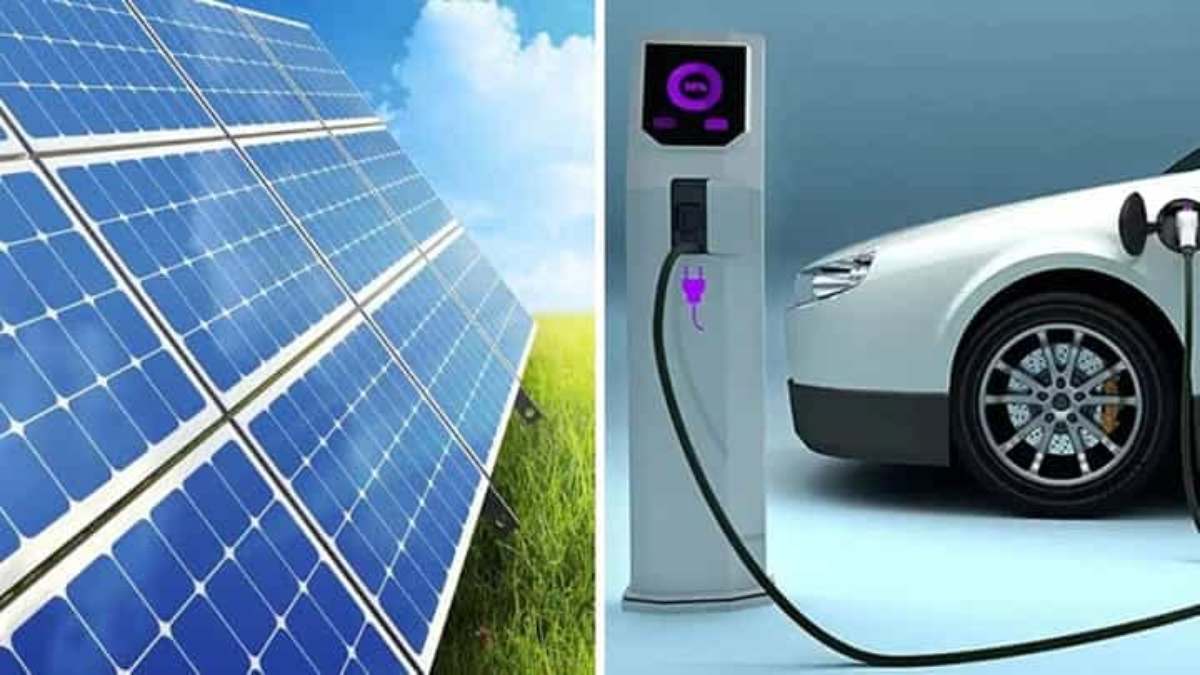
Automobile Desk – In today's era, when electric vehicles (EVs) are being discussed everywhere and people are adopting battery operated vehicles to get relief from the inflation of traditional petrol and diesel, then a common question keeps coming up. Just as all the electricity needs are being met by installing solar panels on the roofs of houses, can electric cars also be easily operated by installing solar panels on their roofs? Amidst the rising electricity bills and the rush to find charging stations, this idea may seem very attractive and economical at first glance, but the ground reality is quite different from this.
Limited size of car roof and limitations on energy production
The biggest obstacle that comes in the way of installing solar panels on the roof of any electric vehicle is its physical design and limited area. Generally, the total roof area of a standard car is around 10 to 25 square feet. It is impossible to produce a large amount of electricity from the number of solar panels that can be fitted in such a small space.
According to meteorological and technical data, during the time of strong sunlight i.e. in the afternoon, about 92 watts of solar energy can be obtained from one square feet of space. However, current solar technology is not able to convert 100 percent of the energy into electricity, rather its efficiency usually remains between 20 to 25 percent. Accordingly, the panels installed on the roof of the car are barely able to generate a few hundred watts of electricity. Although this may charge the car's main battery very slowly, it is insufficient to meet the huge energy requirements of daily driving.
New experiments going on globally on solar cars and special glass
Even though at present it is not completely possible to drive a car only on the basis of solar roof, still the automobile industry and researchers are continuously doing new and revolutionary experiments in this direction. Research students associated with the International Center for Automotive Research of Clemson University of America have recently prepared a prototype of a solar electric car from BMW. This initial model has been designed in such a way that the solar panels installed on its exterior can generate electricity by absorbing sunlight. During testing, this prototype managed to generate about 5.7 kilowatt-hours (kWh) of electricity a day, which can provide enough energy to drive the car for about 12 miles, or about 19 kilometers.
In this context, Fuyao Group has also made a unique innovation. Instead of traditional and heavy solar panels, the company has developed a special solar sunroof, in which microscopic solar cells are embedded inside the glass. With the help of this technology, up to 720 watts of power can be produced. Although it is not possible to directly run the main motor of the car with this much energy, it can easily carry the load of other electronic devices running inside the car and systems like AC. This reduces the pressure on the main battery of the car and there is also a positive increase in the total driving range of the vehicle. This technology can prove to be very helpful especially for drivers going on long journeys.