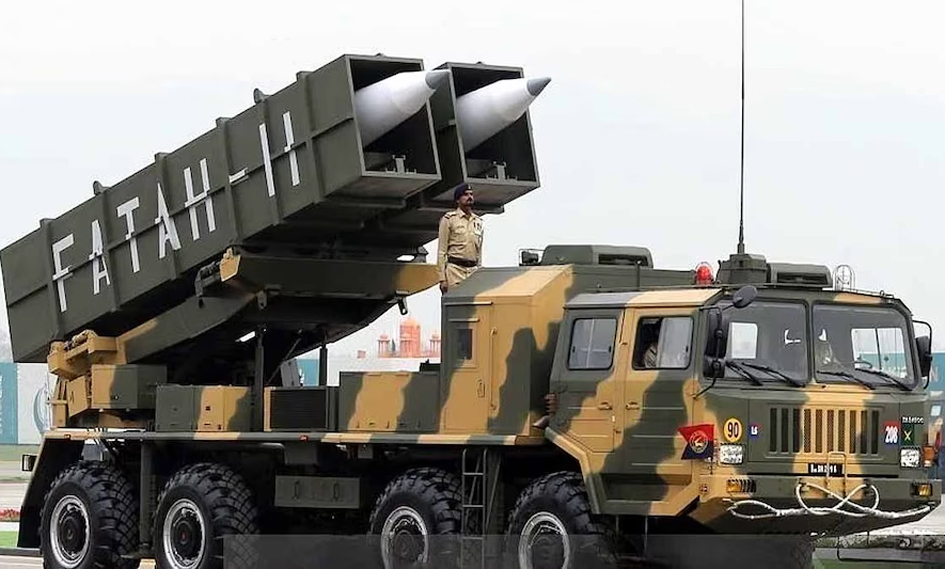
New Delhi. Pakistan has tried to show its military strength by claiming successful testing of Fatah-3 supersonic cruise missile. The design of this missile, which is said to be capable of long range attack, is being linked to China's HD-1 missile. In such a situation, questions are being raised about its technology whether Pakistan has taken the help of Chinese technology? At the same time, how effective Fateh-3 can prove to be against India's Barak air defense system is also a matter of discussion. On one hand, Pakistan is busy increasing its attack missile capability, while on the other hand, India is continuously modernizing its air defense cover.
The Pakistani Army on Wednesday claimed success in testing the Fateh-3 supersonic cruise missile. It has been described as a long range precision attack weapon. However, Pakistan has not made public detailed information regarding the technical characteristics of the missile. There have been claims of similarity with China's HD-1 regarding its design and technical structure, but the technical relationship between the two has not been independently confirmed.
What is the estimated capability of Fateh-3?
The striking range of Fatah-3 has been stated to be around 290 to 450 kilometers in different defense analyses. During its demonstration in March 2024, a range of up to 450 kilometers was claimed. Claims of greater distance have also been made on social media, but they have not been confirmed.
Its potential speed is estimated between Mach 2.2 to Mach 4. The length of the missile is said to be about 8.6 meters, weight is about 2,500 kg and warhead capacity is said to be 240 to 300 kg. However, these figures are approximate and official technical details certified by Pakistan are not available.
According to reports, Fatah-3 may use solid fuel booster and ramjet based propulsion technology. It is expected to be fired from a road-mobile mobile launcher, in which two missile containers can be installed. However, its actual technical capability and operational performance have yet to be independently confirmed.
How strong is India's Barak system?
India's Barak missile defense system is an important part of the air defense system developed in collaboration with Israel. Its various versions have been designed to intercept aerial threats such as aircraft, helicopters, drones and cruise missiles. The purpose of the Barak Point Defense System, deployed on naval ships, is to destroy enemy air threats approaching the ship.
Barak-8 i.e. LR-SAM and MR-SAM are joint defense projects of India and Israel. Their normal striking range is said to be around 70 to 100 kilometers, whereas the range of Barak-8 ER can be around 150 kilometers. Its speed is close to Mach 2 and technology includes features like Active Radar Seeker and Data Link, which help in identifying and intercepting the target.
However, the Barak-8 and the Barak Point Defense systems deployed on naval ships are not the same version. The firepower, deployment and operational role of both are different.
India signs agreement to upgrade Barak system for Rs 1,976 crore
Amidst the testing of Fateh-3, India has taken a big step to strengthen its naval security. On November 18, the Defense Ministry signed an agreement worth Rs 1,976.40 crore with Israeli company Israel Aerospace Industries (IAI). Under this, the Barak Point Defense Missile System deployed on Indian Navy ships will be upgraded.
The project will focus on modernizing the hardware and software of the system as well as replacing old equipment. This will help in increasing the capability and reliability of naval ships to deal with air threats.
Role of Fatah-3 and Barak is different, many aspects are important in comparison
While comparing Fatah-3 and Barak, it is important to understand the role of both. Fatah-3 is an offensive missile, which is used to attack enemy targets. In contrast, Barak is a defensive system, whose purpose is to identify incoming missiles and air threats and destroy them in mid-air.
The estimated strike range of Fatah-3 is 290 to 450 kilometers, while the range of the normal version of Barak-8 is said to be 70 to 100 kilometers and the ER version is said to be around 150 kilometers. But the capability of both cannot be assessed only on the basis of striking distance.
The effectiveness of Fatah-3 will depend on its navigation, accurate target identification, ability to change direction during flight and evading enemy radar. At the same time, the success of Barak depends on the radar network, reaction time, target identification and interception capability. The success of intercepting a missile is not determined only by its speed or distance, but by the capability of the entire defense system.
Pakistan is continuously increasing the scope of missile tests
Pakistan has been continuously conducting tests under its missile program in recent times. In the same month, Pakistani Air Force claimed to test its first indigenous air-to-air missile Faaz. There were also reports of testing of Fatah-2 and Fatah-4 missiles in October. Fatah-2 was reported to be tested on 13 October and the extended version of Fatah-4 to be tested on 6 October.
Through Fateh-3, Pakistan wants to demonstrate its long-range attack capability. However, the missile's actual striking range, accuracy, speed and ability to penetrate modern air defense systems cannot be assessed from test claims alone. This requires independent technical validation and actual operational performance data.
For India, continuous upgrading of defense systems like Barak is part of its strategy to deal with this challenge. The contest between Pakistan's new missile capability and India's modernizing air defense network is not just about weapon range, but also technology, radar, response capability and combat effectiveness.