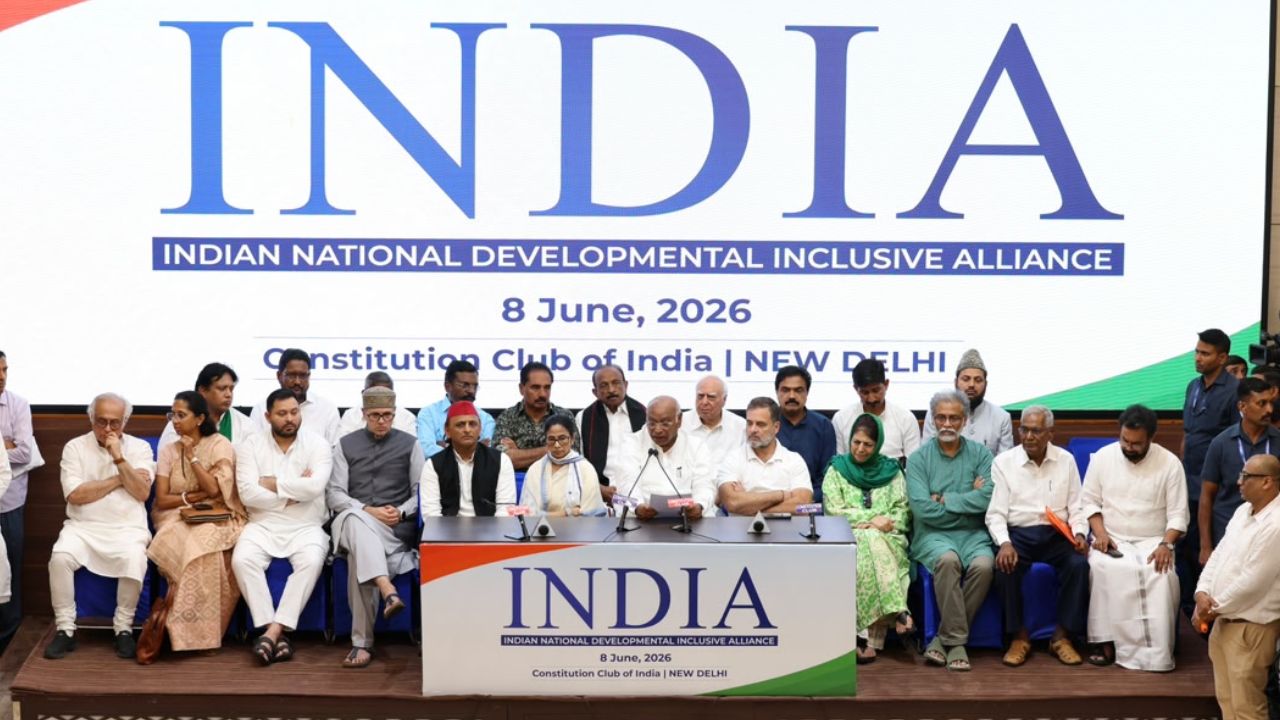
India Alliance was established on 18 July 2023 in Bengaluru, the capital of Karnataka. This alliance was formed to prevent the Bharatiya Janata Party and Prime Minister Narendra Modi from coming to power at the Center in the 2024 Lok Sabha elections. In the elections held two years ago, this alliance could not stop the BJP-led NDA government from coming to power, but it definitely weakened the BJP. The slogan of BJP which used to claim to win more than 400 seats was deflated and the alliance reduced it to 240 seats. With this, BJP single-handedly stayed away from the majority figure.
This was seen as the success of the India alliance. But, after the formation of the Indian Alliance, its supreme unit was formed, which came into existence by the name of 'Coordination Committee'. Whatever major decisions were taken in the India Alliance, all were passed in this coordination committee. In such a situation, questions are being raised that where is this coordination committee of India Alliance now?
Alliance formed coordination committee
In fact, the India Alliance was formed three years ago with the aim of bringing the opposition parties on one platform and a coordination committee was formed to take this alliance forward. Now this coordination committee has become inactive. However, this India alliance exists despite political disunity and conflict.
Also read: Rohini's entry in Dalit politics of UP, will the equations change after meeting Akhilesh?
First meeting on September 13, 2023
The first meeting of the 14-member coordination committee of the alliance was held on September 13, 2023. At that time it was seen as the highest decision-making body of the alliance. However, that also proved to be the last meeting of the committee. Three years later, the coordination committee no longer exists and two of its original members are now in the BJP camp. JDU and RLD. This year, an effort was definitely made to restore coordination at the national level.
On June 8, the leaders of the constituent parties of this alliance held the first major formal meeting in more than two years. Congress President Mallikarjun Kharge had announced that now the alliance parties will meet every two months. This year, a meeting was suggested in Hyderabad in August, but that meeting has not taken place yet. Many opposition parties and leaders are waiting for the Congress to decide the date of the meeting. However, information as to why the proposed meeting could not be held in Hyderabad has not been revealed.
Changes in mutual relations between parties
Meanwhile, changes have also been seen in the mutual relations between the parties forming the alliance. The lack of coordination among the parties involved in the India alliance is continuously decreasing. Due to this, the opposition has faced difficulties before the assembly elections to be held next year in Uttar Pradesh, Punjab, Gujarat, Uttarakhand, Himachal Pradesh, Goa and Manipur. In these states, the parties are allies at some places, rivals at some places and potential partners at some places.
The fight between Aam Aadmi Party (AAP), which broke away from the alliance last year, with Congress in Punjab is becoming increasingly fierce. Last Sunday, Aam Aadmi Party formed an alliance with Goa Forward Party to present a non-BJP, non-Congress alternative in Goa. The party is preparing to contest elections alone in Gujarat. Even where the state-wise strategy has worked electorally, differences have emerged.
Also read: Sachin Pilot passed the first exam, Raja Vadding-Channi came along, what is the challenge ahead?
Some good relationships, some bad relationships
In Jharkhand, the Jharkhand Mukti Morcha-Congress-Rashtriya Janata Dal alliance easily retained power in 2024, while in Jammu and Kashmir, the National Conference and Congress jointly contested the assembly elections and won. Congress leaders in Jharkhand have often complained about representation in the government and coordination with JMM. Congress's relations with the National Conference have deteriorated over power sharing in Jammu and Kashmir.
This month, the differences between the two parties came to the fore when the Congress objected to the singing of all six stanzas of 'Vande Mataram' at a government-sponsored event. In response, the National Conference hit back at the Congress. The alliance of Congress and Dravida Munnetra Kazhagam (DMK) in Tamil Nadu was one of the most durable state-level alliances of the India Alliance and was a significant contributor to the alliance's performance in the 2024 Lok Sabha elections.
TVK joined hands after separating from DMK
However, ahead of the 2026 assembly elections, Congress broke away from the DMK-led front and joined the ruling TVK-led alliance. In a meeting held in Mumbai in September 2023, 13 members of the alliance were included in the 14-member coordination committee. One seat was kept for the CPI(M), but it did not nominate its representative.
Who were in the coordination committee?
The coordination committee includes KC Venugopal from Congress, Sharad Pawar from the then undivided NCP, TR Baalu from DMK, Hemant Soren from JMM, Sanjay Raut from Shiv Sena (UBT), Tejasvi Yadav from RJD, Abhishek Banerjee from Trinamool Congress, Raghav Chadha from AAP, who later joined BJP, Javed Ali Khan from Samajwadi Party, Lalan Singh from Janata Dal (United), who will join BJP in 2024. The leaders who returned to the NDA included D Raja from the Communist Party of India, Omar Abdullah from the National Conference and Mehbooba Mufti from the PDP. Now JD(U), DMK and Aam Aadmi Party are not part of this alliance.