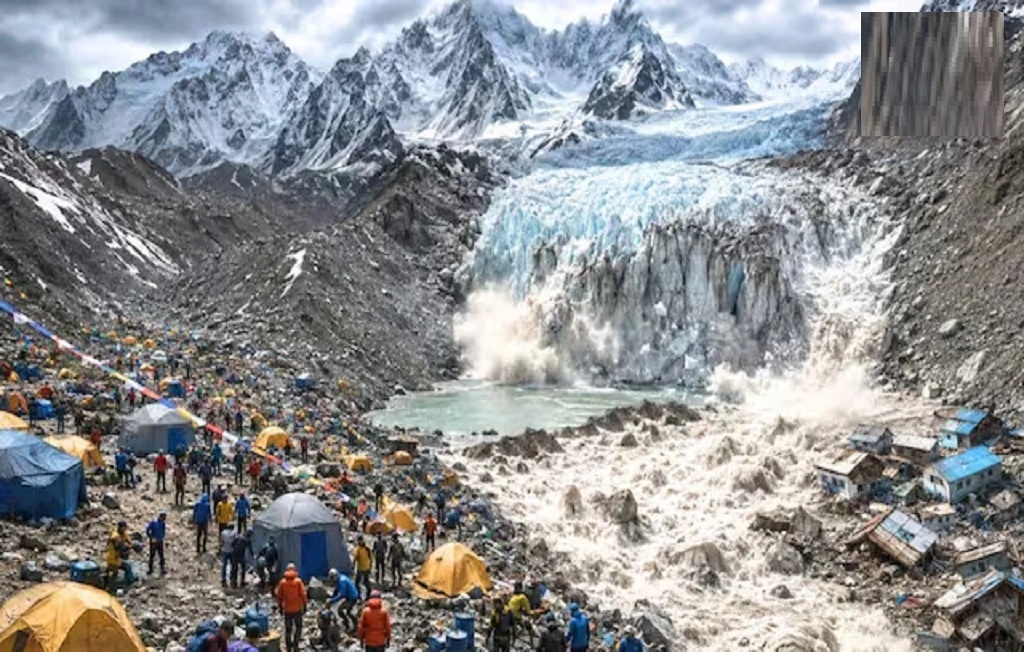
Mount Everest glacier melting: In the bitter cold of May 2023, the Khumbu glacier of Mount Everest, located at an altitude of 5300 meters above sea level, did not look like a quiet, deserted mountain but like a luxurious hill resort. Over 1600 tents, generators spewing smoke all around, the sound of espresso coffee machines, huge TV screens, hot water showers and underfloor heating systems under the carpet on the ground.
But amidst all this luxury and glitz, a man was wandering silently with a diary and pen in his hand. He was neither counting the tents nor taking photographs of the people who had reached the peak. He was simply making a detailed calculation of how many times the people present in this entire camp were going to urinate in a day.
This person was not a common man, but Nepal’s Chief Survey Officer and Geospatial Scientist Khimlal Gautam. People may have found his work strange at that time, but three years later, in July 2026, when his shocking research was published in the international science journal ‘Regional Environmental Change’, the whole world was shocked.
Melted in just one season 2,492 tonnes of ice Mount Everest glacier melting
Research data shows that in just one climbing season in 2023, about 2,492 tons of ice on the Khumbu Glacier melted due to human-generated local heat. The thing to be noted is that this melting was not caused only by the heat of the sun or the general change of weather, but by the burning heaters, stoves, generators in the camp and human body heat and urine.
Scientists estimate that every spring season about 3 million kilograms (3000 tons) of glacier ice melts and flows away in order to provide luxuries and facilities at the base camp. In the 2023 season alone, 824 LPG cylinders, 18,935 liters of kerosene and 5,130 liters of gasoline were burnt for cooking and heating in 1,600 tents.
Human urine responsible for melting 154 tons of snow
The most sensational aspect of this study is related to human urine. According to scientists, the urine of climbers was responsible for melting about 154 tons of ice in the Khumbu Glacier alone. Khimlal Gautam explains that at high altitude, climbers have to continuously drink large amounts of water to avoid dehydration, due to which they pass large amounts of urine daily. More than 6,000 liters of human waste is generated daily at the base camp.
Although solid waste from the camp toilets is collected in drums and brought down, most people urinate on the open glacier. This glacier is the main source of drinking water for the local people living below.
Base camp is heating up at double the speed
US Geological Survey (USGS) scientist Virginia Burkett also helped in this study. They closely studied cloud-free satellite thermal data from 1991 to 2023. When the temperature at the base camp was compared with the rest of the glacier, it was found that the temperature at the human-interrupted base camp had increased twice as fast as the rest of the glacial area.
Gautam says that 478 permits were issued in 2023, while in 2026 this number will increase to around 490. Every season, an entire temporary town of more than 2,000 people, including guides, Sherpas, cooks and doctors, settles here.
Great danger of glacier burst and flood
Dr. Sudeep Thakuri, climate scientist at Tribhuvan University, believes that the impact of urine may be less in proportion to fuel, but it is like a time bomb for the local ecosystem. The rate of melting of Everest’s glaciers has already doubled since 2009. Gautam has warned that melting of snow in this way creates dangerous glacial lakes, whose bursting (GLOF) can cause catastrophic floods similar to those seen recently in the border areas of Nepal and China. At the same time, researcher Peter Hackett, who alone conquered Everest in 1981, said that melting of snow in this manner will not only increase the risk of avalanches, but it is also extremely shameful and horrifying to see heaps of human waste and frozen excrement everywhere on the world’s most sacred mountain.