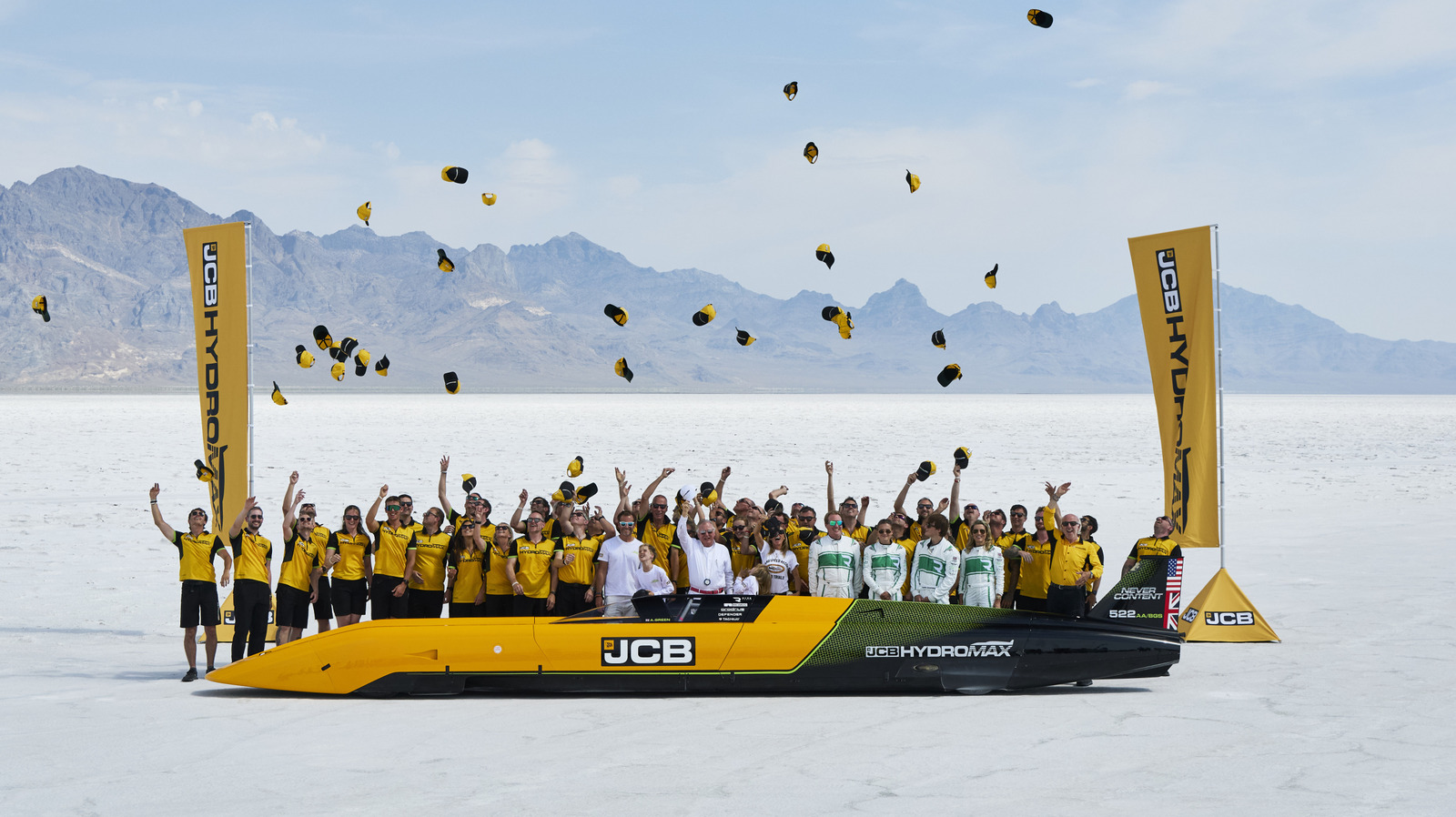
The JCB Hydromax trounced two land speed records in less than a week. On August 6, the 32-foot-long hydrogen-powered car chalked up an SCTA record on the Bonneville Salt Flats in Utah with a speed of 368.347 mph. Five days later, on August 11, it set a new Fédération Internationale de l’Automobile (FIA) world land speed record of 406.320 mph for a hydrogen internal combustion-powered vehicle in the same location. The FIA is the world governing body for motorsport, and has been overseeing and documenting land speed records for more than a century.
For land speed records, the FIA requires cars to perform two runs over a mile, one in each direction within an hour, and uses the average speed from both as its measurement. The JCB Hydromax achieved an average speed of 400.623 mph on its first run and 412.135 mph on its second, giving it the record-breaking average of 406.320 mph. The previous FIA record? A comparably paltry 185.5 mph set by the BMW H2R back in 2004.
A record-breaking car needs a record-breaking driver
In addition to setting a new record for a hydrogen engine, the JCB Hydromax beat the world diesel land speed record of 350.092 mph set in 2006 by another vehicle out of the British engineering firm, the JCB Dieselmax. Even more impressive: this time, there wasn’t a whiff of carbon dioxide from the tailpipe.
It’s not just the car that’s been setting tough-to-beat records. Former RAF fighter pilot Andy Green, who drove the JCB Hydromax, has many other speed-related claims to fame, including being the fastest person on earth and the only one to have broken the sound barrier on land, having traveled at 763.035 mph in the Thrust SSC. Green reached that milestone in the Black Rock Desert in Nevada in 1997, setting the outright world land speed record in the process, in a truly fascinating car that looks more like a missile than it does like anything you’d find on even the most luxurious automaker’s lot.
There’s more to JCB’s ambitions than merely bragging rights, though. Its record-breaking endeavors serve as marketing for its earth-moving equipment. “This record was set by production-based engines, the same engines powering JCB diggers right now,” said JCB chairman Anthony Bamford. “That is the point of JCB Hydromax: it shows hydrogen works, and it works today at the highest level with zero emissions.”