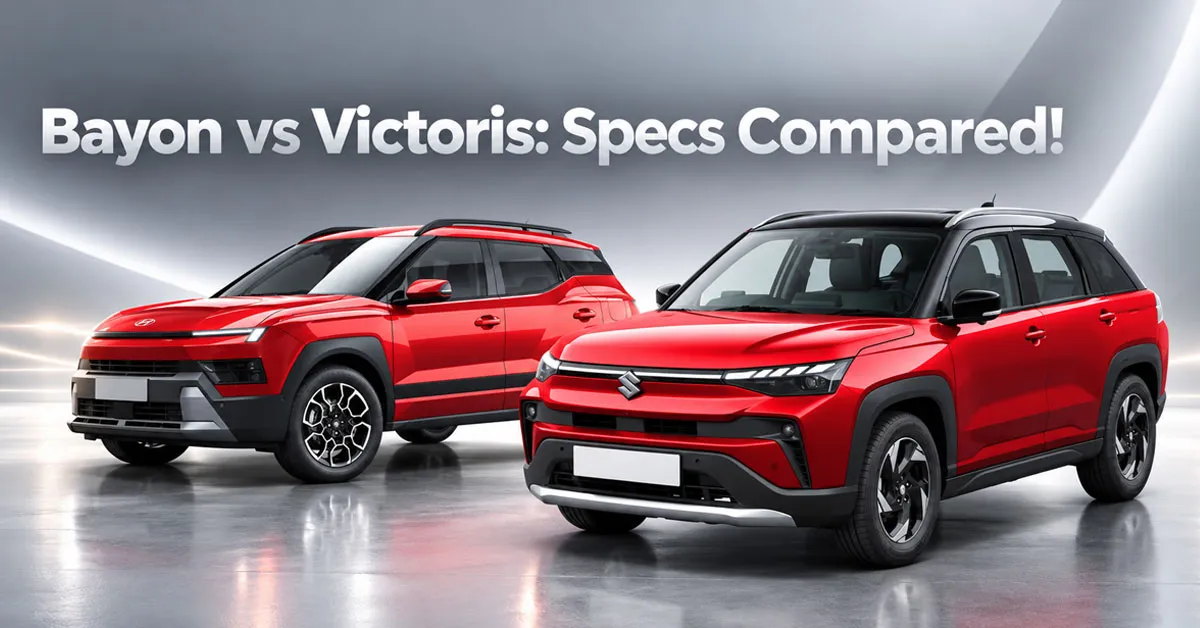
Hyundai has launched the much-awaited Bayon SUV in India at Rs 9.99 lakh, ex-showroom. Though introductory, we would say that’s excellent pricing. In the Indian market, the Bayon will have to compete primarily with the Maruti Suzuki Victoris. Let’s now compare the two SUVs based on available technical specifications.
The Bayon measures 4245mm in length, 1810mm in width and 1605mm in height. It has a wheelbase of 2600mm and a ground clearance of 205mm. The Victoris, on the other hand, is larger. It is 4360mm long, 1795mm wide and 1655mm tall. The wheelbase is the same as that of the Bayon- 2600mm. The Victoris has a 45-litre fuel tank, whereas the Bayon’s tank can hold 43 litres. The Victoris also has a slightly higher ground clearance of 210mm.
Another key difference is in the boot space. The bayon has a 505-litre boot while the Victoris comes with a much smaller 446 litres.
The two SUVs take different approaches to design. The Victoris was first launched in India in 2025. It has been a sales success for Maruti Suzuki. The design has thus become familiar. It has a sweeping silhouette, LED headlamps, LED DRLs, LED tail lamps, and 17-inch alloy wheels with 215/60 tyres.

The Bayon, on the other hand, has a fresh design. It has H-edge LED DRLs, LED headlamps that sit on the front bumper, sculpted bonnet, 17-inch diamond cut alloy wheels, H-edge LED tail lamps and more.
Talking of exterior colour options, the Victoris has seven mono-tones and three dual-tones. The Bayon also has 10 colour options. But here, you get 8 mono-tones and just 2 dual-tones.

Both the Victoris and Bayon have modern, feature-rich cabins. The Victoris is, in fact, the most feature-packed Maruti Suzuki model.
It comes with features like a panoramic sunroof, automatic climate control, ventilated seats, rear AC vents, 10.25-inch instrument cluster, 10.1-inch touchscreen infotainment system, wireless Apple Carplay and Android Auto, head up display (HUD), 360-degree camera, Electronic Parking Brake, 64-colour ambient lighting, wireless charger, connected car features, and a level 2 ADAS suite. The Victoris is Maruti’s first model to get an ADAS suite. Additionally, it also gets a built-in Alexa Auto AI.
The Bayon also has a long list of features on offer. It gets a panoramic sunroof, a curved instrument cluster (12.3-inch touchscreen infotainment system and 12.3-inch digital driver’s display), automatic climate control, ventilated seats, connected car features, 360-degree camera with adaptive lines and a 3D view, electronic parking brake, wireless Apple Carplay and Android Auto, wireless charger, touch-based controls for the climate control, blind spot monitor, and more.
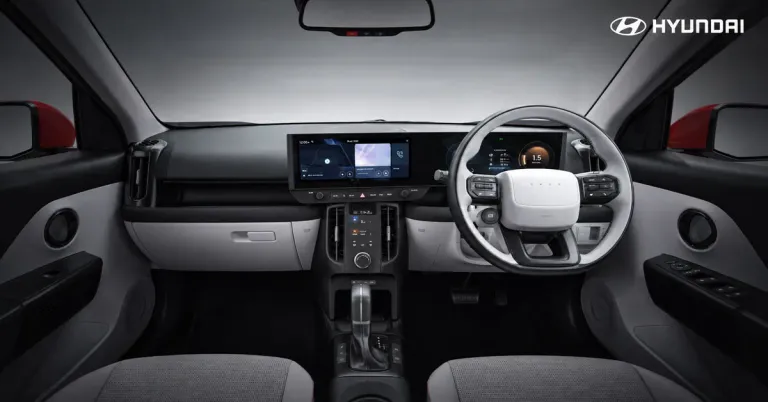
One of the biggest highlights inside the Bayon is the AI-based voice assistant. This setup is based on Perplexity AI and Soundhound AI. The SUV also has a level 2 ADAS that offers 23 driver assistance features.
The top-spec Bayon comes with an 8-speaker BOSE premium audio system. The Victoris gets an 8-speaker Infinity audio system with Dolby Atmos. In comparison, the Bayon lacks Dolby Atmos technology.
In comparison, the Victoris offers more space inside, particularly at the rear. The Bayon isn’t as roomy as the Maruti but is indeed a comfortable place with ample room.

The Victoris is offered with three engine options- 1.5-litre naturally aspirated mild hybrid (K15C) petrol engine, a CNG version based on the K15C and a strong hybrid version based on the M15D engine. The Bayon, on the other hand, offers just one engine option at launch- a 1.5-litre naturally aspirated four-cylinder petrol.
The Bayon’s engine makes 115PS and 144Nm, and is being offered with two transmission options- six-speed manual and a CVT (which Hyundai calls the iVT). The comparable engine option of the Victoris is the 1.5-litre naturally aspirated mild hybrid petrol engine that makes 103PS and 139Nm. It is offered with two gearbox options- 5-speed manual and a six-speed torque converter automatic.
The Victoris is less powerful than the Bayon, at least on paper. It, however, has an edge in the transmission offered. A torque converter automatic box is typically more engaging to drive than a CVT. The Victoris has front wheel drive and All wheel drive (AWD) setups on offer. The Bayon is a strict front wheel drive (FWD) vehicle.