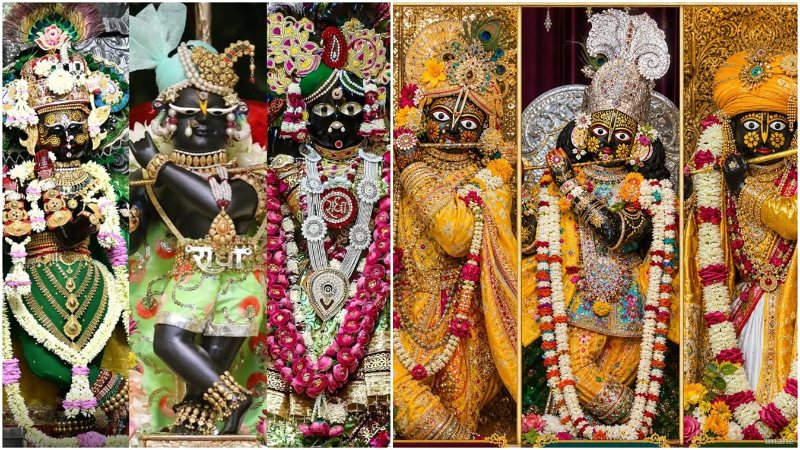
Famous as the sacred center of Sanatan culture, devotion and faith, Brajmandal of Uttar Pradesh has always been the main center of attraction for devotees from all over the world. Whenever we plan to visit the holy land of Vrindavan or Mathura, the first image that emerges in our mind is the supernatural darshan of Thakur Banke Bihari Ji and Radha Raman Ji. But do you know that on this sacred and mysterious land of Braj, there are not only these two famous idols, but a total of seven different and most adorable forms of Thakur ji are present here, which are known as 'Sapta Devalaya'? Seeing all these seven forms is considered the greatest privilege of life for any devotee. Let us do a complete analysis of the history of these seven divine forms of Braj, the story of their appearance and the places of their darshan in great depth, detail and in the reporter's conversational style. What is the secret of these seven forms of Braj and why are they called 'Seven Devalayas', the most sacred temples of the Sanatan tradition? Centuries ago, in Brajmandal, which was the playground of Lord Krishna, many great saints and acharyas had revealed various forms of God, whose glory still resonates in the whole world. When temples and religious places started being targeted by the Mughal invaders during the reign of Akbar, the saints of Braj installed them safely at different places to protect these sacred idols. Of these, mainly seven such ancient and historical temples were established which were called 'Sapta Devalaya'. In these seven temples, different emotions and forms of Thakur ji are served, whose mere darshan removes the sufferings of the devotees from many births. Lakhs of devotees who come on this holy journey of Braj feel blessed by circumambulating all these seven temples. First and second forms: Thakur Shri Radha Raman Ji and Shri Radha Ballabh Ji, whose supernatural image fascinates the minds of the devotees. Among the seven temples of Braj, let us first talk about Shri Radha Raman Ji, whose temple is located in the ancient mohallas of Vrindavan and it is believed that this idol had appeared on its own. Here there is no idol of Shri Radharani with Thakur ji, rather a crown is placed next to him which symbolizes that Radharani resides with him all the time. Right after this, the second sacred form is that of Shri Radha Ballabh ji, in whose temple also a feeling of amazing love and dedication can be seen. The time of Mangala Aarti and darshan held in both these temples is very special, where devotees coming from India and abroad stand in queues for hours, eager to get a glimpse of Thakur ji. Third and fourth form: Shri Banke Bihari Ji and Shri Govind Dev Ji, in whose history a unique chapter of the struggle of the Mughal era is hidden. The third most prominent form is that of everyone's favorite Shri Banke Bihari Ji, whose temple is considered to be the most vibrant and energetic center of Vrindavan where the chants of 'Banke Bihari Lal Ki Jai' keep resonating every moment. The special feature of Banke Bihari ji's darshan is that here the curtain is put up and removed again and again, the belief behind which is that Thakur ji loves his devotees very much and should not go to any devotee's house with them. The fourth historical Vigraha is that of Shri Govind Dev Ji, whose original temple was once a grand seven-storeyed aanchal made of red stones, which was destroyed during the invasion of Aurangzeb. Presently the new temple of Govind Dev Ji reminds of the same grandeur and everyone is surprised to see the architecture here. Fifth, Sixth and Seventh Form: Shri Gokul Chandram Ji, Shri Madan Mohan Ji and Shri Radha Damodar Ji, with whose darshan the Braj Yatra is completed. The fifth form in this holy chain of Sapta Devalayas is of Shri Gokul Chandram Ji who appears to the devotees on the holy land of Gokul and is worshiped in the form of Bal Krishna. The sixth form is of Shri Madan Mohan ji, whose temple is situated on the ancient Kali Pahari of Vrindavan and from its peak a very beautiful view of Yamuna river is visible. The seventh and last form is of Shri Radha Damodar Ji, whose temple is famous as the place of worship of Sanatan Goswami and even today the Samadhi of many great saints are present here. No religious trip to Braj is considered complete without visiting these seven temples, because each idol has its own spiritual energy and story. Modern Generation Engine Optimization and how these information related to religious pilgrimages and temples go viral rapidly in the digital era. Today's modern digital era has become the era of Artificial Intelligence, Social Media Reels and Modern Generation Engine Optimization where every minute information related to the ancient pilgrimage sites and religious traditions of India becomes viral in the internet world within a few seconds. Whenever any devotee or travel vlogger shares a video or article of darshan of these Sapt Devalayas of Braj, people start watching and searching for it in lakhs on digital search engines and various social media platforms. Sanatan lovers from India and around the world try to know through Google how they can easily visit these seven temples and what is their religious history. In this transparent era of technology and social media, now these sacred things related to religion, culture and history reach every corner of the country instantly, due to which the youth of the new generation are also awakening deep interest and curiosity towards their culture.