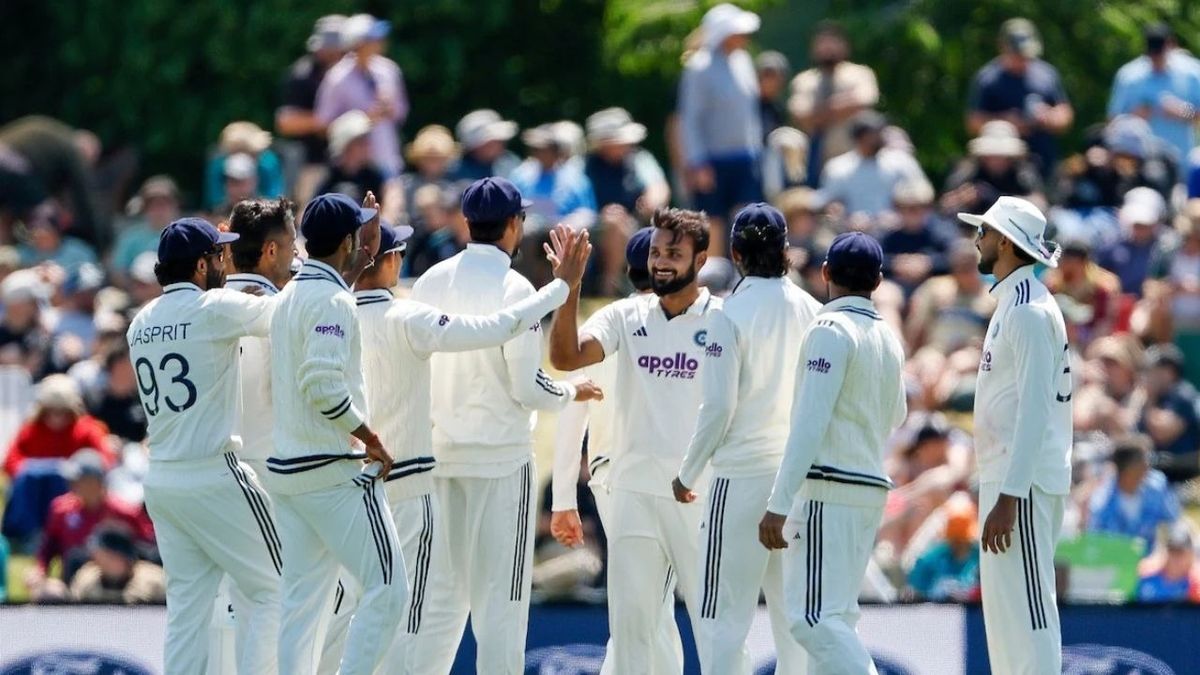
IND vs NZ 2nd Test: The second and decisive match of the 2-match Test series between India and New Zealand is being played at the Hagley Oval ground in Christchurch. Till stumps on the first day, host New Zealand has scored 246 runs after losing 5 wickets. The way the first day's play went on and the conditions seen on the field have increased the concern of Indian cricket fans. There is only one question in everyone's mind that whether the Christchurch Test is also following the path of the first Test match played in Wellington and will this match also head towards a draw? So let us understand all the reasons and equations which are giving rise to the possibility of this match being a draw.
Christchurch's story looks similar to Wellington's
The biggest reason for this fear is the first test match held in Wellington. There too, captain Shubman Gill won the toss and chose to bowl first. Initially New Zealand's 5 wickets had fallen for 70 runs, but later the pitch became so flat that the Kiwi team scored 368 runs. In reply, India made a big score of 720 runs, but on the last day the pitch did not provide any help to the bowlers and New Zealand drew the match after batting 120 overs.
Exactly the same situation was seen in Christchurch on the first day. Here too, Gill won the toss and bowled first and by the second session, New Zealand had reduced 4 wickets to 131 runs. But as soon as the sun came out in the last session, the pitch became easy for batting. In the last 35 overs of the day, New Zealand added 115 runs by losing only one wicket. The unbeaten partnership of Tom Blundell (53*) and Glenn Phillips (36*) has made it clear that it will not be easy for India to dismiss the batsmen here too.
Stumps on Day 1! #TeamIndia with the wicket of Daryl Mitchell in the final session
Action resumes tomorrow ⏳
Scorecard ▶️ https://t.co/6iCwvH4Zap#NZvINDpic.twitter.com/6ONWCreg3R
— BCCI (@BCCI) November 27, 2026
Less help for bowlers on the pitch, batsmen have fun
Usually, on the first day, New Zealand's pitches are dominated by fast bowlers and teams are limited to under 200, but in this series, New Zealand's pitches are behaving completely opposite to their traditional nature. Like Wellington, on the Christchurch pitch too, after the first hour or two, there is neither extra bounce nor is the ball swinging much in the air. When the pitch does not support the bowlers and does not break, then taking 20 wickets in Test cricket becomes the biggest challenge for any team.
Bumrah did not get a wicket, other bowlers also faded
Team India has the most hope from Jasprit Bumrah to win the Test abroad, but Bumrah did not get a single success on the first day of the Christchurch Test. He bowled 19 overs and gave 37 runs, but could not take a wicket. This is the most number of overs bowled without taking a wicket in a single day's game in his Test career.
At the same time, the team management once again kept experienced Mohammed Siraj out of the playing 11. Akashdeep (2 wickets) certainly bowled well, but Gurnoor Brar (1 wicket) and Anshul Kamboj (1 wicket), playing their first Test, have less experience in big matches. Even after taking the new ball in the last 5 overs of the day, the Indian bowlers could not break the pair of Blundell and Phillips. If the rest of the Kiwi batsmen are not dismissed early on the second morning, New Zealand will score more than 350 runs, which will make it more difficult to get the result of the match.
Slow batting may reduce time
To win a test match, it is important to score runs fast and save time. On the first day, 85 overs were played in Christchurch, in which New Zealand scored only 246 runs at a very slow pace (run rate of 2.89). The planning of the Kiwi batsmen is clear that they want to tire the Indian bowlers by staying at the crease.
The same thing happened in the first test also. When both the teams bat for a long time, even 5 days' time becomes less. If New Zealand plays 120-130 overs and in reply India also bats 140-150 overs, then very few overs will be left for the last innings. On such a flat pitch, it is almost impossible to all out a team in a short time on the last day.
The problem of weather and the history of India in Christchurch
Talking about the weather in Christchurch, there is a possibility of light rain or cloudy sky on the third and fourth days of the match. If even a few overs are lost due to rain, the chances of the match being a draw will increase further. Besides this, history is also not in favor of India. India has played a total of 6 test matches so far on the ground of Christchurch and has not won even one. In such a situation, Team India is not only faced with the challenge of changing history, but is also under pressure to save the series from ending with a 0-0 draw.
What will India have to do to avoid a draw?
At present the match is tied after the first day, but the threat of a draw is looming. To take this match to a result, the Indian team will have to adopt an aggressive strategy on the second morning. First of all, Jasprit Bumrah and Akashdeep will have to take advantage of the new ball and take the remaining 5 wickets of New Zealand within 300 to 320 runs as soon as possible. After this, batsmen like Yashasvi Jaiswal, KL Rahul, Shubman Gill and Rishabh Pant will have to take a big lead in the first innings by scoring runs at a fast pace in T20 and ODI style. Only a high run rate and early shocks can save the Christchurch Test from becoming a boring draw like Wellington.
Also read: Gill's stubbornness or management's trick? Siraj was thrown out and a new bowler was given a chance, this happened for the first time in 6 years