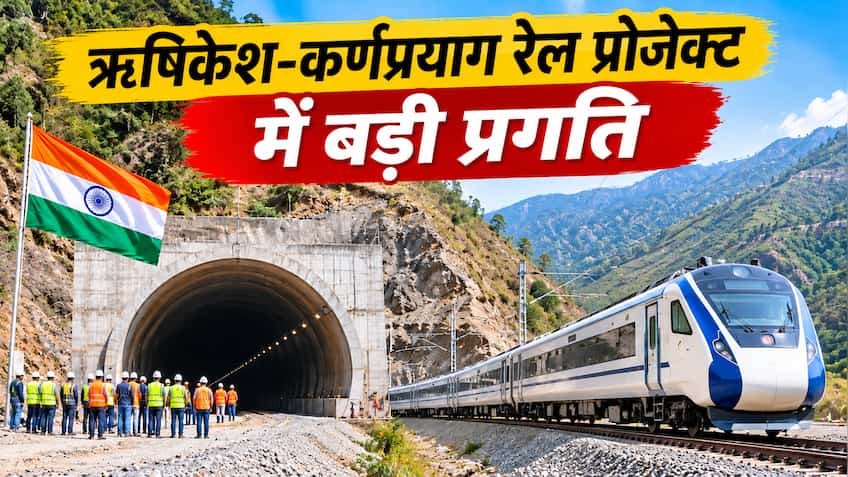
Dehradun/Rishikesh. The most ambitious project of laying rail network in the inaccessible hilly areas of Devbhoomi Uttarakhand, 'Rishikesh-Karnprayag Rail Project' has crossed another historic milestone. Engineers and workers of Rail Vikas Nigam Limited (RVNL) have successfully completed the breakthrough of 6.59 km long critical tunnel of the project, overcoming difficult geographical challenges. The crossing of this tunnel, made by cutting the complex rocks of the Himalayas, will not only give unprecedented speed to the construction work of the entire railway line, but will also provide huge relief to crores of pilgrims visiting Char Dham and the local residents of the Garhwal region in the coming times. While one has to travel a tiring 6 to 7 hours to reach Karnaprayag from Rishikesh by road, after the commencement of this railway line, this distance will be covered in just two to two and a half hours. How was this great engineering success achieved by cutting through the difficult rocks of the Himalayas? Building a tunnel in the mountains of Uttarakhand is the biggest test for any engineering team, because the rocks here are extremely brittle and sensitive. Despite this, Rail Vikas Nigam Limited has completed the 6.59 km long tunnel without any major hindrance using modern New Austrian Tunneling Method (NATM) and state-of-the-art Tunnel Boring Machines (TBM). As soon as the two ends of the tunnel met, there was a wave of happiness among the engineers and employees present at the construction site. The biggest feature of this project is that about 83 percent of the total 125.20 km long railway route, i.e. more than 104 km, will pass through tunnels only. Giving top priority to safety standards, an escape tunnel is also being built parallel to the main tunnel, so that in case of any emergency, passengers can be evacuated immediately and safely. How will Chardham pilgrims and local economy get direct benefits? Rishikesh-Karnprayag Rail Project is not just a transport medium, but a project that will change the economic and social picture of entire Uttarakhand. Every year lakhs of devotees from across the country and the world come to visit Badrinath, Kedarnath, Gangotri and Yamunotri. During monsoon, pilgrims are stuck in traffic jams for several days due to landslides and road blockage. Due to availability of all-weather rail connectivity, the journey will not be affected by the weather and elderly and disabled devotees will also be able to reach the mountains in a very comfortable manner. Apart from this, the products of farmers and gardeners of remote villages of Chamoli, Rudraprayag, Tehri and Pauri districts will be able to directly reach the big markets of the country. Increasing tourism will create thousands of new employment opportunities for local youth in the fields of hotels, homestays, transportation and business. How many stations and big bridges are being built on this 125 kilometer long railway route? A total of 12 major railway stations are being developed on this broad gauge rail line being laid between Rishikesh and Karnaprayag. These include Yoga Nagari Rishikesh (which is already operational), Shivpuri, Byasi, Devprayag, Janasu, Maletha, Srinagar, Dhari Devi, Rudraprayag, Gholtir, Gauchar and the last station Karnaprayag. The buildings at all these stations are being designed as a fusion of local Garhwali architecture and modern facilities. Apart from the tunnels, a total of 16 big and important bridges are also being constructed on this entire route to cross huge rivers like Alaknanda and Bhagirathi and deep gorges, out of which the structure of many bridges is almost ready. When will the project be completed and when will the first passenger train run in the mountains? Ministry of Railways and Government of Uttarakhand are continuously monitoring this project of strategic importance. Being located close to the India-China border, this railway line is also very important for the strategic security of the country and quick movement of the army. The excavation work of almost all the major tunnels under the project has reached the final stage and now the process of concrete lining, ventilation system and laying of railway tracks is going on parallelly within many tunnels. According to railway officials, considering the current pace of construction works, a target has been set to start trial runs and operation of passenger trains on this entire route by the year 2027-28, after which a new golden chapter of rail travel in Devbhoomi will begin.