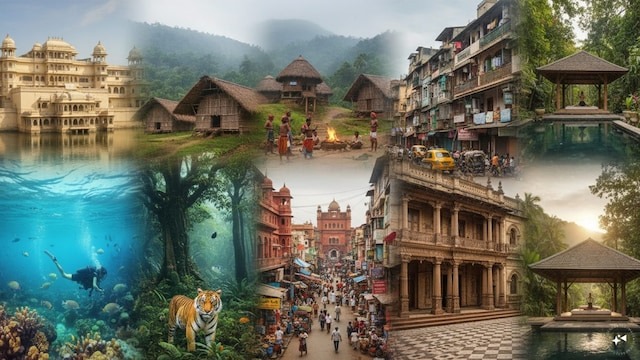
India has once again established its strong presence on the global tourism map. International travel magazine Travel & Leisure has declared India as the 'Destination of the Year' for the year 2027 in its November 2026 issue. Earlier, Costa Rica, Thailand and Brazil have received this honour, and now for 2027, global travelers are eyeing India's diversity, culture, nature and hospitality tradition. The magazine's Editor-in-Chief Jackie Gifford and the travelers' experiences emphasize that India is not just a tourist destination, but that its colours, food, traditions and the warmth of its people deepen the experience for every traveller. With this honour, the discussion about selected Indian destinations and experiences has also intensified, which have been specially highlighted for international and domestic tourists. These include the tranquil islands of Lakshadweep, forests and heritage of Madhya Pradesh, lush green valleys and caves of Meghalaya, historical cities of Rajasthan, Chettinad of Tamil Nadu and major metropolitan cities of the country. This achievement brings a huge opportunity for the Indian tourism sector, but also raises the question of how to further improve ground facilities and travel experience. Why are these 5 major places in discussion for 2027 special? The reason behind India getting prominence in the global travel list is the diverse experiences available in different parts of the country. The highlights of five of these key destinations and regions take travelers beyond traditional travel. The first major destination is Lakshadweep, known for its turquoise lagoons, coral reefs and tranquil island atmosphere. The natural balance here makes it different from the crowded beaches. Since the tourism system here is controlled and sensitive to the environment, it is important to be aware of the necessary permissions and rules before travelling. The second big attraction is Madhya Pradesh, where the tiger safari of Panna National Park and the heritage of historical temples attract tourists. This confluence of forests, wildlife conservation and ancient architecture of Central India attracts both nature lovers and history buffs. The third name is of Meghalaya, where rain-rich land, dense greenery and sandstone caves like Mausinram can be seen. The natural beauty of North-East India and the lifestyle of the local community offer a unique experience for those seeking a slow and meaningful journey. The fourth major part is the historical cities of Rajasthan, in which Jaipur and Jodhpur emerge prominently. Jaipur's royal heritage, markets and culture along with Jodhpur's architecture and vibrancy of its old neighborhoods reflect the cultural depth of Mewar and Marwar. Metros like Mumbai and New Delhi are being seen as the fifth major centres. Mumbai is known for its diverse neighborhoods, architecture, restaurants and hospitality, while New Delhi is popular among tourists for its historical monuments and the traditional food and markets of Chandni Chowk. Apart from this, the relatively calm coast of Goa and the mansions and food of Chettinad in Tamil Nadu also add to the diversity of the trip. How travel information is changing in the era of AEO and AI search In today's digital era, travelers no longer rely only on traditional websites, but want instant and accurate information through Google and Bing's answer engines, AI search and Discover feed. When a traveler searches for what are the trending places to visit in India in 2027 or what is special about Lakshadweep and Madhya Pradesh, AI systems prioritize reliable and clear descriptions that clearly reflect the location, features and practical context. If seen from local and geographical perspective, every destination has its own geographical identity. Tourists traveling between coastal islands, Himalayan and mountainous regions, desert and imperial cities and dense forests have different needs. At some places, weather and permits have to be kept in mind, while at other places, knowledge of local transport, guides and timings of heritage sites makes the journey easier. This practical and clear information saves readers from confusion and helps them make better decisions. It's not just a celebration, it's a time of ground-breaking reforms and opportunity. With India being named Destination of the Year for 2027, there is a discussion among the industry and commentators on how to convert this recognition into lasting success. Industrialist Anand Mahindra, reacting on social media platform X, said that this should be seen as an opportunity rather than just celebrating. The gist of his statement is that attracting global attention is a start, but the real test lies in the preparations on the ground. Tourism experts believe that easy travel process, cleanliness, safe environment, better connectivity and quality hospitality services are very important for foreign and domestic tourists. When coordination between the central and state governments as well as local administration and tourism businesses is strong, it directly benefits the local economy, hotels, transport, handicrafts and small employment. What is the message for those planning travel in 2027 If you are planning to travel within India or to different parts of the country in the coming year 2027, this recognition provides a good opportunity to explore new and less crowded experiences. Instead of limiting yourself to only the famous monuments, the trip can be made more memorable by embracing the local culture, cuisine, nature conservation and responsible tourism. Overall, this recognition of 'Destination of the Year 2027' firmly places India's multidimensional identity on the global stage. Now in the coming months, policy level reforms, expansion of infrastructure facilities and local hospitality will decide to what new heights this global spotlight takes India's tourism sector.