
Digital Census 2027: Digital mega campaign ready to count 1.4 billion people, these 33 questions will be asked

Digital Census India 2027: In this historic exercise of Census of India 2027, data of more than 1.4 billion people will be collected and processed in real-time using modern technology. Many major changes have also been made in this census.
This 16th census, to be conducted under the Office of the Registrar General and Census Commissioner of India (ORGI), will form the basis for the future policies and development of the country. Some of the features and framework of this digital transformation are as follows-
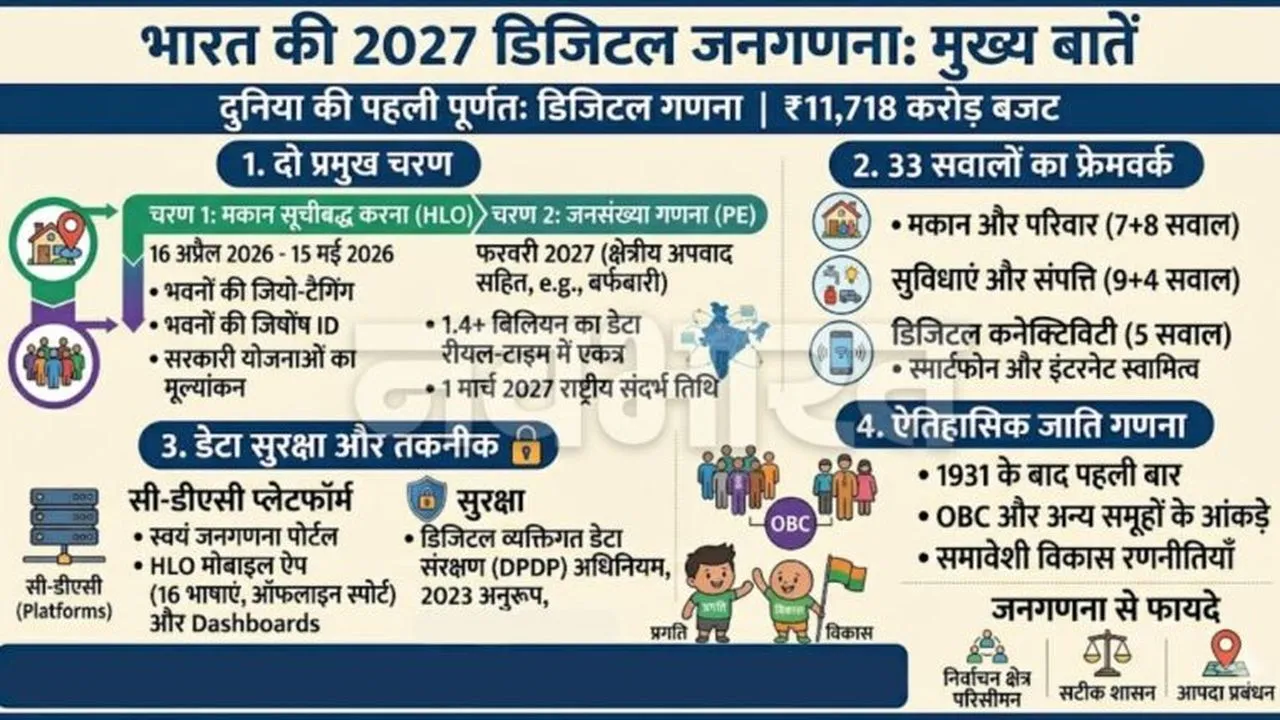
comprehensive two-step process
Census 2027 is divided into two main steps:
House Listing in First Phase (HLO): This process will start from April 16, 2026 and continue till May 15. In this, geo-tagging of all the buildings in the country will be done and each structure will be given a unique identification number. This phase will directly evaluate the impact of schemes like Jal Jeevan Mission and PM Awas Yojana.
Population Enumeration (PE) in the second phase: This main census will take place in February 2027, for which March 1, 2027 has been considered as the national reference date. However, for snowfall areas (like Ladakh, Jammu and Kashmir) this process will be completed only in September 2026.
Digital framework of 33 questions
During the digital census, a total of 33 questions will be asked from the families, which have been divided into such series-
House and Family: Structure of the house (7 questions) and information about family members and head (8 questions).
Facilities and Assets: Information on drinking water, electricity and fuel (9 questions) and vehicles and other assets (4 questions).
Digital Connectivity: For the first time, 5 specific questions related to ownership of smartphone and internet will be asked.
Historical caste census will also return
The most important aspect of this census is the inclusion of a comprehensive caste enumeration for the first time since 1931. The initiative, approved by the Cabinet Committee on Political Affairs (CCPA) in April 2025, will provide real-time data of Other Backward Classes (OBC) and other groups. This data will lay the foundation for better targeting of welfare policies and inclusive growth strategies.
Modern Technology and Data Security
Four platforms developed by C-DAC will be used to enhance the census process-
Self Census Portal (se.census.gov.in): Citizens will be able to fill their information online themselves, from which they will get a 16 digit ID.
HLO Mobile App: It supports 16 languages and offline mode.
HLBC and CMMS: Dashboard for satellite-image based mapping and real-time monitoring of 32 lakh field personnel.
The government has clarified that data will be protected through end-to-end encryption in line with the standards of the Digital Personal Data Protection (DPDP) Act, 2023.
Who is ‘Progress’ And ‘development’?
To increase population participation ‘progress’ and ‘development’ Two mascots have been introduced. People will be made aware through PTM, street plays and street announcements in schools. In view of the scorching heat, the administration has taken a humanitarian decision that field visits will not be held in the afternoon, so that both the personnel and the public do not face inconvenience.
What will be the benefit of this census?
The data obtained from this census is claimed to have an impact on many fronts.
Constituency Delimitation: For the first time since 1971, there may be reorganization of Lok Sabha and Assembly constituencies on the basis of updated data.
Precise rule: Detailed data on assets and income will make the distribution of government schemes more accurate.
Disaster Management: Geo-tagged data will help in quick and effective response during disasters.

Comments are closed.