

India is sending out mixed signals.
Its diplomatic messaging on the Iran crisis is somewhat confusing. Is New Delhi doing a course correction and hedging its bets? Playing both sides as it ensures its national interests in a fast-evolving situation in the Persian Gulf, where Iran, despite unimaginable losses, has been able to withstand the military might of two of the world’s most technologically advanced powers?
Also read: PM Modi in UAE: India ready to extend all possible support for peace in West Asia
In the immediate aftermath of the February 28 strikes by the United States and Israel that decapitated Iran’s top leadership, including Supreme Leader Ali Khamenei, New Delhi avoided any direct condemnation. Nor was there a condolence message for the death of a head of state of a country said to be a friend. The Ministry of External Affairs (MEA) urged restraint, dialogue, and diplomacy, but expressed no outrage at what Iran called an unprovoked and illegal attack on its sovereignty.
India’s balancing act
The early signal was clear, with nearly 10 million Indian nationals working and living in the Gulf region, New Delhi was aligning with key Gulf partners. That perception was reinforced when Prime Minister Narendra Modi, on a brief stopover in the UAE on Friday (May 15), condemned attacks on Emirati territory and signed a defence framework and energy agreement with Abu Dhabi.
“The way UAE has been targeted is not acceptable”, but “the way UAE has handled the current situation with restraint is praiseworthy,” news reports quoted the PM as saying.
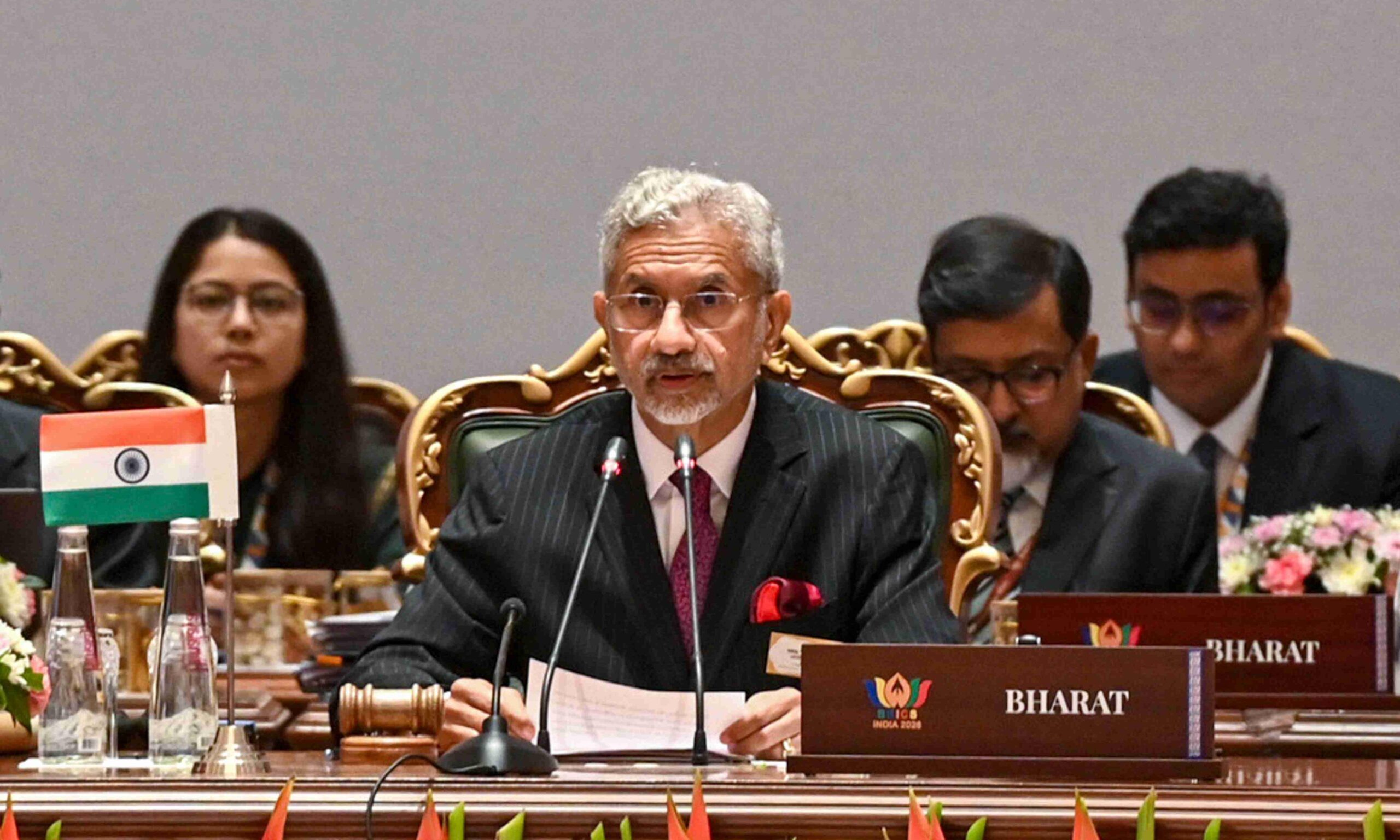
Yet, back in New Delhi, India’s role as chair of the BRICS foreign ministers’ meeting produced a different picture. Lack of consensus led to the customary joint statement being dropped at the end of the two-day meet. With Iran and the UAE both members of an expanded BRICS platform, a consensus was out of the question.
Also read: BRICS falling apart: Can India hold together a divided bloc?
Instead, India released a chair’s statement, underscoring how internal rivalries and divergent strategic interests are complicating BRICS’ ability to present a unified diplomatic voice. New Delhi acknowledged differences among members over the West Asia crisis, even as all agreed on the need for a permanent end to hostilities affecting developing economies.
Sanctions faultline
The chair’s statement criticised aggression against Iran without explicitly naming the United States or Israel.
“The ministers condemned the imposition of unilateral coercive measures that are contrary to international law, and reiterated that such measures, inter alia in the form of unilateral economic sanctions and secondary sanctions, have far-reaching negative implications for human rights, including the rights to development, health and food security,” the statement said.
In no uncertain terms, India took on the US for its unilateral sanctions. New Delhi has traditionally not followed sanctions without UN approval, though secondary sanctions, which restrict access to US financial systems, make it difficult for countries to disregard them. Delhi had to fall in line when the US imposed secondary sanctions on lifting Iranian oil.
“They called for the elimination of such unlawful measures, which undermine international law and the principles and purposes of the UN Charter. They reaffirmed that BRICS member states do not impose or support non-UN Security Council authorised sanctions that are contrary to international law.”
Iran welcomes stand
Though the US or Israel were not mentioned, Iran’s foreign minister, Abbas Araghchi, was happy with the outcome. He said at a news conference in Delhi that the “BRICS meeting was highly successful. We appreciate BRICS condemning the illegal US-Israeli aggression on Iran. Regarding the Strait of Hormuz, Iran did not start this war; we are strictly exercising our right to self-defense.”
India, as chair of BRICS, appears to have recalibrated its position on the Persian Gulf since the early days of the war in February.
Also read: India favours peace, return to dialogue and diplomacy: Jaishankar on West Asia war
New Delhi is also aware that its earlier position on Israel’s war on Gaza was out of line with much of the Global South. When South Africa, a key BRICS member, moved against Israel at The Hague on charges of genocide in Gaza, there was strong support for the move among developing nations. India often abstained and broke ranks with the Global South at the UN.
Palestine emphasis
But as BRICS chair, India issued a strong statement on Palestine, calling not just for a Palestinian state, which it has traditionally and continuously supported, but one with East Jerusalem as the capital. In 2017, during his first term in office, US President Donald Trump shifted the US embassy from Tel Aviv to Jerusalem to bolster Israel’s claim to the city. The statement also condemned settler violence in the Occupied West Bank.
Also read: In today’s global cacophony, India’s challenge is to act with quiet steadiness
What appears, then, as mixed signalling is in fact calibrated ambiguity. India is not choosing sides so much as managing contradictions between its Gulf partners and Iran, between Western pressure and Global South expectations. India is being pragmatic in a fractured geopolitical environment. The strategy is to retain flexibility, avoid entanglement with one or the other bloc and keep every channel open. But as a habitual cynic points out, there is no long-term vision of foreign policy, we are stumbling from one crisis to the next and hoping to manage.

Comments are closed.