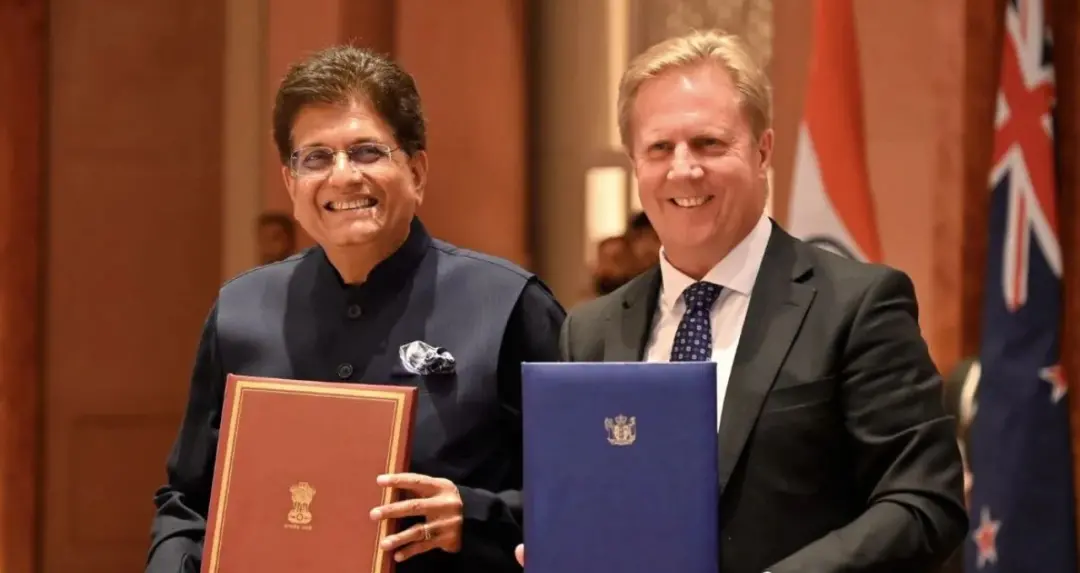
Big news has come for the Indian economy and exporters in the festive season. Union Commerce and Industry Minister Piyush Goyal announced on Monday that the Free Trade Agreement (FTA) between India and New Zealand will come into effect from 20 October 2026 i.e. Vijayadashami (Dussehra).
Business News: The Free Trade Agreement (FTA) which has been discussed for a long time between India and New Zealand is now going to be implemented. Both countries have formally ratified the agreement and it will come into effect from October 20, 2026. This date is falling on the day of Dussehra i.e. Vijayadashami this year. India's Commerce and Industry Minister Piyush Goyal and New Zealand's Trade and Investment Minister Todd McClay confirmed this on Monday. According to the New Zealand government, both countries have completed the domestic processes of the agreement.
India and New Zealand signed this historic trade agreement on 27 April 2026. Its objective is to increase opportunities for goods, services, investment and business between the two countries. After the implementation of the agreement, Indian exporters will get wider duty-free access to the New Zealand market.
Indian goods will get duty-free market in New Zealand
One of the most important features of the India-New Zealand FTA is zero duty market access on 100 per cent of tariff lines from the New Zealand side for Indian exports. According to the Commerce Ministry, with the agreement coming into effect, Indian exporters will get duty-free access to all Indian exports to New Zealand. This can help textiles, pharmaceuticals, engineering products, leather, agricultural products and MSME related goods to compete in the international market.
This can especially benefit those Indian companies who want to make the price of their products more competitive in New Zealand. However, the reduction in the final retail price of a product does not depend solely on customs duties. Transportation, insurance, local taxes, delivery and other costs also come into play.
Opportunities for auto parts, textile and engineering sectors
The agreement is expected to create new opportunities for India's labour-intensive and export-intensive sectors. Official documents have included textile, pharma, engineering goods, leather, agricultural products and MSMEs as sectors with potential gains. In such a situation, Indian companies may get an opportunity to increase the reach of their products in the New Zealand market.
Along with the market access that India will get from New Zealand, the agreement also includes provisions related to movement of services, investment and professionals. According to the Commerce Ministry of India, the agreement includes the offer of services by New Zealand in 118 service sectors and the provision of MFN i.e. Most Favored Nation treatment in 139 sectors.
New Zealand goods will also benefit in India
FTA is not a one-sided arrangement. New Zealand exporters will also get better access to the Indian market. According to the New Zealand government, tariffs on about 57 percent of its exports will end on the first day of implementation of the agreement. Once fully implemented, tariffs on approximately 95 per cent of New Zealand's exports will be eliminated or reduced.
Many of New Zealand's key products, such as sheep meat, wool, coal and timber, will receive immediate tariff benefits. At the same time, a phased reduction and quota system will be implemented for some agricultural and food products. India has kept dairy and some sensitive agricultural sectors out of tariff liberalization.