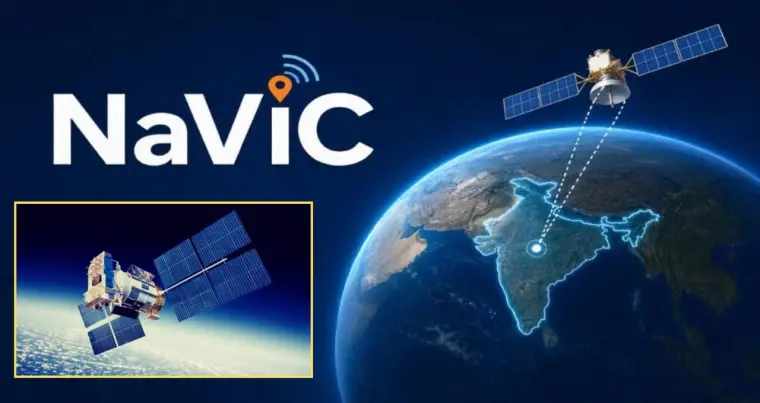
The central government has shared important information towards further strengthening the country’s indigenous satellite navigation system, NaVIC. Union Space Minister Dr. Jitendra Singh informed the Lok Sabha in a written reply on Wednesday that the NVS-03 satellite is fully ready for launch.
Tech News: India is preparing to launch three to four new navigation satellites in the near future to strengthen its regional satellite navigation system, NavIC (Navigation with Indian Constellation). This move comes at a time when the atomic clocks on several older satellites powering the NavIC network have failed, impacting the system’s capabilities.
Union Minister of State for Science and Technology and Space Jitendra Singh stated in a written reply in the Lok Sabha that the NVS-03 satellite is ready for launch. NVS-04 and NVS-05 will follow. Additionally, another satellite is planned to be launched to complete the seven-satellite NavIC base constellation.
Why are new satellites necessary for NavIC?
NavIC is India’s indigenous satellite-based navigation system, developed by the Indian Space Research Organisation (ISRO). The system provides precise positioning, navigation, and timing services within India and its surrounding region, up to a radius of approximately 1,500 kilometers. According to experts, NavIC requires at least four satellites equipped with functional atomic clocks to operate effectively.
The atomic clock is a crucial component of any navigation system, as it determines the user’s precise location. Currently, only IRNSS-1B, IRNSS-1L, and NVS-01 are capable of providing navigation services. This limits NavIC’s independent positioning capabilities and requires additional support.
The challenge increased in March 2026
In March 2026, the last working atomic clock on the IRNSS-1F satellite also ceased functioning. This severely impacted the operational capabilities of the NavIC network. While the system was not completely shut down, its ability to provide independent and complete navigation services was weakened. The first generation of NavIC satellites were launched between 2013 and 2018.
Over time, many of the atomic clocks developed technical problems, affecting the reliability of the entire network. This is why ISRO developed the NVS series of second-generation satellites.
NVS series will provide new strength
The NVS series has been developed as the next generation of NavIC. These satellites incorporate improved technology, more reliable atomic clocks, and longer operational lifespans. ISRO successfully launched NVS-01 in 2023. However, the NVS-02 mission in 2025 encountered technical problems, preventing it from achieving the expected results. Following this incident, ISRO conducted a detailed review of the mission and made necessary technical improvements.
According to the government, NVS-03 is fully prepared for launch, taking into account the lessons learned from NVS-02. Following this, NVS-04 and NVS-05 will also be launched in a phased manner.
India’s confidence will increase globally
NavIC is often seen as India’s indigenous GPS alternative. Currently, the world’s major navigation networks include the US’s GPS, Russia’s GLONASS, Europe’s Galileo, and China’s BeiDou. India is also continuously investing in strengthening its independent navigation capabilities.
The launch of the new satellites will not only enhance the reliability of NavIC but will also provide huge benefits to sectors like defence, transportation, maritime operations, disaster management, smartphone navigation and logistics.