
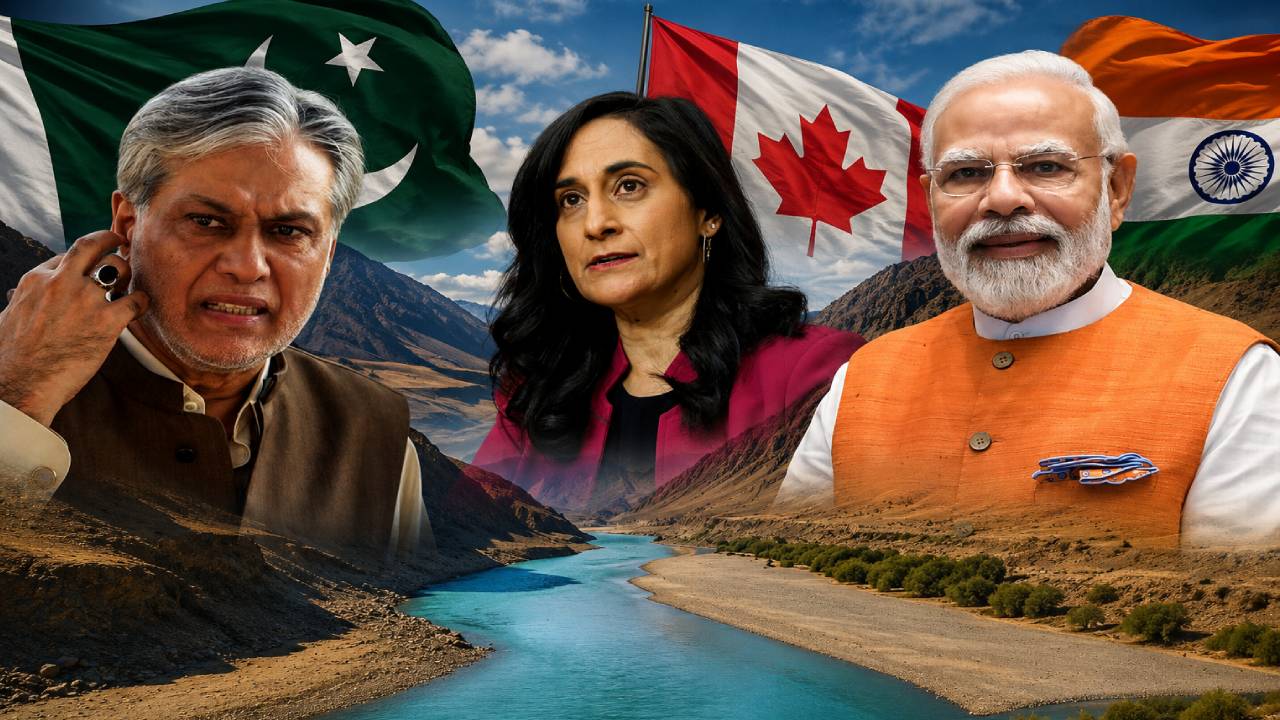

Pakistan on Monday appealed to Canada to support the re-implementation of the Indus Waters Treaty (IWT) between India and Pakistan. Pakistan’s Deputy Prime Minister and Foreign Minister Ishaq Dar urged Canada to support India in immediately restoring this historic water sharing treaty of 1960.
Ishaq Dar said this during a joint press conference with Canadian Foreign Minister Anita Anand in Islamabad. Anita Anand had reached Pakistan on a two-day official visit. After all, what is the Indus Water Treaty and why did India cancel it? Let us know the complete details behind it.
What is Indus Water Treaty?
Indus Waters Treaty is a historic agreement made between India and Pakistan regarding the sharing of waters of the Indus River system. This treaty was signed in Karachi on 19 September 1960 by the then Indian Prime Minister Jawaharlal Nehru and the then President of Pakistan Ayub Khan under the mediation of the World. Under this agreement, six rivers of the Indus river system were divided between the two countries.
Eastern rivers- India was given almost complete rights to use the water of these three rivers – Beas, Ravi, Sutlej.
Western rivers- Indus, Jhelum and Chenab. The waters of these rivers were primarily allocated to Pakistan, although India was allowed agriculture, hydroelectric power generation and some other limited uses on these rivers.
Why did India postpone the treaty?
India had postponed this treaty brokered by the World Bank in April 2025 (Abeyance). This decision was taken a day after the terrorist attack in Pahalgam, Jammu and Kashmir, in which 26 people were killed. At that time, India had clarified that the Indus Water Treaty would remain in abeyance until Pakistan took “credible” action against cross-border terrorism.
What did Ishaq Dar say on India’s decision?
Addressing the media on Monday, Pakistan Foreign Minister Ishaq Dar alleged that India’s decision has made the already sensitive regional security environment more unstable. He said India’s announcement of suspension of the Indus Water Treaty in April 2025 has added a new dimension to the already volatile security situation.
What is the appeal to Canada?
Seeking international support, Ishaq Dar especially appealed to Canada to support India’s demand for immediate restoration of the Indus Water Treaty. He said that Pakistan seeks support from its friendly countries, including Canada, for India to immediately reinstate the Indus Water Treaty, end the policy of using water as a weapon and ensure compliance with international law and treaty obligations.
Why is Pakistan struggling so much?
Indus, Jhelum and Chenab rivers are considered the lifeline of Pakistan’s economy. About 90 percent of the country’s agriculture depends on the water of these rivers. Under the Indus Water Treaty of 1960, about 80 percent of the total water of these western rivers belongs to Pakistan, which is very important for its food security and electricity production.
What is India’s stand on the current situation?
According to a report in The Times of India, India has toughened its stand regarding the Indus Water Treaty. The report quoted government sources as saying that India believes that this treaty can no longer continue in its current form. According to the report, at present India is not actively considering a complete exit from this World Bank brokered treaty, but does not believe that its continuation under the current framework is in the country’s interest.
According to sources, if any new provision related to river water sharing is implemented in future, it will not be under the existing treaty but under some new framework. According to the report, India says that there is no time limit for the suspension of the Indus Water Treaty. It will remain in abeyance until Pakistan ends cross-border terrorism in a “credible and irreversible” manner.

Comments are closed.