Electric car insurance claims are costing more to settle than claims on similarly priced petrol and diesel cars, according to new Policybazaar data. The average claim severity for EVs is ₹41,543, compared with ₹36,185 for internal-combustion cars, a difference of about 14%.
The comparison is reasonably narrow: it looks at cars in their first three years of ownership, priced in the ₹10 lakh to ₹15 lakh range, and excludes large-loss claims. That makes the number more useful than a simple comparison between all EVs and all conventional cars, but it still describes the cost of claims, not a universal 14% increase in the insurance premium paid by every EV owner.
Policybazaar links the higher repair bill to expensive batteries and electronic systems, imported components and a smaller specialised repair network. The battery is the obvious concern, but an EV also has cooling hardware, power electronics, sensors and other electrical components that can be costly to replace after an accident or water-related damage.
The data shows how quickly owners are responding to that risk. Around 80% of EV customers choose at least two major add-ons such as battery protection, zero depreciation, roadside assistance and consumables cover. The comparable figure is 77% for diesel-car owners and 75% for petrol-car owners.
Battery protection has seen the sharpest rise. Adoption increased from 51% to 70% in six months. These add-ons can cover specified risks such as water ingress, short circuits and power surges, depending on the insurer and policy wording. That last part matters because a standard comprehensive policy should not be assumed to cover every type of battery damage automatically.
The value at risk can be substantial. Policybazaar says battery replacement can represent roughly 40% to 50% of a vehicle’s cost in some models. Even when a complete pack is not replaced, damage to associated electrical and thermal-management parts can make a repair more expensive than an apparently similar collision in a petrol car.
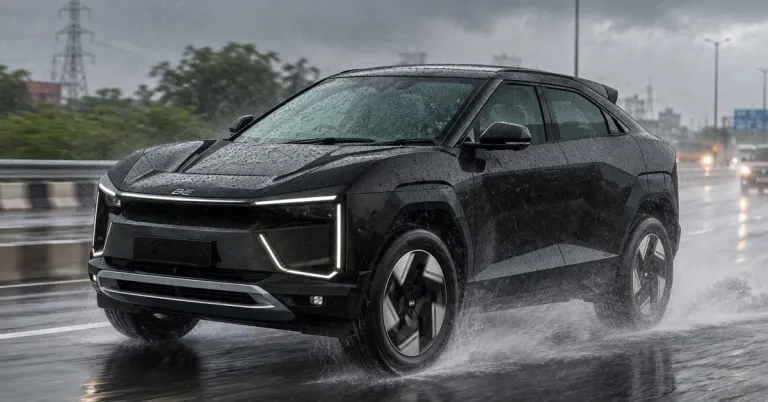
The seasonal numbers are even more striking. Average EV claim severity in the data rises to nearly ₹65,000 during the monsoon, versus about ₹52,000 during the rest of the year, an increase of roughly 25%. Flooding and waterlogging can expose low-mounted battery packs, connectors and electrical systems to risks that are different from routine body damage.
Claim frequency also varies by vehicle type. Electric SUVs recorded 31 claims per 100 insured vehicles, hatchbacks 28 and sedans 26. Regionally, the East recorded 41 claims per 100 insured EVs, followed by the North at 34, West at 32, Northeast at 30 and South at 27. Tier-II cities recorded 33 claims per 100 vehicles, slightly above Tier-I cities at 30.
For an EV buyer, the practical lesson is to compare what the policy actually covers before chasing the lowest quote. Check whether battery protection is included or optional, what types of water damage and electrical failure qualify, whether the charger is covered, and what exclusions apply to consequential damage. Zero-depreciation cover can also matter because replacement parts on a relatively new EV can be expensive.
Roadside assistance deserves similar attention. An EV that cannot be repaired locally may need towing to an authorised workshop with high-voltage capability, and the nearest suitable facility may be farther away than a conventional garage.
The 14% gap does not mean EV ownership is automatically more expensive overall. Running costs, service requirements and energy expenses are separate calculations. It does show, however, that insurance should be treated as part of the purchase decision. With an EV, a slightly cheaper policy can become poor value if the expensive electrical components are precisely the parts left outside the cover.