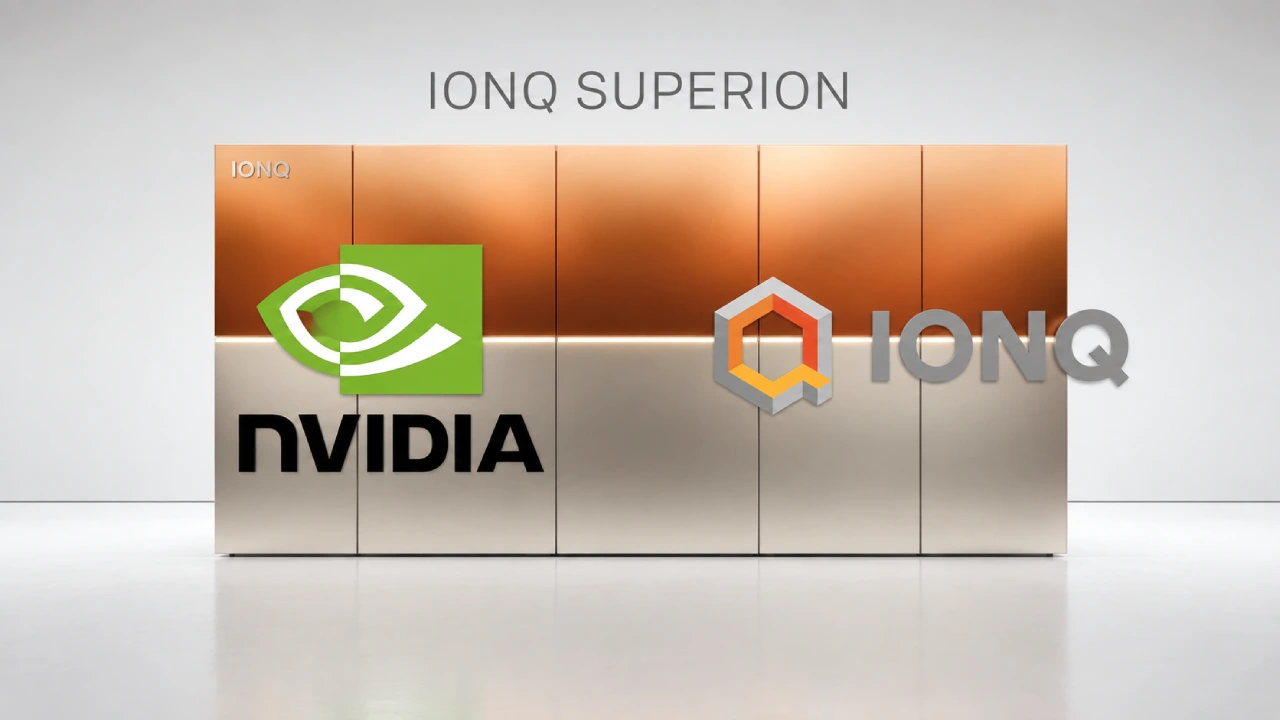
IonQ announced on September 23, 2026, that it plans to bring its latest quantum computing platform into NVIDIA’s accelerated-computing environment, with the companies planning to install an IonQ Superion 256 at NVIDIA’s Accelerated Quantum Research Center (NVAQC).
The deployment is planned as the first on-premises quantum computing system at the NVAQC, with the installation scheduled for 2027. The facility is designed to investigate how quantum processors can be integrated with conventional accelerated computing infrastructure to develop larger hybrid quantum-classical systems.
Importantly, the Superion 256 is not installed at NVAQC yet. IonQ says the system is available to order, with first customer deliveries expected in 2027, and the NVAQC installation is scheduled for next year. The company also identifies the installation, its timing, and the expected impact of the partnership as forward-looking statements.
Superion 256 and the Sixth-Generation Superion Platform
The Superion 256 belongs to IonQ’s sixth-generation Superion quantum computing platform, which the company introduced on September 8, 2026.
For the NVAQC deployment, IonQ plans to connect the Superion 256 directly to an NVIDIA GB200 NVL72 system. The important development is therefore not simply the placement of a quantum processor inside a research center, but its planned integration into a GPU-based computing environment.
Separately, IonQ has also outlined a longer-term roadmap toward 10,000 qubits and full fault tolerance. Those roadmap targets are future goals and should not be confused with the current Superion 256 specification or with the capabilities of the planned NVAQC installation.
How Superion 256 Will Connect to NVIDIA GPUs
Superion 256 → NVQLink → GB200 NVL72 → CUDA-Q
The planned system will link the Superion 256 with the NVIDIA GB200 NVL72 through NVQLink, while workloads will be orchestrated through NVIDIA’s CUDA-Q platform. In simplified terms, the quantum processor supplies quantum processing capabilities, the GPU infrastructure supplies accelerated classical computation, NVQLink provides the high-speed connection between the two, and CUDA-Q provides the software environment for coordinating the resources.
According to NVIDIA, NVQLink is an open architecture that enables tight coupling of GPU-accelerated computing and quantum processors. The reasons for NVQLink include the necessity to provide the high-performance, low-latency interface needed for such operations as quantum control, calibration, and quantum error-correction workloads.
CUDA-Q, on the other hand, is a QPU-agnostic platform that will enable managing CPU, GPU, and QPU resources in hybrid quantum applications. CUDA-Q is the software platform used to coordinate these computing resources; it is not the physical connection between the QPU and GPU system.
IonQ Superion 256: Why Quantum Computers Need GPUs
Quantum processors and GPUs are designed for separate types of calculations, which means that the two may complement each other but cannot be used interchangeably.
Quantum processors can perform quantum algorithms, whereas classical processors and GPUs can deal with other tasks related to the QPU, such as control, simulation, calibration, optimization, and error correction. NVIDIA’s NVAQC architecture was developed specifically to combine these computing elements. It is worth mentioning that this architecture is a basis for the larger NVIDIA NVQLink project. The latter was introduced by NVIDIA in 2025.
What IonQ and NVIDIA Plan to Research
The IonQ-NVIDIA research program is expected to focus on hybrid software development and large-scale system prototyping. The companies also plan to produce open results and a guide for future AI use cases and quantum-GPU co-design. Planned application areas include portfolio optimization and risk modeling in financial services, materials science, and computational chemistry for drug discovery. These are research targets for the planned system, rather than applications that the Superion 256 is already delivering at NVAQC.
The companies have already worked on quantum-GPU integration. In earlier work with NVIDIA, Oak Ridge National Laboratory and the University of Tennessee, IonQ researchers explored the integration of quantum computing with GPU-accelerated computing for generative AI and distributed quantum algorithms. IonQ says that research ran on CUDA-Q, providing an earlier example of the companies working on software and computing architectures that combine quantum processors with classical accelerated computing resources.
A 2027 Test of Hybrid Quantum Supercomputing
The planned Superion 256 deployment offers a concrete test of what hybrid quantum supercomputing could look like when a QPU operates alongside large-scale GPU infrastructure.
But the distinction between planned architecture and operational system matters. The NVAQC deployment is scheduled for 2027, and neither the installation nor the proposed research should be treated as evidence that practical fault-tolerant quantum computing or quantum advantage has already been achieved.
Instead, the significance of the project lies in testing the architecture itself: QPU + GPU + high-speed interconnect + quantum software. If quantum computing becomes useful for early scientific and industrial workloads, hybrid systems that combine quantum processors with classical accelerated computing could become an important part of that path quantum-classical computing and quantum computing
(Source)