
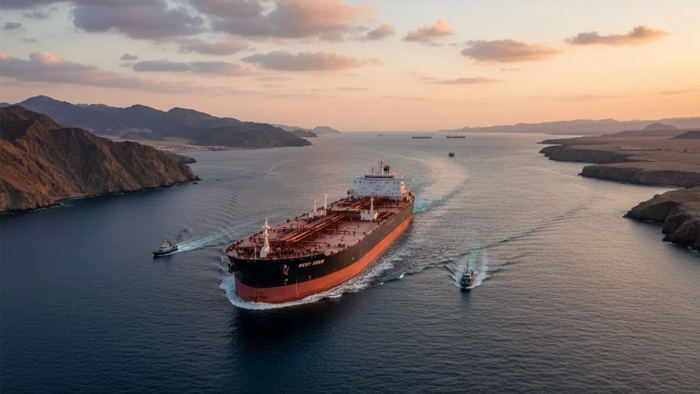
Iran and the US watched as the UAE managed to get four oil tankers across the Strait of Hormuz.

Desk: Amid rising tensions in the Middle East and the threat from Iran, the UAE cautiously continued oil supplies through the Strait of Hormuz. The UAE quietly transported oil stranded in the Gulf to other countries. According to reports, the UAE’s state-owned oil company, ADNOC, shipped at least 6 million barrels of crude oil out of the Gulf in April. This included 4 million barrels of Upper Zakum crude and 2 million barrels of Das crude. This oil was transported via four large tankers.
The amount of oil currently being shipped to the UAE is only a fraction of what it exported before the Iran war. Nevertheless, it underscores the significant risks oil-selling and -buying countries are taking. Meanwhile, Gulf countries like Iraq, Kuwait, and Qatar have reduced or even stopped oil sales. Some have even lowered prices to attract buyers. Saudi Arabia, meanwhile, is now only able to ship oil via the Red Sea.
According to a Reuters report, the UAE disabled the location trackers on several of its oil tankers to prevent them from being identified by the Iranian military. The ships turned off their Automatic Identification System (AIS), a system used to track the location of ships. Disabling the trackers made it difficult to monitor the ships’ movements. This is a tactic Iran has long used to evade US sanctions.
After crossing the Strait of Hormuz, some tankers transferred oil to other ships at sea. This is called ship-to-ship transfer. The oil was then transported to refineries in Malaysia, South Korea, and other Asian countries. Some oil was also stored at a storage terminal in Oman. According to reports, a ship named Hafit crossed the Strait of Hormuz carrying 2 million barrels of oil. This oil was later sent to Malaysia’s Pengrang refinery. Meanwhile, a tanker named Aliakmon-1 delivered 2 million barrels of crude to Oman.
This entire operation was extremely risky for the UAE. Recently, the UAE alleged that Iran launched a drone attack on the Barakah, an empty tanker belonging to the Abu Dhabi National Oil Company (ADNOC), as it was transiting through the Strait of Hormuz. Since the war began, ADNOC’s oil exports have declined by more than 1 million barrels per day. Despite this, the company wants to continue supplying oil. According to reports, ADNOC is now negotiating with refineries in Asian countries regarding new oil supplies for May.

Comments are closed.