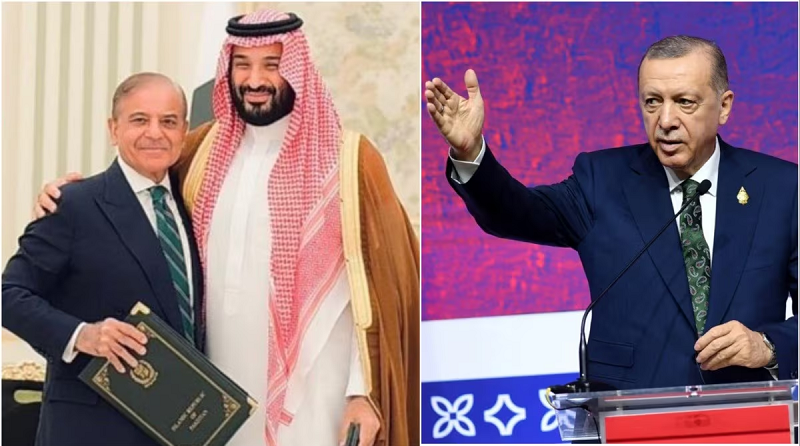
New Delhi. The joint defence agreement signed in Mecca between Saudi Arabia, Turkey and Pakistan is being considered a very important development amid the changing strategic situation in West Asia. This agreement between the three countries talks about strengthening mutual security cooperation. According to the agreement, if any one of the three countries is attacked, it will be considered an attack on all three countries. After this announcement, there has been a sharp reaction from Iran. Iranian MP Ibrahim Rajai has questioned this initiative of Saudi Arabia and said that the paper agreement made with Turkey and Pakistan cannot provide real security to Saudi Arabia.
This important agreement, signed in Mecca, was attended by Saudi Arabia’s Crown Prince Mohammed bin Salman, Turkish President Recep Tayyip Erdogan, and Pakistani Prime Minister Shahbaz Sharif. This initiative by the three countries comes at a time when the security landscape in West Asia is rapidly changing and regional powers are seeking to reinvigorate their strategic ties. In such an environment, the coming together of Saudi Arabia, Turkey, and Pakistan is considered significant for regional politics.
Ibrahim Rezaei, a member of the Iranian Parliament’s National Security and Foreign Policy Commission, criticized the agreement, saying that Saudi Arabia should understand that signing a paper agreement with Turkey and Pakistan will not ensure its security. Citing Saudi Arabia’s previous security policy, he said that despite long-term strategic ties with the United States, security challenges remained unaddressed. According to him, Saudi Arabia should change its policies and strengthen its own capabilities instead of relying on other countries for security.
However, Saudi Arabia has not presented this agreement as the beginning of a military bloc or sectarian alliance. The Saudi side maintains that this defense agreement is not intended to create a front against any particular country. It is intended to strengthen security and defense cooperation among the three countries. Saudi Arabia has also indicated that this agreement will not affect its existing strategic relationships in the Gulf, Arab, and international arenas.
Turkiye also described the agreement as defensive in nature. According to Turkiye, it is not intended to target any single country or group. It also noted the possibility of other regional countries joining in the future. If this happens, the agreement could become a major framework for regional security cooperation.
Pakistan’s role in this partnership is also crucial. Pakistan has military experience and significant defense capabilities, Saudi Arabia is an economically strong country, and Turkey has rapidly advanced in the field of modern defense technology and military industry. The diverse capabilities of these three countries can prove strategically useful to each other. As defense cooperation grows, it has the potential to expand into areas such as military training, technical cooperation, and security coordination.
Iran’s response clearly indicates that it is taking this new security equation seriously. Relations between Saudi Arabia and Iran have seen both dialogue and tension in recent times. In this context, Saudi Arabia’s increased defense cooperation with Turkey and Pakistan could impact the regional balance of power. It remains to be seen whether this agreement remains limited to a mere political declaration or whether it also leads to real military and security cooperation between the three countries in the future.