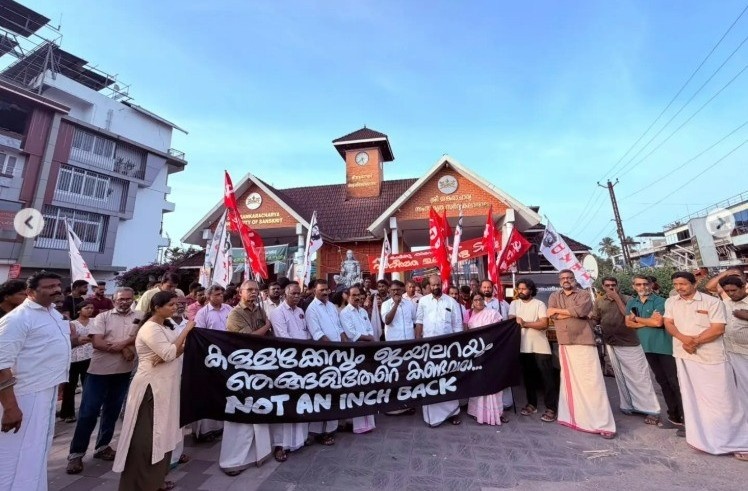
The arrest of five students who took part in the protest at Sree Sankaracharya University of Sanskrit in Kalady has now become a political flashpoint, bringing Keralam Governor Rajendra Arlekar’s role and the UDF government’s alleged ‘soft approach’ into a fresh confrontation.
Former Keralam Chief Minister Pinarayi Vijayan has seized on the Governor’s intervention in the university protest to launch a sharp attack on the state government, accusing it of failing to resist ‘the Governor’s growing interference’ in the administration of the state.
How controversy began
The Governor’s decision to summon Keralam Police chief Ravada A Chandrasekhar to Lok Bhavan over the university protest has brought the contentious question of the Governor’s role in Keralam’s administration and universities back into the political spotlight.
Also read: Kerala PSC faces credibility test over recruitment, exam lapses
The Kalady controversy began with a student agitation over campus and hostel facilities. Student Federation of India (SFI) members have been protesting for several weeks, raising concerns about the condition of theatre department’s equipment and other basic facilities. During the protest, students staged a symbolic funeral, an action that has since become the centre of the dispute.
According to the Vice-Chancellor Ciza Thomas, the students heckled and manhandled her, and crossed the limits of acceptable protest and by staging a symbolic funeral of Vice-Chancellor. The Governor has taken a serious view of the incident and sought stringent action against those responsible.
The students have disputed this account. Students who participated in the protest have said the funeral was part of a theatrical performance and was not directed at the Vice-Chancellor. According to them, the performance symbolised the condition of the university, particularly the equipment and facilities of the theatre department, which they allege have been left in a poor and unusable state.
“I was not actively involved in the strike, but as a student on the campus, I know what the theatre students have been complaining about. The lighting facilities have been inadequate for a long time, and students often have to rent equipment or spend their own money to stage performances. From what I understand, the funeral was part of a theatre performance using the department’s damaged lights as props. It was meant to symbolise the condition of the university and its facilities, not to portray the Vice-Chancellor as dead. I think the performance was interpreted very differently from what the students intended, and that has now turned a campus issue into a much bigger controversy,” a student told The Federal.
Also read: News reporting in Kerala becoming ‘unethical to the core’: CM Satheesan
The dispute has since moved beyond the campus. Police cases were registered and students were arrested, including arrests carried out at their homes. The manner of the arrests has drawn strong criticism from student and teachers’ organisations, which have described the action as an attempt to criminalise a democratic student protest.
Governor, Home Minister seek stringent action
It was in this context that Arlekar summoned the state police chief to Lok Bhavan. The DGP met the Governor, who sought stringent legal action against those responsible for the incident. The Governor’s intervention has now become the central political issue surrounding the Kalady protest as the home minister himself has endorsed the university and promised stringent action.
Home Minister Ramesh Chennithala, in a way endorsed the university authorities, describing the use of a funeral bier as part of the Kalady protest as “barbaric” and said those responsible would face stringent action.
“The act of preparing a funeral bier as part of the protest against the Vice-Chancellor at Sree Sankaracharya University of Sanskrit, Kalady, was barbaric. Strict action will be taken against those responsible, and such tendencies cannot be allowed under any circumstances,” Chennithala said.
‘Blatant violation of constitutional principles’
However, the Opposition terms it another instance of gubernatorial overreach and holds the UDF responsible for it.
Also read: Kerala: Pesticide residues found in 58 of 1,262 food samples tested, says Minister
“The Governor’s attempt to directly intervene in the administration of the state, without respecting the elected government, is a blatant violation of constitutional principles and an open challenge to the democratic system,” Vijayan said in his statement.
“The Governor is interpreting the government’s silence as submission. In effect, the Governor is challenging the constitutional and federal powers of the state government,” he said.
He has alleged that the Governor’s direct involvement with the state police chief could ultimately result in the state’s police administration being “handed over to the RSS”.
During Vijayan’s second term as Chief Minister, the confrontation with then Governor Arif Mohammed Khan was one of the most persistent political disputes in Keralam. The two sides repeatedly clashed over university appointments, the Chancellor’s powers, and the Governor’s role in higher education.
The SFI was an active participant in that confrontation. It organised protests against Khan and consistently opposed the Governor’s interventions in universities. The organisation has continued its opposition under Arlekar, making the conflict at Kalady part of a broader pattern of confrontation between the student organisation and Governors appointed by the Centre.
The Congress had been on the other side of the confrontation when the LDF was in power. VD Satheesan, then Leader of the Opposition, repeatedly accused Vijayan of turning the Governor issue into political theatre. Satheesan had alleged that Vijayan was privately hobnobbing with the Governor while publicly staging a confrontation for political purposes, describing the conflict as an eyewash.
Disputes involving Keralam’s universities
The controversy comes against the backdrop of other disputes involving Keralam’s universities and the ideological space occupied by the Governor and Vice-Chancellors.
The participation of Vice-Chancellors in an RSS programme addressed by RSS chief Mohan Bhagwat had already created discomfort for the UDF government. The government criticised the Vice-Chancellors for attending the programme, with Higher Education Minister Roji M John saying that Vice-Chancellors should avoid taking positions that could contribute to ideological polarisation.
The issue has also surfaced in disputes over political activity and expression on university campuses. At Mahatma Gandhi University, the administration objected to a poster associated with the student protests at Jantar Mantar. The university cited restrictions on political content in programmes conducted using university funds, while students challenged the move as an attempt to restrict political expression on campus.
At Kannur University’s Palayad campus, another controversy emerged over a programme featuring SFI leader Aishe Ghosh, who was one of the faces of the Jantar Mantar protest. The Vice-Chancellor denied permission for the event, while the students went ahead with the programme, turning the denial itself into another point of confrontation between SFI and university authorities.
UDF defends arrests
For the CPI(M), the LDF government had resisted similar interventions from Lok Bhavan and had established a constitutional precedent for protecting the authority of the elected government.
“During the previous LDF government, when there were similar interventions from Raj Bhavan (Lok Bhavan), there was a history of confronting them with strong constitutional resistance. The Chief Minister himself wrote to Raj Bhavan and stopped officials from attending such meetings,” Vijayan said.
The UDF government argues that the Kalady arrests are based on police cases and allegations of misconduct, not the Governor’s intervention, and that the government itself has criticised Vice-Chancellors’ actions when it considered them inappropriate. The episode has reopened the old Keralam debate over the Governor’s role in universities, the limits of student protest and the authority of an elected government.