By: The Obnews Editorial Team
When devotees gather for Krishna Janmashtami, midnight carries a special meaning. In Hindu tradition, it marks the birth of Krishna, whose arrival in a prison cell begins a story of protection, courage and the defeat of a tyrannical ruler. The festival brings that sacred story into homes and temples through prayer, music and the joyful welcoming of the divine child. B.A.P.S..
Krishna Janmashtami is the Hindu festival celebrating Krishna’s birth, also described by devotees as his divine appearance on Earth. The name combines janmameaning birth, with Ashtamithe eighth lunar day. It falls during the waning phase of the moon, usually in August or September on the Gregorian calendar. Its timing follows the Hindu lunisolar calendar, which is why its date changes from year to year. Festival background.

Understanding who Krishna is helps explain the festival’s importance. Many Hindus worship him as an avatar, or incarnation, of Vishnu, associated with preserving and protecting the universe. In traditions such as Gaudiya Vaishnavism, Krishna is understood as the Supreme Divine himself. Across these traditions, devotion to Krishna can take deeply personal forms, including love for him as a child, a friend or a spiritual guide. Hindu American Foundation.
According to the traditional birth narrative, Krishna’s parents, Devaki and Vasudeva, were imprisoned in Mathura by Devaki’s brother, King Kamsa. A prophecy had warned Kamsa that Devaki’s eighth child would cause his death. His attempt to prevent that future brought persecution upon the family, setting the stage for Krishna’s birth amid fear and confinement. ISKCON Bangalore.
The story continues with the prison doors opening and the guards falling asleep after Krishna’s arrival. Vasudeva carries the infant across the Yamuna River to Gokul, where he is placed in the care of Yashoda and Nanda. Krishna later returns to Mathura and defeats Kamsa. For devotees, the narrative expresses the promise that divine protection can overcome oppression and restore dharma, understood here as righteousness and moral order. ISKCON Bangalore.
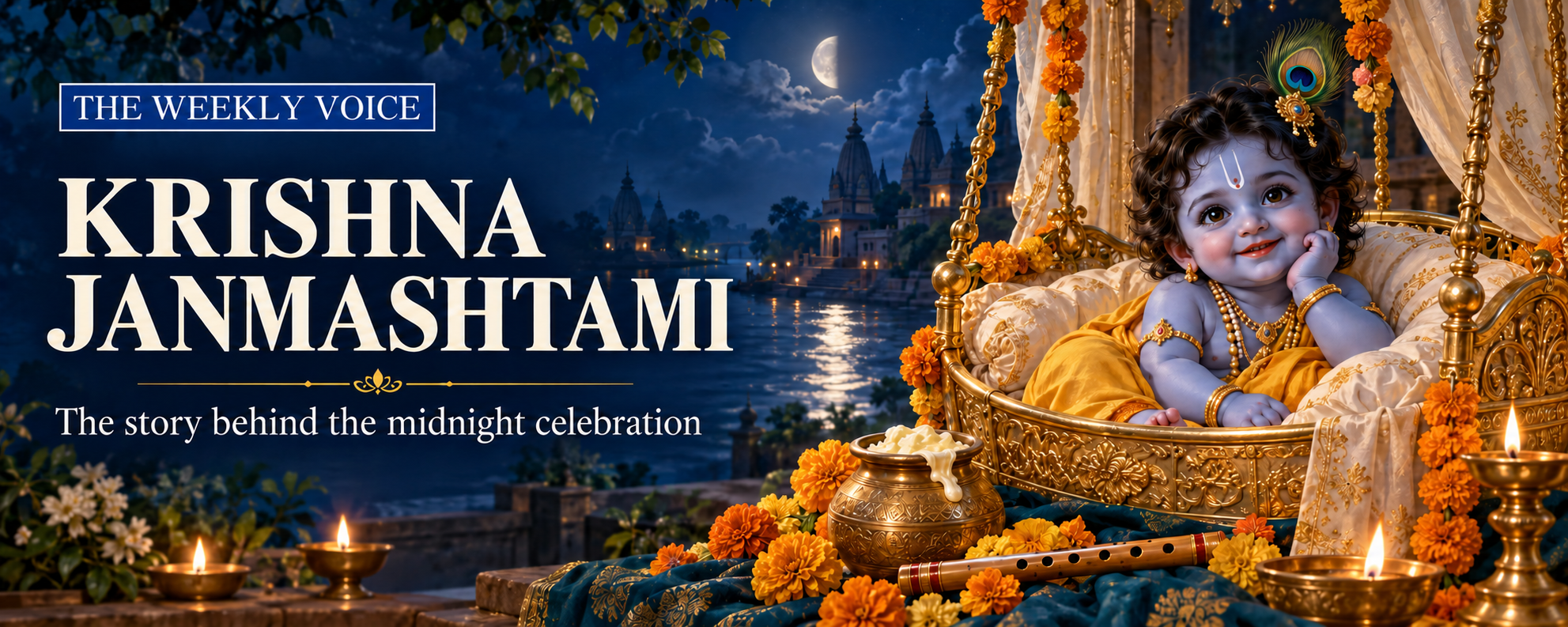
That birth story explains the festival’s midnight celebrations. Worshippers gather for devotional songs and aarti, a ceremony involving the offering of light. A small sacred image, or murti, of the child Krishna may be placed in a decorated swing or cradle. The gestures of welcoming and caring for him express an affectionate relationship with the divine, allowing worshippers to celebrate his arrival much as a family welcomes a newborn. B.A.P.S..
Other observances include abhisheka, the ceremonial bathing of Krishna’s sacred image, readings from religious texts, and performances depicting episodes from his life. Many devotees fast as an expression of discipline and devotion, then share prasad, food offered to the deity and received as blessed. Practices differ among communities, so the precise fasting rules and time for breaking the fast are not identical everywhere. Hindu American Foundation, Drik Panchang.
The celebrations also embrace Krishna’s playful childhood. Dahi Handi, especially associated with Maharashtra, involves teams forming human pyramids to reach and break a suspended earthen pot. The tradition recalls stories of young Krishna and his friends reaching dairy foods that households had hung out of reach. It gives a lively public expression to the affection surrounding Krishna’s childhood adventures. Incredible India.
Krishna is also revered for the teachings he gives Arjuna in the Bhagavad Gita. One of its best known passages, verse 2.47, calls for fulfilling one’s responsibilities without attachment to the rewards of action, while also rejecting inaction. Read alongside Janmashtami’s celebrations, that teaching invites reflection on how devotion can shape everyday conduct: doing one’s work conscientiously, examining personal motives and meeting difficult responsibilities. Bhagavad Gita 2.47.
For Canadians following the festival in 2026, there is a useful calendar distinction. Drik Panchang’s Toronto calendar lists Smarta Janmashtami on Thursday, September 3, and ISKCON Janmashtami on Friday, September 4. Different observance rules and local calendar calculations can produce different dates. Community celebration schedules may also extend beyond the principal religious observance, making the local temple’s announcement the best guide for attending a particular programme. Toronto’s 2026 Hindu calendar.
ISKCON Toronto’s 2026 announcement identifies Friday, September 4, as its main Janmashtami celebration, with programmes extending through the weekend. BAPS Toronto lists Janmashtami events for September 5 and 6. These gatherings give Canadian communities places to pray together and participate in traditions that connect religious learning with music, celebration and shared time. ISKCON Toronto, BAPS Toronto.
The decorated cradle captures something central to Janmashtami: the opportunity to approach the divine with tenderness. Alongside Krishna’s role as a protector and teacher stands the child who is welcomed, sung to and loved. Through those simple acts, the festival gives families a way to make devotion tangible and pass its stories to another generation. B.A.P.S..