
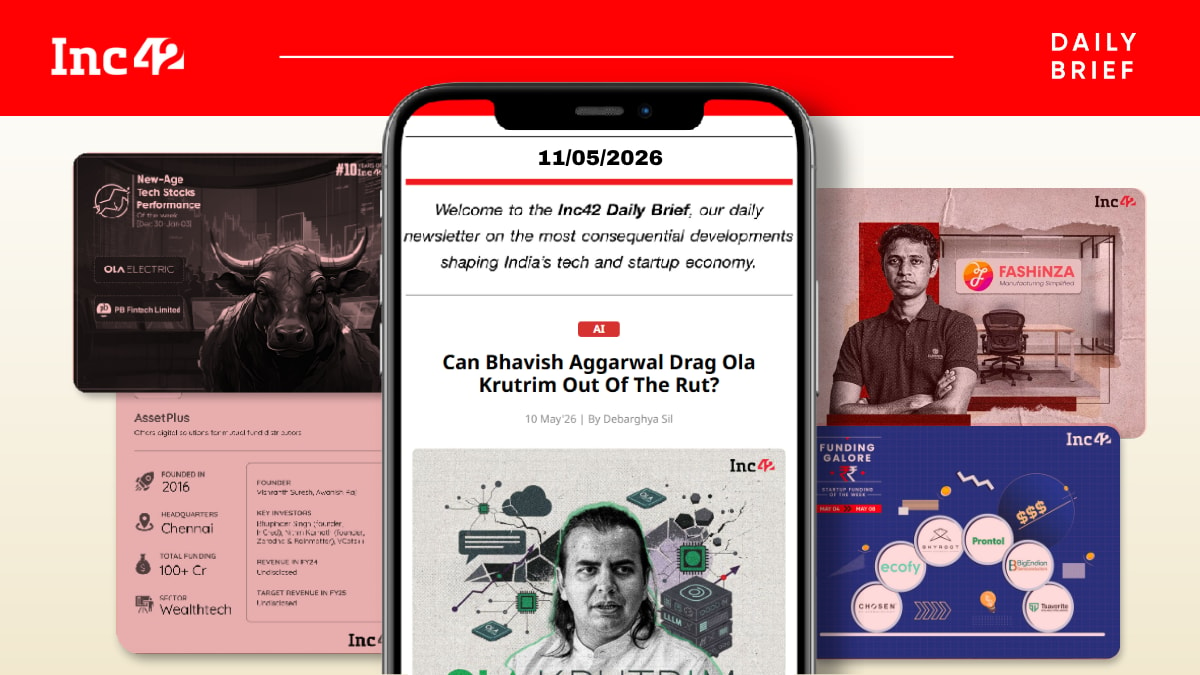

What Went Wrong At Krutrim?
Ola Krutrim began as one of India’s boldest AI moonshots in 2023. Three years and a unicorn leap laterthe homegrown challenger to OpenAI seems to be dumping its promises of building custom chips and sovereign AI models. So, how did things go wrong at Krutrim?
The Sovereign Ambition: Krutrim quickly rose on the strength of a powerful narrative – India-first AI, multilingual models and a full-stack sovereign tech vision. Unsurprisingly, it became the country’s first AI unicorn in early 2024, almost a year after OpenAI CEO Sam Altman said that Indian startups would struggle to build a rival to ChatGPT on limited budgets.
Cracks Emerge: Krutrim tried to do too many things simultaneously. This stretched the startup to its breaking point. By late-2025, the company paused work on its LLM and chip initiatives, pulled the plug on its consumer chatbot Kruti and saw a wave of senior exits across AI, product and semiconductor teams.
The workforce also shrank dramatically to 160 (versus 550 in August 2025) as the company restructured, leaving Ola Krutrim far smaller than the full-stack AI empire it once promised.
The New Core: Realising its folly, Krutrim appears to have fully pivoted to AI cloud infrastructure. This shift makes financial sense as enterprise demand for compute continues to soar. However, it also marks a retreat from the original sovereign AI dream. The startup now appears to be leaning on Ola Group’s clients and a handful of early enterprise users to build traction.
Hard Road Ahead: Krutrim now faces an uphill climb ahead as it faces intense competition from entrenched global giants and domestic rivals. The Bhavish Aggarwal-led startup will also now have to prove that it can win new customers, retain talent and grow beyond the Ola ecosystem. So, can Krutrim still turn its grand vision into a durable business? Let’s find out…
From The Editor’s Desk
🍟 Swiggy’s Mixed Q4 Platter
- The foodtech major’s food delivery business held its ground in Q4 FY26 even as the LPG crisis disrupted operations. The recovery was driven by the company working closely with restaurants to pivot cuisines and ensure availability in real-time.
- The quarter also reinforced that Swiggy’s food delivery vertical is no longer chasing hypergrowth. It is instead focusing on retention-led spending, prioritising higher-value customers, and intentionally churning out price-sensitive users.
- Meanwhile, Instamart saw slight cooling off as AOV dipped to ₹700 and GOV fell marginally to ₹7,881 Cr. This came as the quick commerce arm tempered its dark store expansion pace to focus on bottom line discipline.
⛔ Fashinza Cofounder Quits
- The Accel-backed B2B fashion supply chain startup’s cofounder and CEO Pawan Gupta has quit to pursue new opportunities in the AI space. He also cited Fashinza’s pivot to a manufacturing-heavy business as the reason for his departure.
- Currently on a break, Gupta claims to be exploring AI-led ideas in areas such as healthcare, ecommerce enablement, logistics and marketing. Notably, he is the second cofounder to exit the startup, after Jamil Ahmad left the company in 2024.
- Meanwhile, Honasa CBO Yatish Bhargava also stepped down within a year of his appointment citing “personal circumstances”. The Mamearth parent is yet to name his successor.
🚚 Euler’s Growth Blueprint
- The EV maker has had an eventful eight years. After initially testing demand and learning from real-world operations, Euler quickly moved into manufacturing. Customer validation and revenue quickly came through, but so did the losses.
- To curb cash burn, the company reset operations in 2023. It laid off staff, focused on efficiency and optimised its supply chain. But the biggest shot in the arm came when it forayed into the cargo EV segment and received backing from Hero MotoCorp.
- The EV maker now expects to break even in about three years on the back of better gross margins, higher asset utilisation and expansion to 100 cities. Once profitable, Euler would then move ahead with its IPO plans.
📉 Weekly Startup Funding Tanks
- Indian startups managed to raise $132.3 Mn across 18 deals last week, down 35.2% from $204 Mn bagged in the preceding week. Skyroot topped the charts with its $60 Mn fundraise, while Pronto closed its Series B round by securing $20 Mn.
- Advanced hardware and technology emerged as the most funded sector last week, raising $73.4 Mn. The AI sector clocked the highest number of deals at four.
- Seed stage funding shot up 21.7% week-on-week to $5.6 Mn. Meanwhile, Alkemi Growth Capital emerged as the most active investor last week, backing three startups.
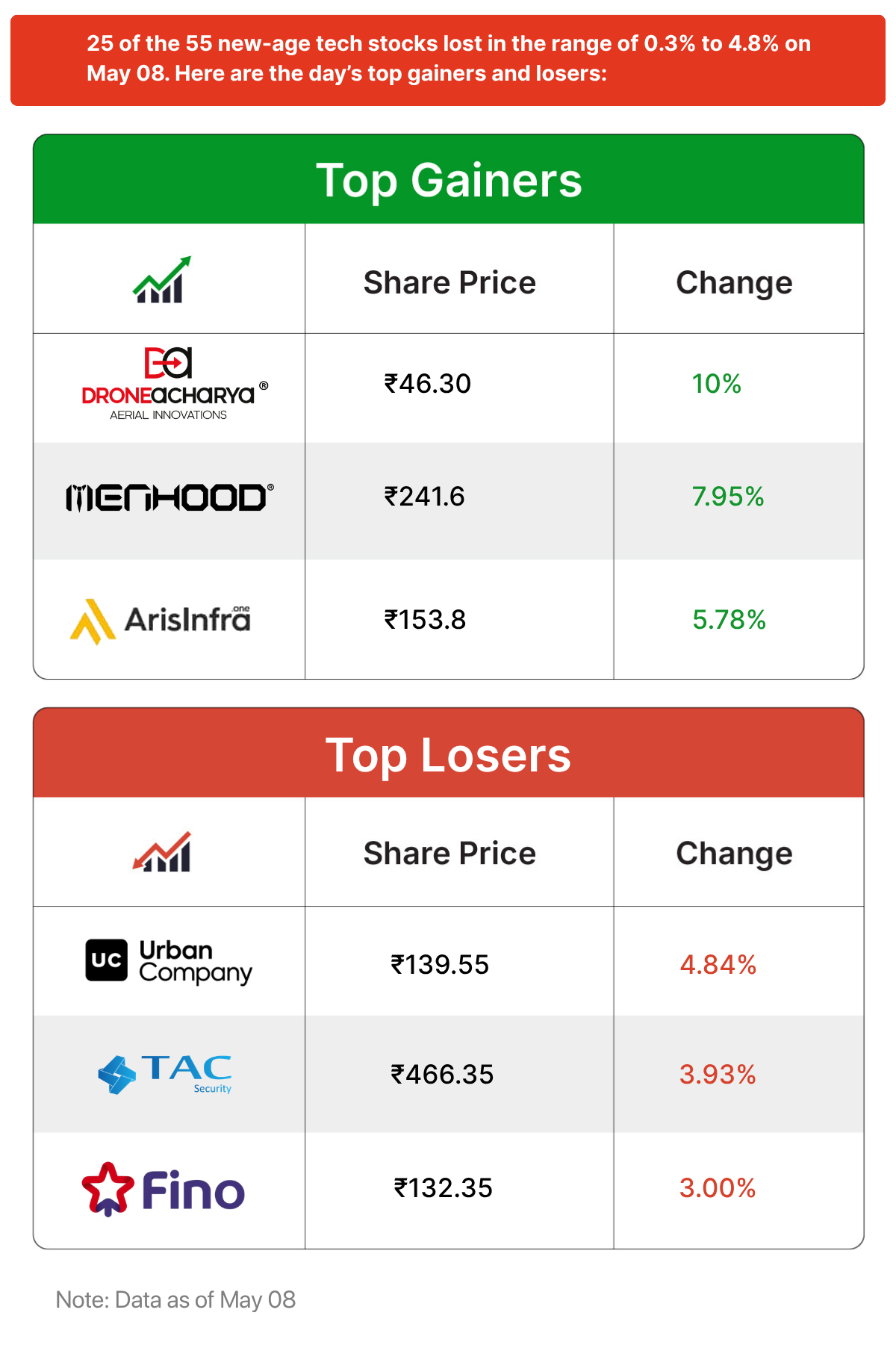
📊 New-Age Tech Stocks Rebound
- Of the 56 startup stocks under Inc42’s coverage, 40 ended last week with gains in the range of 0.4% to 33%. The remaining 16 stocks declined in the range of 0.01% to 8%, amid selective profit booking and broader market volatility.
- Drone tech startups ideaForge and DroneAcharya gained the most last week, while Urban Company and Wakefit emerged as biggest losers. The m-cap of the 56 new-age tech stocks rose to $138.2 Bn at the end of last week from $129.7 Bn a week ago.
- Geopolitical tensions in West Asia and fluctuating crude oil prices contributed to the caution last week. Meanwhile, DIIs, better-than-expected Q4 earnings and favourable domestic political developments helped improve investor sentiment.
Inc42 Markets
Inc42 Startup Spotlight
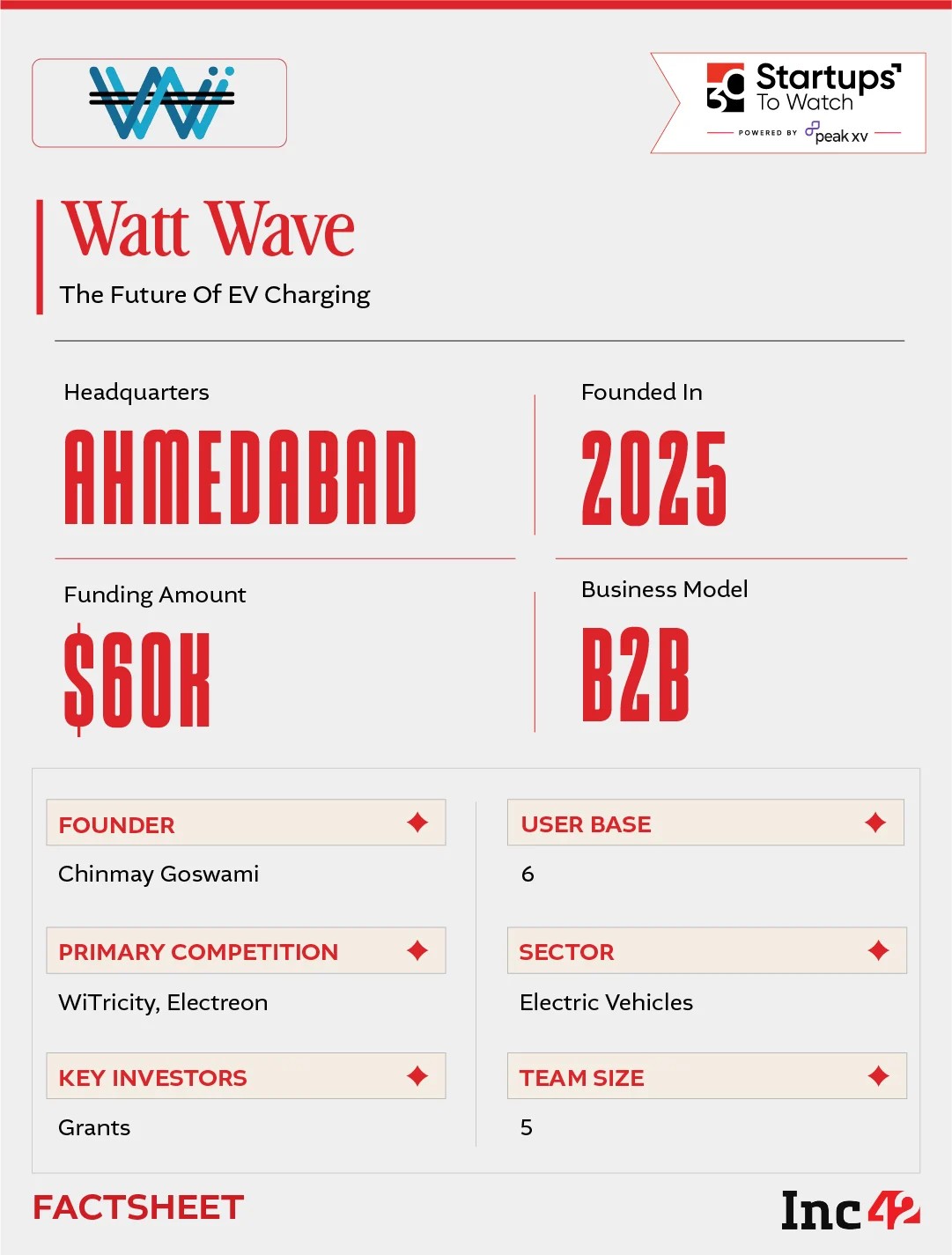
Can Watt Wave Build The Future Of EV Charging?
India’s EV market is growing, but charging is still a pain point because most systems depend on cables, connectors and manual effort. Enter Watt Wave, a startup trying to remove this barrier and foster EV adoption with wireless charging.
Contact-Less EV Charging: Founded in 2024, Watt Wave began as a college project before evolving into a hardware-led deeptech company. The Ahmedabad-based startup is building wireless EV charging systems that allow vehicles to charge simply by parking, without any cables.
Ditching The Cord: Watt Wave claims that its prototype has already reached 86-88% charging efficiency at a coil-to-coil distance of 14.5 cm. Its current 1.2 kW system is aimed at segments like e-rickshaws and three-wheelers, where frequent charging and quick turnaround can make wireless convenience valuable.
Built For Scale: The Ahmedabad-based startup is working with Terra Motors for real-world testing, an important step for validating performance beyond the lab. It also plans to extend the technology to cars and electric buses as the system matures. Watt Wave is also exploring adjacent use cases such as drone charging and warehouse automation.
With an eye on India’s growing wireless EV charging market that is projected to cross $5.5 Bn by 2030, can Watt Wave disrupt electric mobility with wireless charging?
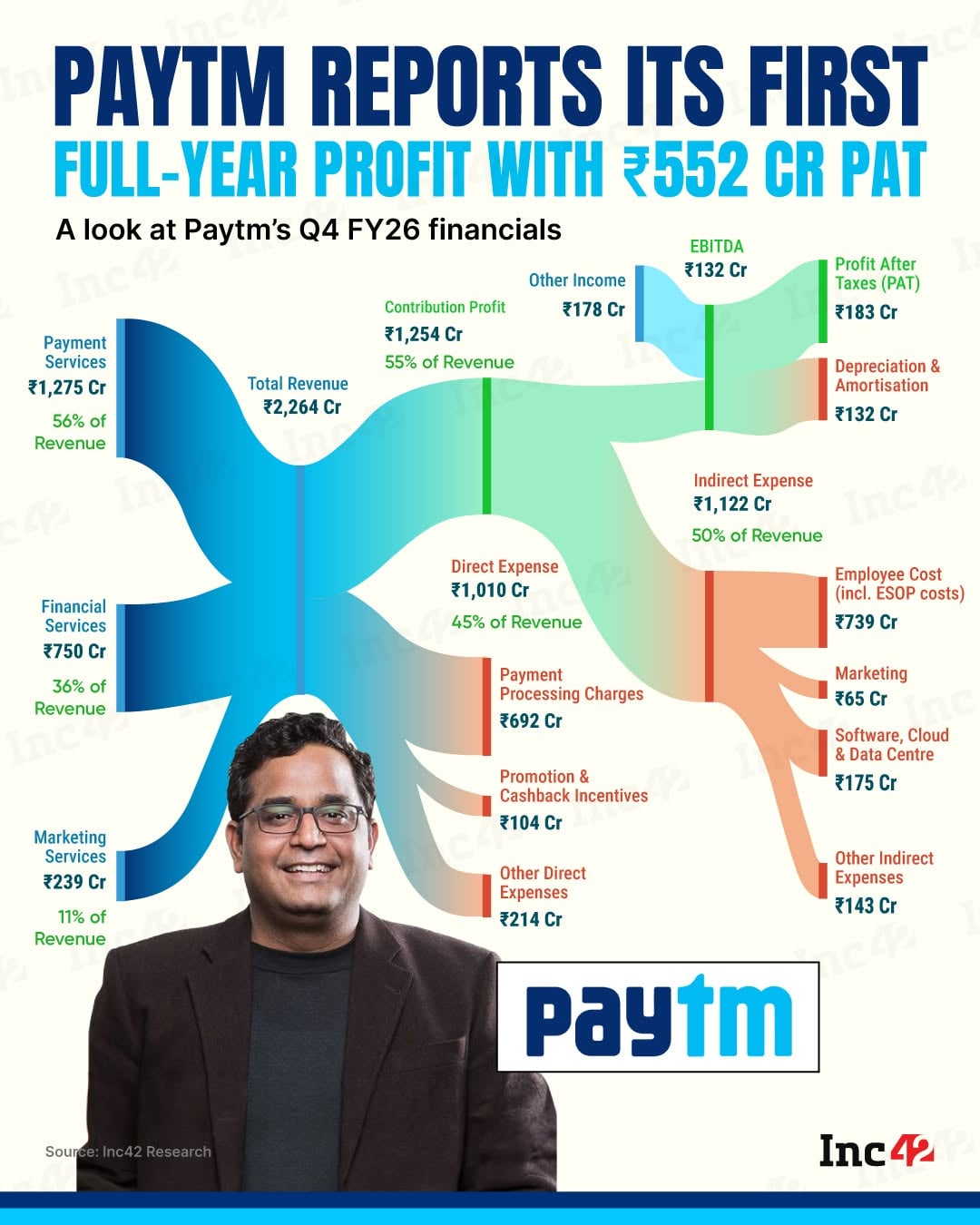
Infographic Of The Day
After years of losses, regulatory heat, and a near-death RBI crisis, Paytm just posted its maiden full-year profit of ₹552 Cr in FY26. Here is how the numbers stack up…

Comments are closed.