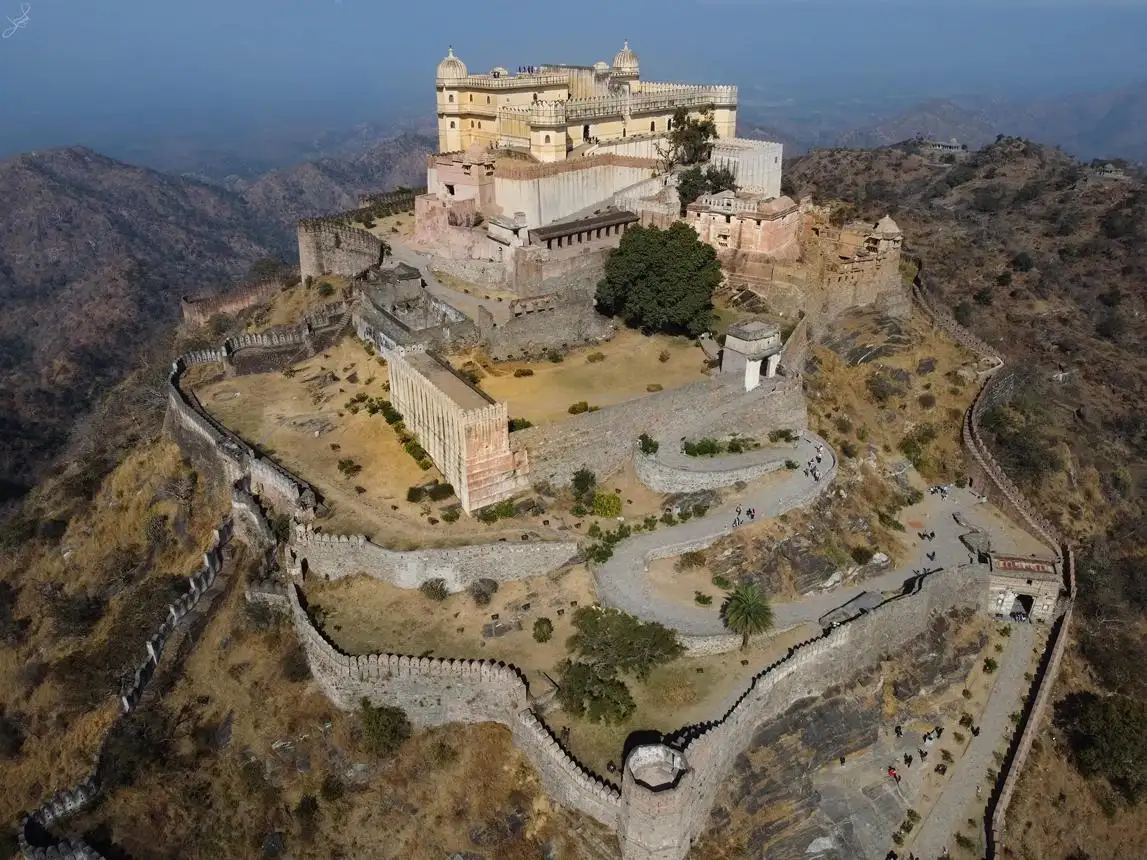
Kumbhalgarh Fort, located in the Aravalli Mountains of Rajasthan, is renowned worldwide for its impenetrable defenses, towering walls, and tales of valor. Considered the pride of Mewar, this fort has a history dating back more than 500 years. It is said that due to its robust structure and strategic location, Kumbhalgarh Fort remained invincible to its enemies for centuries, facing defeat only once in its history.
Kumbhalgarh was built by Maharana Kumbha
Kumbhalgarh Fort was built in the 15th century by Maharana Kumbha , the great ruler of Mewar . Construction began around 1443 AD and was completed around 1458 AD.
Maharana Kumbha built this fort to strengthen Mewar’s defenses. Located on the high Aravalli Hills, the fort was naturally very secure.
The second longest wall in the world
Kumbhalgarh’s most striking feature is its massive wall. At approximately 36 kilometers long , it is considered one of the longest walls in the world. Its width is so great that in many places, several horses could run simultaneously.
This massive wall played an important role in protecting the fort from enemy attacks.
Defeated only once in 500 years
Kumbhalgarh Fort was historically considered nearly invincible, and even the most powerful invaders were unable to conquer it for long.
It is said that the fort faced its first major challenge during the reign of the Mughal emperor Akbar in the 16th century . In 1578, the Mughal army campaigned against Mewar and captured Kumbhalgarh after a long struggle.
However, this victory was short-lived. After some time, the warriors of Mewar recaptured the fort.
The story of Maharana Pratap related to Kumbhalgarh
Kumbhalgarh’s history is also linked to the great warrior of Mewar, Maharana Pratap , who is believed to have been born in this fort in 1540.
Maharana Pratap fought against the Mughal Empire throughout his life and showed amazing courage to maintain the independence of Mewar.
The security system of the fort was amazing.
Kumbhalgarh Fort has seven massive gateways, called “pols.” The most prominent among these are Ram Pol, Hanuman Pol, and Paghra Pol.
Numerous temples, palaces, reservoirs, and military outposts were built within the fort, making it easy to monitor the surrounding areas.
The reason for the defeat was not due to war but due to circumstances.
The defeat at Kumbhalgarh is not seen as a mere act of war. Historians believe the Mughal army employed a strategy of prolonged siege and disruption of logistics. This weakened the fort, allowing the Mughal army to succeed.
Kumbhalgarh is still a symbol of bravery.
Today, Kumbhalgarh Fort is a symbol of Rajasthan’s glorious heritage. Its massive walls, historic palaces, and tales of valor attract thousands of tourists every year.
Kumbhalgarh is not just a stone fort, but a living testimony to Mewar’s self-respect, struggle, and spirit of independence. Standing firm for 500 years, this fort’s story still showcases Rajasthan’s glorious history to the world.