
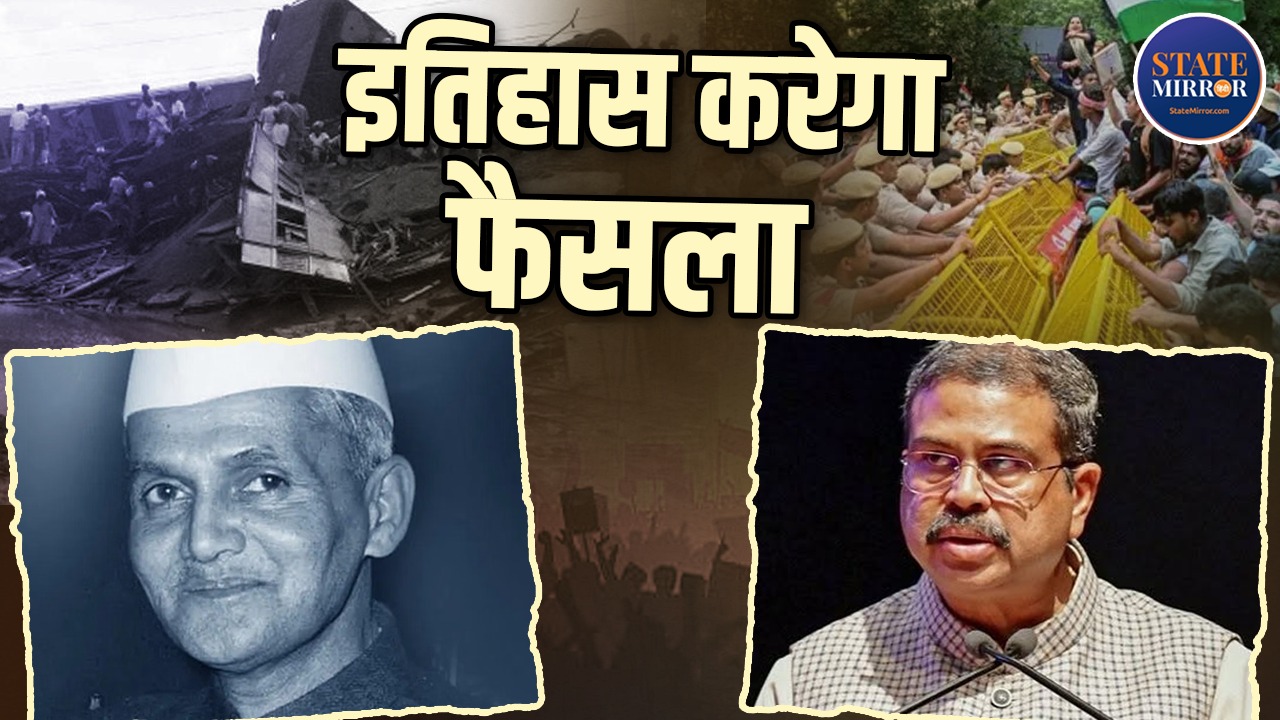
Explained: Is every resignation like Lal Bahadur Shastri? Will Dharmendra Pradhan’s decisions stand up to that test?

Resignation politics is not a new matter in India. Be it a train accident, an examination controversy or the responsibility of any major administrative crisis – every time a question arises whether the minister should take moral responsibility and resign. On every such occasion, the name of former Prime Minister Lal Bahadur Shastri is first taken, who, while being the Railway Minister in 1956, resigned without anyone’s demand after the Ariyalur railway accident and set an example of political accountability, which became immortal. now when Dharmendra Pradhan has taken a big decision regarding his post, then the comparison is again being made with the same historical example. But are both situations really the same, or does history judge on some different criteria?
Why did Lal Bahadur Shastri’s resignation become immortal in history?
Actually, many ministers have resigned in the political history of India, but Lal Bahadur Shastri’s resignation is considered different because he did not accept personal mistake, but accepted constitutional and moral accountability.
In 1956, hundreds of people died in a horrific railway accident near Ariyalur in Tamil Nadu. The accident was not the direct fault of any minister, but as Railway Minister, Shastri acknowledged that the ultimate responsibility lies with the ministry. He submitted his resignation to Prime Minister Jawaharlal Nehru.
Initially Nehru was not in favor of accepting the resignation, but Shastri remained firm on his decision. Ultimately his resignation was accepted. This incident became the biggest example of Moral Responsibility in Indian democracy.
This resignation was not just an administrative action, but a political message that with power comes accountability.
Is history made just by resigning?
No. After independence, many central and state ministers have resigned due to various reasons. Some left the post after allegations of corruption, some under political pressure and some due to the court’s comment or the compulsion of the alliance. Most of these resignations became political incidents with time. History did not remember him in the same way as Lal Bahadur Shastri. The reason for this is that history not only sees the resignation, but also sees the reason, circumstances of the resignation and the political message sent by it.
In what context is Dharmendra Pradhan’s decision being seen?
Dharmendra Pradhan’s decision is also being discussed in the context of accountability. It is natural that the example of Lal Bahadur Shastri should come to the fore in political debate. However, while comparing both the cases it is important to understand some fundamental differences. Shastri’s case was a major public tragedy, after which he accepted moral responsibility.
In the case of Dharmendra Pradhan, it has to be seen why his decision was taken, in what political and administrative context, and whether it reflected the same level of personal moral accountability that made Shastri’s resignation historic.
What does the test of history say??
History evaluates any resignation on three main grounds-
- Did the minister accept moral responsibility rather than legal compulsion?
- Was the resignation voluntary or the result of political pressure?
- Did that decision set a new standard of accountability in public life?
Due to these three reasons, Lal Bahadur Shastri’s resignation is still cited as an example in the study of political science, administration and democracy.
Will Dharmendra Pradhan’s decision also reach the same level?
This question cannot be answered immediately. If the impact of a political decision is limited to immediate controversy only, then it remains a common occurrence in history. But if it becomes an example of changing accountability, political culture and administrative standards in public life, then it acquires historical importance.
This is the reason why even today, almost seven decades later, Lal Bahadur Shastri’s resignation is discussed, whereas many resignations of the same period and later remained confined to the pages of history. Lal Bahadur Shastri himself resigned, taking responsibility for the train accident. He did not resign under any pressure. Dharmendra Pradhan’s resignation does not meet the high standards of morality in this matter. This is because he resigned after working for more than one and a half months and that too under political pressure. Regardless, he has based it on morality.
Shastri’s resignation was not the result of any pressure
Lal Bahadur Shastri’s resignation is considered different because it was neither the result of a court order, nor allegations of corruption, nor pressure from the alliance. He stepped down accepting moral responsibility for the administrative failure. This is the reason why his resignation is still considered the highest example of accountability in Indian democracy.
Lal Bahadur Shastri’s resignation became immortal because it strengthened the tradition of moral accountability in Indian democracy. Comparison with any contemporary resignation or decision to step down would be appropriate only if the circumstances, nature of the decision and the democratic standards established by it are also at the same level. Therefore, the final evaluation of Dharmendra Pradhan’s decision will not be based on immediate political reaction, but on the test of time, impact and history.
Famous resignations of independent India
In the history of independent India, many Union Ministers have resigned under different circumstances, but not all resignations have had the same political and historical importance.
- In 1956, Railway Minister Lal Bahadur Shastri resigned from the post accepting moral responsibility after the Ariyalur train accident. Even today it is considered the greatest example of democratic accountability.
- In 1958, Finance Minister T.T. Krishnamachari resigned after the investigation report of LIC-Mundra scam.
- After the India-China war of 1962, Defense Minister V.K. Krishna Menon stepped down amid military failure and political pressure.
- In 1987, V.P. Singh changed the direction of national politics by separating from the government amid the defense procurement and Bofors controversy.
- In 1995, Communications Minister Sukhram resigned after allegations of corruption.
- In 2001, George Fernandes stepped down on moral grounds after the Tehelka sting operation, although he later became a minister again.
- In 2010, Telecom Minister A. Raja resigns due to 2G spectrum allocation controversy
- In 2010 itself, Minister of State for External Affairs Shashi Tharoor left the post due to the IPL controversy.
- In 2011, Dayanidhi Maran resigned after being accused in the Aircel-Maxis case.
- In 2013, Law Minister Ashwini Kumar resigned from the Cabinet after the Supreme Court’s comments on the coal block allocation (Colgate) case. It is clear from all these cases that resignations in India were sometimes due to moral responsibility, sometimes judicial investigation, sometimes allegations of corruption and sometimes political pressure, but among these, the resignation of Lal Bahadur Shastri is still considered the highest example of accountability.

Comments are closed.