“Over the past two years, Chinese buyers have increasingly asked for more types when placing orders for Musang King and Black Thorn. Even kampung durians are in demand,” exporter Simon Chin said at a trade forum last weekend, as quoted by The Star.
“These lesser-known clones could sell quickly once they find the right market.”
Durian farmer Alex Chan said niche varieties like Red Prawn had gained traction in China as consumers there grew more familiar with Malaysian durians and began seeking out different selections to review and compare their flavors.
Shipments flown to provinces including Henan and Hebei were sold out within three days, he said.
Malaysia’s advantage, he said, was the broad range of durian varieties it could offer.
|
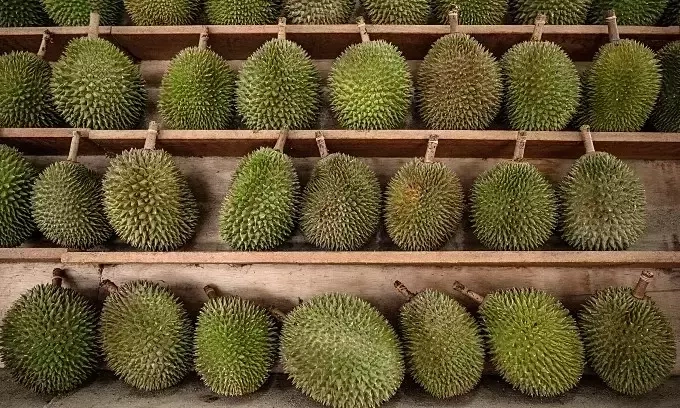
This picture taken on July 8, 2020, shows durians displayed for sale in Kuala Lumpur. Photo by AFP |
Malaysia is home to more than 200 durian varieties that offer a wide range of flavors. While Musang King remains the country’s best-known variety, newer names such as the premium Tupai King have emerged in recent years.
And there are even more lesser-known varieties, such as Hor Lor, Mas Hijau (Green Gold) and D24 (Sultan), according to the Malay Mail.
Still, other industry players noted that supply could struggle to keep pace with demand for these varieties, particularly as some smallholders in certain states have been replacing their existing trees with Musang King.
Musang King and Black Thorn would likely remain the industry’s mainstay, while other varieties would continue to find a place in both domestic and export markets, one industry expert said.
China is the world’s largest durian market, importing nearly 1.87 million tonnes of the fruit worth US$7.49 billion last year.
Demand has continued to rise in 2026, with imports increasing 47% year-on-year in the first half, according to the South China Morning Post.
Thailand was the biggest supplier during the six-month period, accounting for $3.79 billion or 81% of shipments. Vietnam followed with shipments worth $846 million and an 18% market share.
Malaysia remains a relatively new entrant, but its shipments to China surged 342% from a year earlier to $30.26 million during the period. It has built a reputation for premium durians.
The country is taking steps to bolster the trade. Earlier this month, Named reported that a fast-track mechanism was being explored that could allow fresh Malaysian durians to clear Chinese customs in as little as three to four hours.